Summer Changes the Way You Travel
夏 / Natsu / Summer is often described mainly in terms of heat and humidity, but that misses much of what makes the season distinctive.
Early summer can bring 梅雨 / Tsuyu / Rainy season, hydrangeas, deep green gardens, and quieter indoor-outdoor travel. Later in the season, evening festivals, fireworks, beaches, mountain trips, and regional celebrations become more prominent.
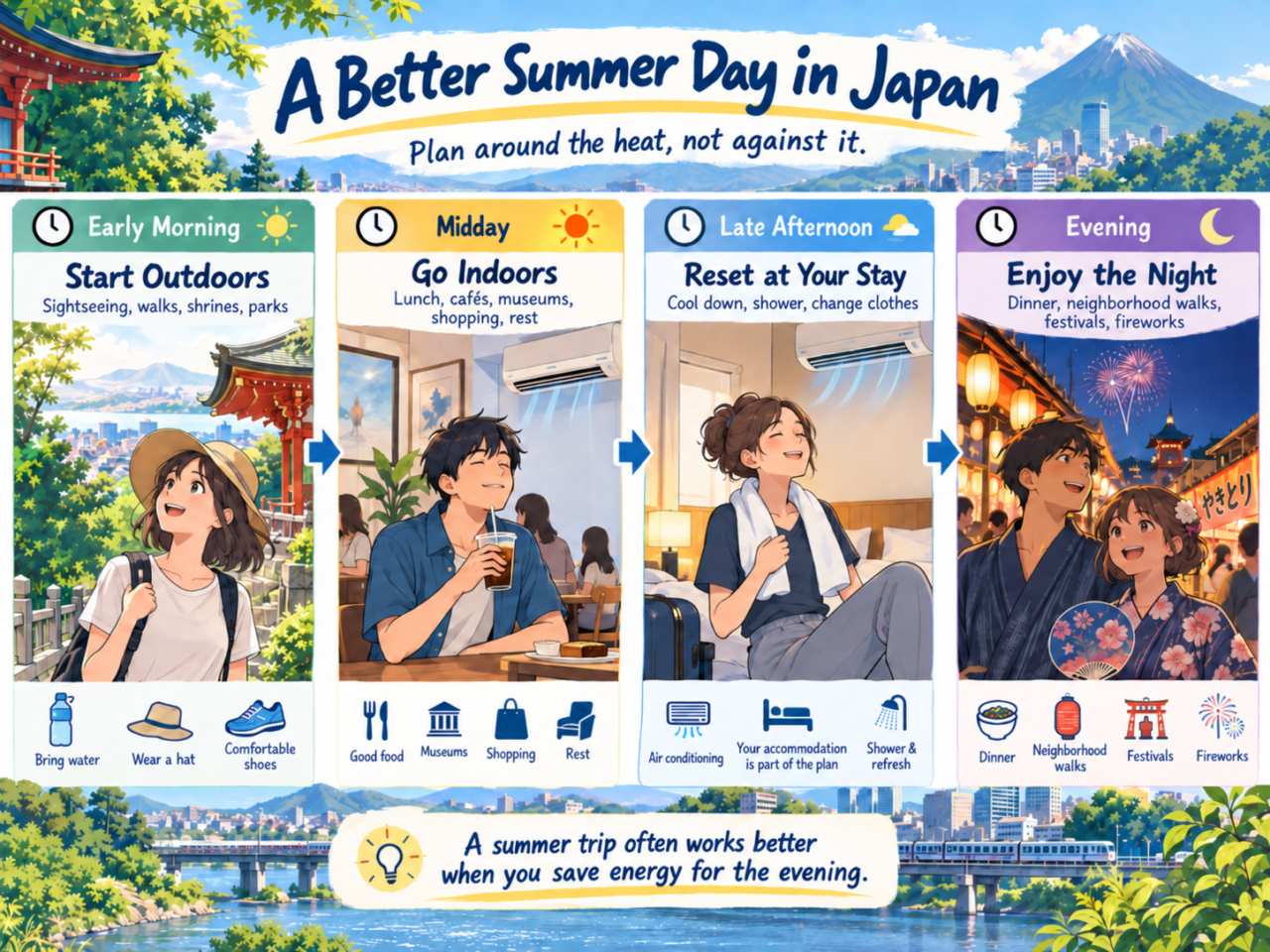
Summer also changes the rhythm of a typical sightseeing day. Starting early, resting during the hottest part of the afternoon, returning to your accommodation to cool down or change clothes, and going out again in the evening can make a large difference to how the trip feels.
If your travel dates are still flexible and you are comparing summer with other seasons, our Best Time to Visit Japan: A Season-by-Season Guide explains the broader trade-offs between spring, summer, autumn, and winter.
When Is Summer in Japan?
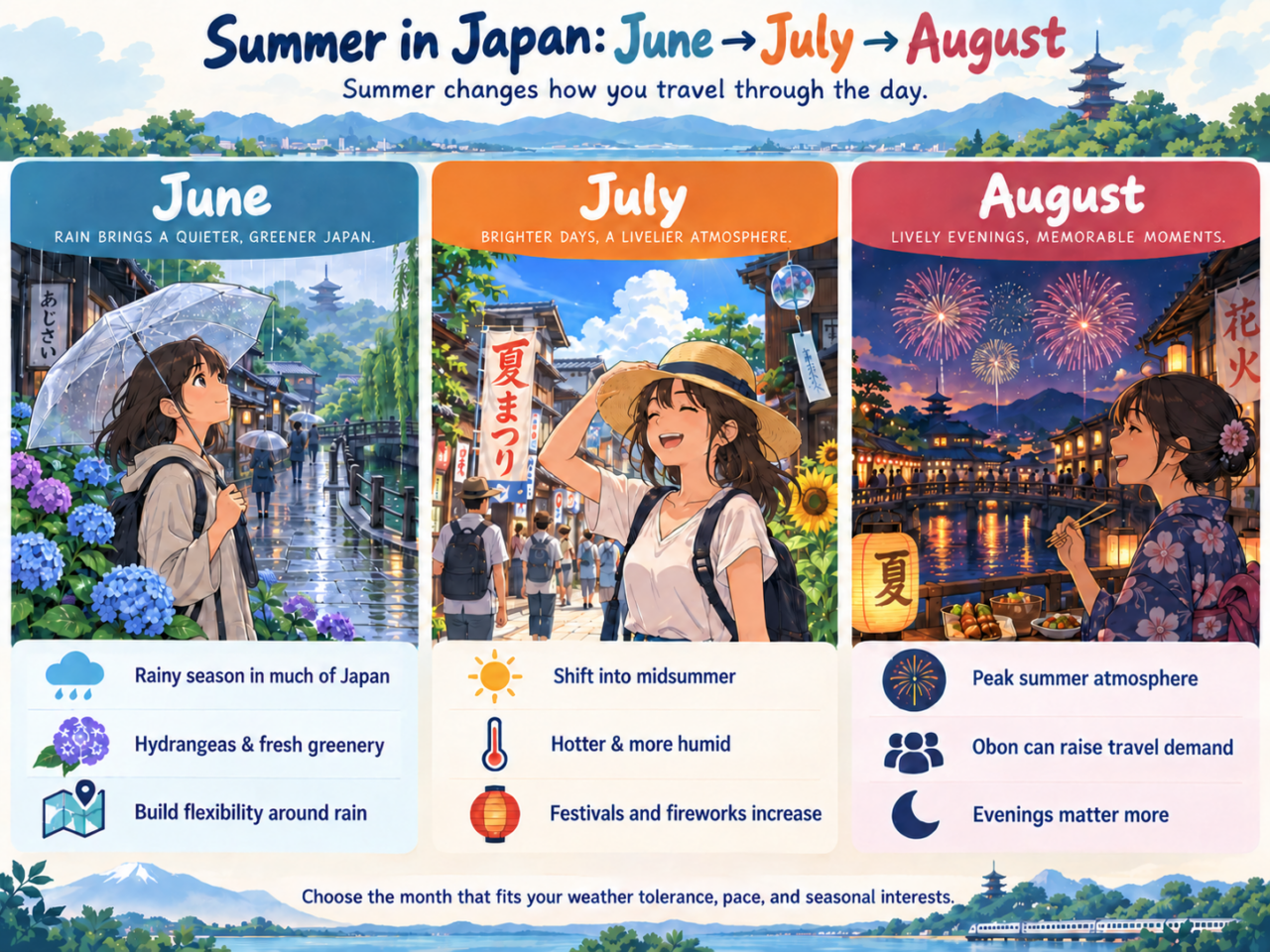
For practical travel planning, June, July, and August are the main summer months. They should not be treated as interchangeable.
| Month | How It Often Feels | Seasonal Character | Main Planning Point |
|---|---|---|---|
| June | Warm and increasingly humid in many cities | Rainy season in much of Japan, hydrangeas, fresh greenery | Build flexibility around rain rather than assuming every day will be washed out |
| July | Hotter and more humid as midsummer develops | Rainy season ending in many regions, festivals, beaches, mountain travel | Heat management begins to shape the daily itinerary |
| August | Very hot and humid in many major cities | Peak summer atmosphere, festivals, fireworks, Obon travel, beach and mountain trips | Plan around heat, domestic travel demand, and possible severe weather |
June: Rainy Season and Early Summer
June is often the most misunderstood summer month. In many parts of Japan, it falls within the rainy season, but that does not mean continuous rain from morning to night.
Cloudy periods, showers, heavy rain, humid air, and occasional clearer days can all occur. Gardens, temple grounds, moss, rice fields, and 紫陽花 / Ajisai / Hydrangeas can look especially vivid in wet conditions.
For travelers who do not mind carrying rain protection and keeping some indoor options available, June can offer a quieter and greener version of summer than July or August.
July: The Shift Into Midsummer
July often begins with rainy-season conditions in much of mainland Japan before hotter midsummer weather becomes more established.
As the rainy season ends, temperatures and humidity usually rise. Beaches, mountain destinations, evening events, festivals, and fireworks become more important parts of the travel calendar.
July is also when travelers should stop planning the day as though they were visiting in spring. Long outdoor sightseeing blocks around midday can become tiring, particularly in large cities.
August: Peak Summer and Stronger Travel Demand
August brings some of the strongest summer atmosphere in Japan, but it also combines heat, humidity, major events, and domestic travel demand.
お盆 / Obon / Obon period is especially important to understand. Customs and dates vary by region, but a major domestic travel period generally occurs around the middle of August as many people travel to visit family or take summer holidays.
Festivals and fireworks can make August exciting, but transportation and accommodation may require more advance planning than on an ordinary summer weekday.
How Summer Changes Across Japan
Summer does not feel the same across the country.
北海道 / Hokkaidō / Hokkaido is generally cooler than Tokyo, Kyoto, Osaka, or Fukuoka, and it does not have the same clearly defined rainy season as most of Japan. Mountain and highland destinations can also provide lower temperatures, although weather can change quickly and transportation may be less frequent.
By contrast, 東京 / Tōkyō / Tokyo, 京都 / Kyōto / Kyoto, 大阪 / Ōsaka / Osaka, and 福岡 / Fukuoka / Fukuoka commonly experience hot, humid conditions in July and August. The combination of temperature, humidity, direct sun, and walking can make a sightseeing day feel more demanding than the thermometer alone suggests.
沖縄 / Okinawa / Okinawa follows a different seasonal pattern again. It is already very warm by June, and its rainy season generally begins and ends earlier than in much of mainland Japan.
What Is the Weather Like in Summer?
The table below shows long-term mean temperatures from the Japan Meteorological Agency for June, July, and August. These monthly averages are useful for comparing regions, but individual daytime temperatures can be considerably higher.
| Destination | June Mean | July Mean | August Mean |
|---|---|---|---|
| 札幌 / Sapporo / Sapporo | 17.0°C | 21.1°C | 22.3°C |
| 東京 / Tōkyō / Tokyo | 21.9°C | 25.7°C | 26.9°C |
| 京都 / Kyōto / Kyoto | 23.3°C | 27.3°C | 28.5°C |
| 大阪 / Ōsaka / Osaka | 23.6°C | 27.7°C | 29.0°C |
| 福岡 / Fukuoka / Fukuoka | 23.3°C | 27.4°C | 28.4°C |
| 那覇 / Naha / Naha | 27.2°C | 29.1°C | 29.0°C |
Source: Japan Meteorological Agency climate normals (1991–2020). Kyoto values are from the JMA Kyoto observatory normals. These are long-term averages, not a forecast for a particular trip.
Monthly means can make summer look milder than a sightseeing day may actually feel. Long-term August average daytime highs are about 31.3°C in Tokyo, 33.7°C in Osaka, and 32.5°C in Fukuoka, before humidity, direct sun, and long periods of walking are taken into account.
The main practical lesson is that “summer weather” is too broad a label. June in Sapporo, August in Osaka, and June in Naha can require very different expectations even though all fall within the same season.
Rainy Season: Plan for Rain, Not Continuous Rain
梅雨 / Tsuyu / Rainy season is a cloudy and rainy period of early summer in much of Japan.
According to the Japan Meteorological Agency, the climatological rainy-season period usually begins around early June and ends around the second half of July in many parts of 本州 / Honshū / Honshu and 九州 / Kyūshū / Kyushu. Okinawa and 奄美 / Amami / Amami generally enter and leave the season earlier, while Hokkaido does not have the same clearly defined rainy season.
For regional climatological dates, see the Japan Meteorological Agency guide to Baiu onset and withdrawal.
The useful planning approach is not to avoid June automatically. Carry a compact umbrella or light rain layer, protect electronics, and have one or two indoor options for each destination.
Museums, covered shopping streets, department stores, cafés, aquariums, indoor cultural activities, and a slower afternoon near your accommodation can all help keep the trip flexible.
Heat and Humidity Change the Daily Rhythm
In July and August, heat is not only a clothing issue. It can change how far you walk, how much luggage you want to carry, how long you can wait outdoors, and how many sightseeing stops are realistic in one day.
A practical summer day may work better when you:
- Start outdoor sightseeing earlier in the morning
- Use the hottest part of the afternoon for lunch, museums, shopping, cafés, or rest
- Return to your accommodation if you need to cool down, shower, or change clothes
- Resume walking, dining, or events later in the day
- Leave more buffer time for station transfers and luggage movement
Do not assume that an itinerary that feels comfortable in April or November will feel equally manageable in August.
On very hot days, check more than the air temperature. Japan’s Ministry of the Environment publishes English information on the Wet Bulb Globe Temperature (WBGT) and Heat Stroke Alert. If heat risk is high, reduce strenuous outdoor activity, drink regularly, take breaks in air-conditioned places, and change the plan rather than trying to complete every stop.
Festivals and Fireworks Make Evenings Matter
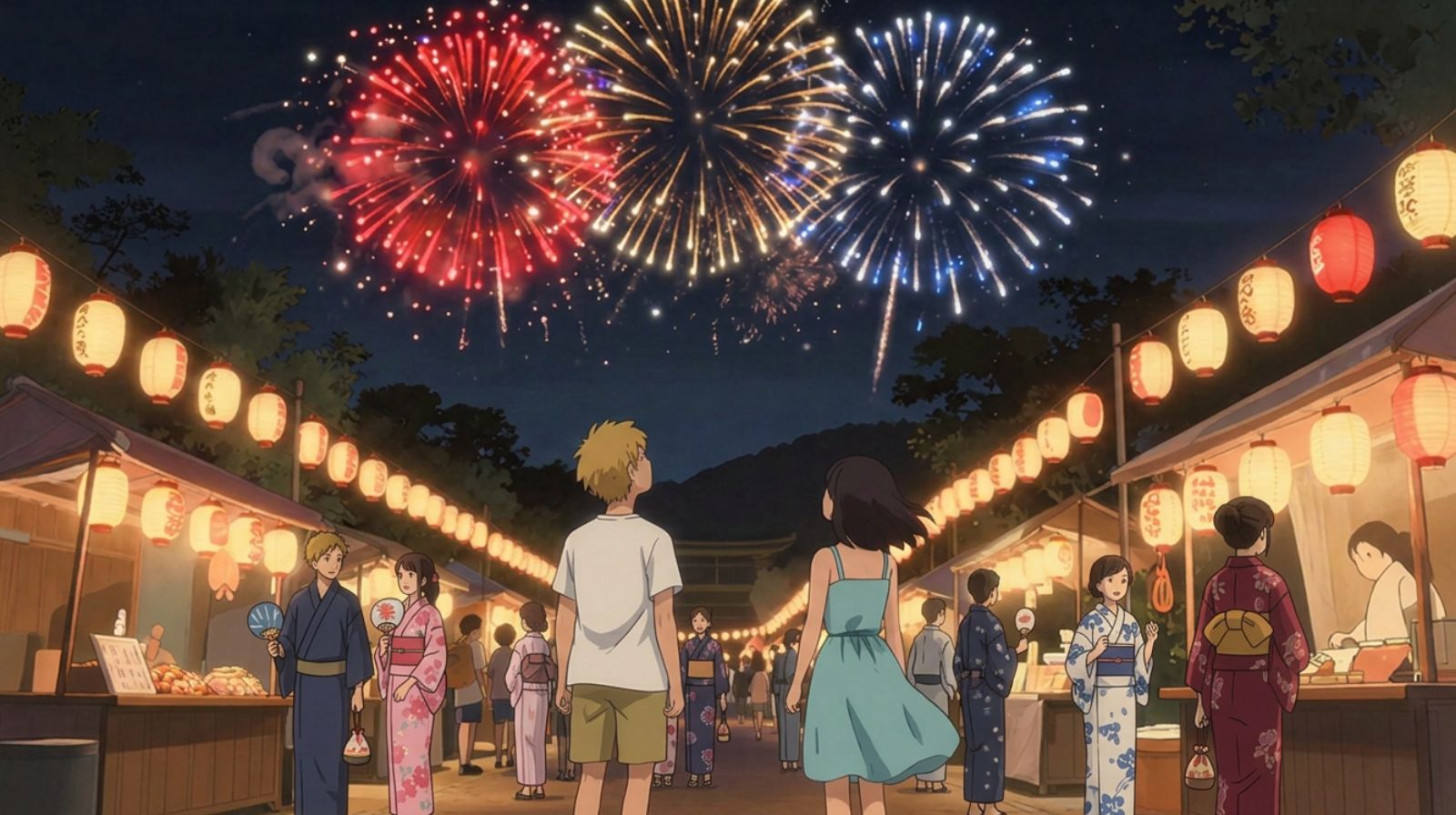
夏祭り / Natsu matsuri / Summer festivals, 花火大会 / Hanabi taikai / Fireworks festivals, and 盆踊り / Bon Odori / Bon dances are important parts of summer travel in Japan.
They can also change the structure of the day. Instead of using all your energy on sightseeing from morning to late afternoon, it may be better to leave time for dinner, a neighborhood festival, a riverside event, or fireworks after sunset.
Major events require more planning than an ordinary evening. Check official schedules, ticket or reserved-seat requirements, transportation after the event, weather-related postponements, and the last useful connection back to your accommodation.
For a deeper look at event planning, continue with our guide to Summer Festivals in Japan.
Summer Food and Everyday Seasonal Life
Summer can also be experienced through ordinary meals and small stops between sightseeing.
You may encounter かき氷 / Kakigōri / Shaved ice, そうめん / Sōmen / Chilled thin wheat noodles, 冷やし中華 / Hiyashi chūka / Chilled noodles with toppings, seasonal fruit, grilled corn, and food from 屋台 / Yatai / Festival food stalls. What appears varies by region, restaurant, and time of summer.
Convenience stores, supermarkets, department-store food halls, cafés, shopping streets, and restaurants near your accommodation can all reflect the season. Leaving room for these everyday stops can make a summer trip feel more local without adding another major attraction to the itinerary.
Typhoons and Severe Weather Can Affect Summer Travel
Summer and early autumn can bring typhoons, heavy rain, thunderstorms, and other weather disruptions.
This does not mean you should avoid summer travel, but it does mean a rigid itinerary can create unnecessary problems. Flights, trains, ferries, buses, festivals, and outdoor activities may be delayed, changed, or cancelled when severe weather approaches.
Keep booking details and accommodation contact information available offline, avoid placing important long-distance journeys too close together, and check official transportation and weather information when conditions change.
For broader preparation, see our guide to natural disasters and weather disruptions in Japan.
Where to Go in Summer
The best destination depends on whether you want to work with the heat, escape some of it, or make summer events part of the trip.
For a Classic First Trip: Tokyo, Kyoto, and Osaka
Tokyo, Kyoto, and Osaka remain realistic summer destinations. You do not need to abandon the classic route simply because the weather is hot.
What should change is the pace. Start earlier, reduce unnecessary cross-city travel, use indoor breaks strategically, and choose accommodation that makes it easy to return during the day.
For Cooler Summer Conditions: Hokkaido
Hokkaido is generally cooler than Japan’s major central and western cities in summer. It can be a strong choice for travelers who prefer milder temperatures, open landscapes, flower fields, hiking, food, or regional road and rail trips.
It is still summer, not a guaranteed escape from warm weather, so check the forecast for the specific area rather than assuming the whole island will be cool.
For Mountains and Highlands: Use Elevation
Mountain and highland destinations can provide cooler conditions than nearby lowland cities. They can also add hiking, forests, lakes, 温泉 / Onsen / Hot spring stays, and slower regional travel to a summer itinerary.
However, mountain weather can change quickly. Trails, roads, buses, and ropeways may also have seasonal schedules or weather-related restrictions, so check local conditions before setting out.
For Beaches and Islands: Choose the Region Carefully
Japan has beaches and island destinations from Okinawa to the 瀬戸内海 / Seto Naikai / Seto Inland Sea and the coasts of Honshu, 四国 / Shikoku / Shikoku, and Kyushu.
Beach conditions, swimming seasons, marine activities, weather, and transportation vary by location. Okinawa offers a very different summer experience from a beach day added to a Tokyo, Osaka, or Fukuoka itinerary.
For Festivals and Local Evenings: Let the Event Shape the Route
If a festival or fireworks display is one of your main reasons for visiting, build the day around it rather than treating it as an extra stop after a full sightseeing schedule.
Staying near the event area, understanding the return route, and leaving time to eat before or after the event can make the evening much easier.
What Should You Wear in Japan in Summer?
Light, breathable clothing is practical for most summer travel, but the right approach depends on the month and region.
| Travel Situation | Practical Clothing Approach |
|---|---|
| June in major cities | Light clothing, breathable layers, compact umbrella or light rain shell, comfortable shoes that can handle wet streets |
| July and August in major cities | Lightweight breathable clothing, sun protection, comfortable walking shoes, and a spare top if useful |
| Hokkaido or highlands | Summer clothing plus a light layer for cooler mornings, evenings, air-conditioned interiors, or changing weather |
| Mountain trips | Pack for the specific elevation and activity rather than the city forecast; conditions can be much cooler |
| Okinawa and islands | Very light clothing, strong sun protection, rain protection, and activity-specific beach or marine gear |
Sun protection, water, and regular breaks can matter as much as clothing. Air-conditioned trains, shops, museums, and restaurants may also feel cool after time outdoors, so a very light layer can still be useful for some travelers.
How Accommodation Changes the Summer Experience
Summer is one of the seasons when accommodation can directly affect how comfortable the rest of the trip feels.
A property that looks only a few minutes farther from the station on a map may feel very different when you are carrying luggage in heat, humidity, or heavy rain.
Before booking, consider:
- Walking distance from the nearest station or bus stop
- Whether the route includes hills, stairs, or long uncovered sections
- Air conditioning in the sleeping area
- Refrigerator availability
- Laundry or drying facilities
- Whether you can return easily during the afternoon
- Nearby restaurants, cafés, and convenience stores
- How easily you can get back after a festival or evening event
In summer, accommodation is not only where you sleep. It can be the place that lets you reset the day, avoid unnecessary exposure to heat, and enjoy the evening with more energy.
Which Summer Month Is Best for Your Trip?
There is no single best summer month because June, July, and August solve different travel problems.
- Choose June if you can accept rain and humidity in exchange for hydrangeas, fresh greenery, and a less intense summer atmosphere.
- Choose July if you want the transition into full summer, with more beaches, mountains, festivals, and fireworks becoming part of the trip.
- Choose August if peak summer atmosphere and major seasonal events matter most, and you are prepared for stronger heat, domestic travel demand, and possible weather disruption.
The best choice is the month whose weather, travel rhythm, and seasonal atmosphere match what you want to do.
Planning a Summer Trip That Works With the Heat
A strong summer itinerary works with the season rather than trying to ignore it.
- Choose the month first. June rain, July transition, and August heat and events create different trips.
- Match the route to the region. Hokkaido, Okinawa, mountain areas, and major cities can feel very different during the same week.
- Protect the middle of the day. Use the hottest hours for rest, meals, indoor sightseeing, or a return to your accommodation when needed.
- Keep weather flexibility. Rain and severe weather can affect transportation and outdoor plans, so avoid an itinerary with no backup options.
- Leave energy for the evening. Dinner, neighborhood walks, festivals, fireworks, and local events can be among the best parts of a summer trip.
Summer becomes easier when you stop measuring success by how many attractions you can fit into daylight hours and start planning around the way the season actually feels.
Frequently Asked Questions
- What months are summer in Japan?
-
June, July, and August are the main summer months for travel planning. June often includes the rainy season in much of Japan, July shifts toward hotter midsummer conditions, and August is typically hot and humid with major festivals, fireworks, and Obon travel demand.
- Is Japan too hot to visit in summer?
-
Summer can be hot and humid, especially in major cities, but travel is still possible with a different daily rhythm. Starting early, taking indoor afternoon breaks, reducing unnecessary walking, and choosing convenient accommodation can make a significant difference.
- Is June a bad time to visit Japan because of rain?
-
Not necessarily. The rainy season does not mean continuous rain every day. June can also bring hydrangeas, vivid greenery, atmospheric gardens, and a less intense summer feel. Flexible indoor options and simple rain protection make the month easier to manage.
- Which is hotter in Japan, July or August?
-
Both can be very hot and humid. Long-term averages are slightly higher in August in several major cities, although actual conditions vary by year and region. Check the forecast for each destination close to your trip.
- Is Hokkaido cooler than Tokyo in summer?
-
Generally, yes. Long-term average summer temperatures in Sapporo are lower than in Tokyo, Kyoto, Osaka, and Fukuoka. Hokkaido can still have warm days, so it should not be treated as a guaranteed cool-weather destination.
- What is Obon and does it affect travel?
-
Obon is a period associated with family remembrance and homecoming traditions. Customs and dates vary by region, but domestic travel demand often increases around the middle of August, which can affect trains, flights, roads, and accommodation.
- Are typhoons common in summer in Japan?
-
Typhoons can affect Japan during summer and early autumn, but their timing and impact cannot be predicted far in advance. Keep flexibility in the itinerary and check official weather and transportation information when conditions change.