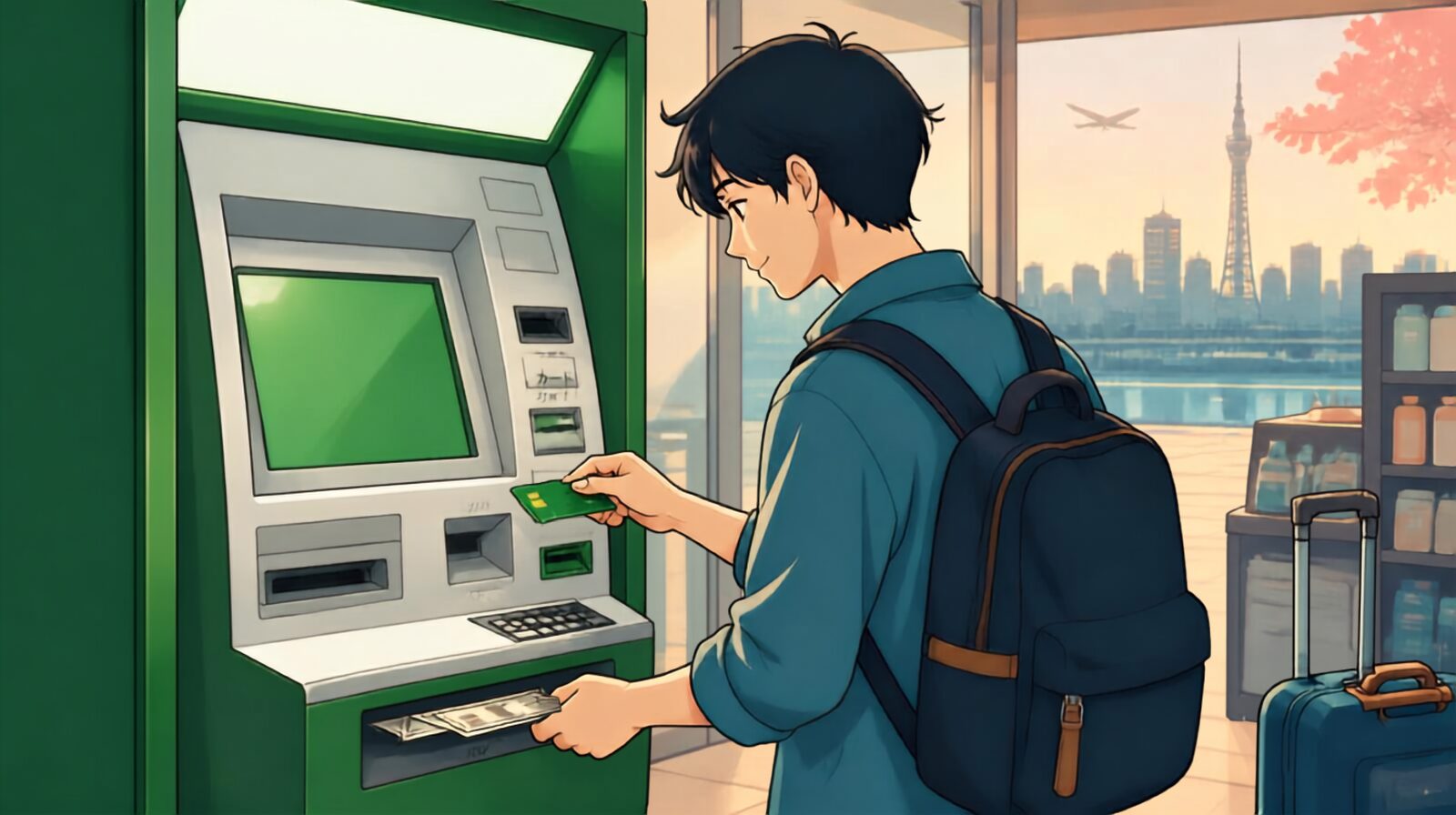
- Identify the machine before inserting your card: choose an ATM marked for international or overseas-issued cards, not a machine labeled only Currency Exchange.
- Start with an established international ATM: Seven Bank and Japan Post Bank are practical first options for many visitors.
- Use a debit card first when its terms are suitable: a credit card withdrawal is generally treated as a cash advance.
- Bring the physical card and know the PIN: do not rely only on a phone wallet or cardless withdrawal.
- Check more than the ATM fee: your bank may add an overseas withdrawal fee, foreign transaction fee, or exchange-rate markup.
- Choose Japanese yen when offered a currency choice: JPY is usually the clearer default unless you have compared and intentionally accepted the home-currency conversion.
- Carry a backup: bring a second card from another account or network and keep some yen available if your main card or ATM network does not work.
How to Choose the Right Machine in Japan
Many travelers are used to finding one familiar type of ATM and checking for a card or network logo. Japan can be more confusing because different machines may stand next to one another while providing different services.
| What the Machine Says | What It Does | What a Visitor Should Check |
|---|---|---|
| ATM with “International Cards” or “Cards Issued Overseas” | Withdraws Japanese yen using a compatible foreign-issued debit, credit, or prepaid card | Match the network shown on the ATM with your card, then review fees and limits |
| Bank ATM without an international-card indication | May mainly serve cards and accounts issued in Japan | Do not assume it accepts your card simply because it is operated by a bank |
| Currency Exchange or Foreign Currency Exchange | Exchanges supported foreign banknotes for yen, or provides another currency exchange service | This is not an ATM withdrawal; use it when you are exchanging physical cash |
Read the Signs in This Order
- Confirm that the machine is an ATM, not an automatic currency exchange machine.
- Look for International Cards, Cards Issued Overseas, or equivalent wording.
- Check for the network used by your card, such as Visa or PLUS, Mastercard, Maestro or Cirrus, JCB, UnionPay, or another supported network.
- Check the service hours, withdrawal limit, and any fee shown before confirming.
A matching logo shows that the ATM supports that network; it does not guarantee approval of every card on the network. Your issuer can still decline the transaction because of account settings, cash-withdrawal limits, security controls, or the specific card product.
Which ATMs in Japan Accept Foreign Cards?
After confirming that a machine supports cards issued outside Japan, check its operator. Each ATM network has different locations, card support, service hours, fees, and withdrawal limits.
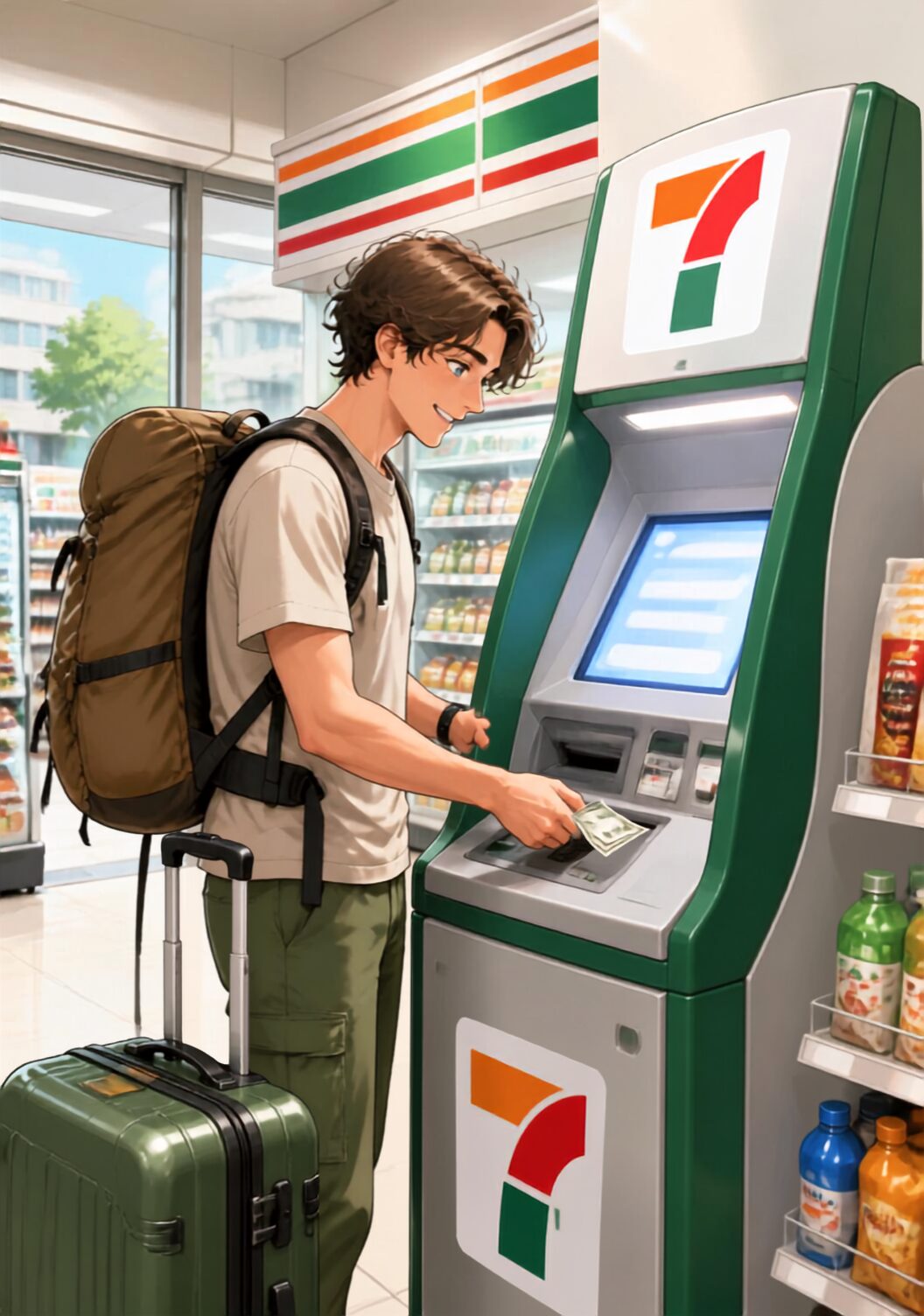
Seven Bank and Japan Post Bank are established starting points. Lawson Bank, E-net, and AEON Bank also operate ATMs that support selected overseas-issued cards.
| ATM Network | Where You May Find It | Operator Limit per Withdrawal | What to Know |
|---|---|---|---|
| Seven Bank | Many 7-Eleven stores, airports, stations, shopping facilities, and other locations | Up to ¥100,000; ¥30,000 for magnetic-stripe card transactions | Supports several international networks. Service hours and fees vary by card brand, and some cards may still be declined. |
| Japan Post Bank | Post offices, Japan Post Bank locations, and some compact ATMs in convenience stores | ¥50,000 | A ¥220 ATM fee may apply to certain overseas-issued cards. Hours and card availability vary by location and issuer. |
| Lawson Bank | Many Lawson stores | ¥50,000, in ¥10,000 increments | Fees vary by card and issuing bank. Check the ATM screen and card-network logos. |
| E-net | Many FamilyMart stores, Don Quijote locations, and other participating facilities | Up to ¥100,000; ¥40,000 for magnetic-stripe card transactions | Supports selected overseas cards. Store hours, maintenance, the ATM’s partner bank, and the card issuer can affect access. |
| AEON Bank | AEON malls, selected Ministop stores, airports, stations, and other facilities | ¥50,000 | Supports selected cards issued overseas. Availability follows the hours of the facility where the ATM is installed. |
These are limits set by the ATM operators, not guaranteed withdrawal amounts. Your card issuer may apply a lower per-transaction or daily limit, and the available account balance or cash-advance limit also matters.
Can You Use an Ordinary Bank ATM?
Sometimes. Some Japanese bank ATMs accept compatible cards issued overseas, while others do not or support them only at selected machines. Japan Post Bank provides international withdrawals at its ATMs for supported networks. MUFG Bank also accepts selected overseas-issued cards, but the available ATM locations can differ by card network.
Judge the individual ATM by its overseas-card wording and network logos rather than assuming that every machine belonging to the same bank will work. If you are unsure, Seven Bank or Japan Post Bank is usually a simpler first attempt than testing several unfamiliar bank ATMs.
Check the ATM Operator, Not Only the Store Name
Two convenience stores from the same chain do not necessarily contain the same ATM operator. Some FamilyMart locations use E-net, while others may contain a different machine. Look at the name on the ATM itself and check its international card logos before inserting your card.
A store that opens 24 hours also does not guarantee uninterrupted overseas-card service. The ATM may follow different operating hours or become unavailable during maintenance.
What to Check Before Using an ATM in Japan
Overseas purchase permission and overseas cash-withdrawal permission are not always the same setting. Check your bank or card app before departure rather than discovering a restriction when you need cash.
- Overseas ATM access: confirm that international cash withdrawals are enabled.
- PIN: know the PIN for the physical card you will insert.
- Card network: match the logo on the card with the networks displayed by the ATM.
- Issuer limits: check both the amount allowed per withdrawal and the daily overseas limit.
- Issuer fees: review the overseas ATM fee, foreign transaction fee, and any exchange-rate markup.
- Credit card terms: confirm the cash-advance fee, interest start date, limit, and repayment method before using credit.
- Backup access: bring a second card from another account or network and keep it separately.
Plan to use a physical card. Contactless and cardless ATM functions vary by operator, device, card, and account, so they are not a dependable replacement for an overseas-issued physical card.
How to Withdraw Japanese Yen
The screens and order differ by ATM, but an overseas-card withdrawal usually follows this pattern:
- Confirm that the ATM supports overseas-issued cards and your card network.
- Select English or another available language.
- Insert the physical card in the direction shown on the machine.
- Select Withdrawal, Cash Withdrawal, or the equivalent option.
- Select the account type if requested. Use the account linked to the card and check with the issuer before traveling if you are unsure.
- Enter the PIN and choose the amount in Japanese yen.
- Review the ATM fee and any currency-conversion choice.
- Confirm the transaction only after checking the currency and amount.
- Collect the card, cash, and receipt. The order in which they are returned varies by machine.
- Make sure you have the card, cash, and receipt.
- Put the cash away before leaving the ATM area.
- Keep the receipt until the withdrawal appears correctly in your account.
- Do not photograph a screen showing your account or card information.
Debit, Credit, or Prepaid Card: Which Should You Use?
For many travelers, an overseas-enabled debit card is the first option to check because the withdrawal normally comes from money already held in the linked account. It is not automatically the cheapest option: the issuer’s withdrawal fee and exchange-rate markup can still make it expensive.
| Card Type | How the Withdrawal Is Usually Treated | What to Check |
|---|---|---|
| Debit card | Money is taken from the linked bank account | Overseas ATM access, issuer fee, foreign transaction fee, exchange markup, daily limit, network, and PIN |
| Credit card | Usually treated as a cash advance | Cash-advance fee, interest start date, repayment method, cash-advance limit, issuer fee, network, and PIN |
| Prepaid or travel card | Money is taken from the available card balance | ATM access, supported currencies, loading method, withdrawal fee, exchange markup, limit, network, and PIN |
A credit card that offers good rewards for purchases may have unfavorable cash-advance terms. Use it at an ATM only after checking those separate conditions. For purchases at hotels, shops, restaurants, and attractions, see Credit Cards in Japan: Where They Work and What to Do If Declined.
What Does an ATM Withdrawal Cost?
The fee shown by the Japanese ATM may be only one part of the final cost. Depending on the card, a withdrawal can include:
- A fee charged by the Japanese ATM operator
- An overseas ATM or withdrawal fee charged by the card issuer
- A foreign transaction or currency-conversion fee
- An exchange-rate markup
- A cash-advance fee when using a credit card
- Interest on a credit card cash advance
There is no single cheapest ATM for every traveler because the Japanese operator cannot control the fees or exchange terms applied by your issuer. Compare the complete terms for the cards you already have before choosing one for withdrawals.
Choose Japanese Yen at the ATM
Some ATMs offer to convert the withdrawal into your home currency before you confirm. This is called Dynamic Currency Conversion (DCC).
DCC can make the amount in your home currency visible immediately, but the displayed rate may include an additional markup or fee. Choosing Japanese yen normally leaves the conversion to your card network or issuer according to its terms.
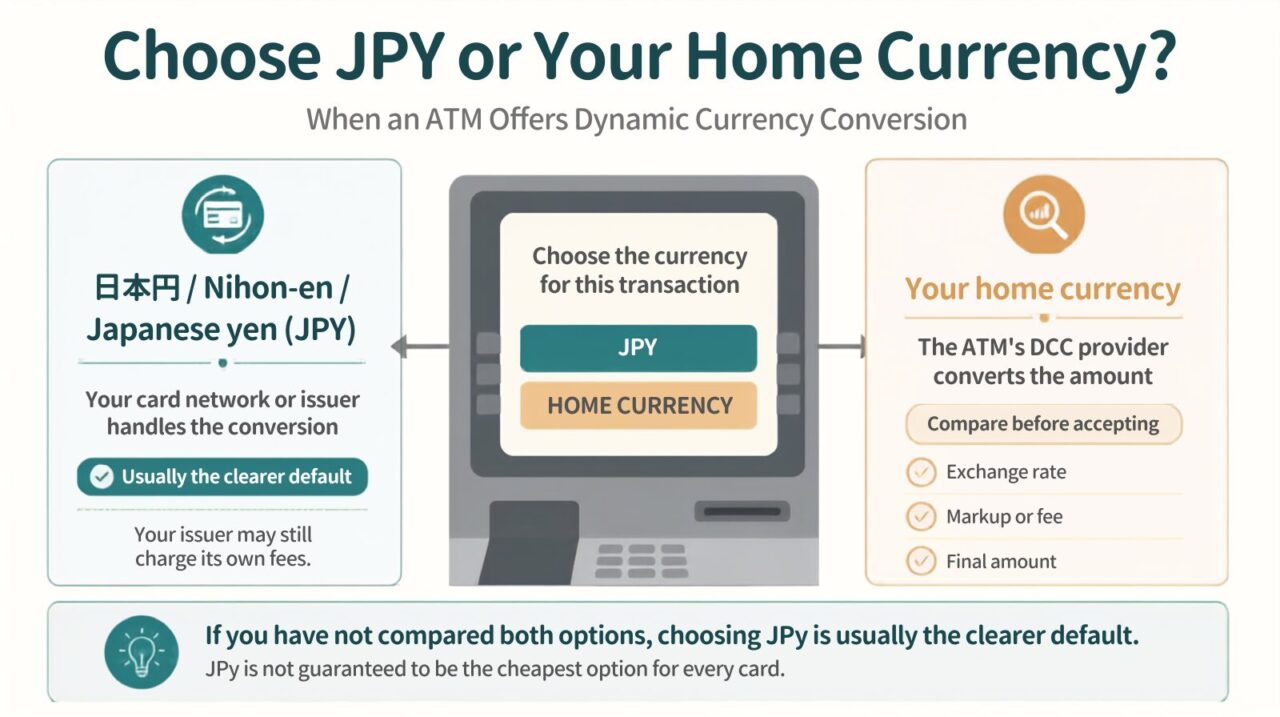
- Charge in Japanese yen / JPY: usually the clearer default. Your card network or issuer handles the conversion.
- Charge in your home currency: the ATM or its conversion provider sets the conversion through DCC.
Choose JPY unless you have compared the exchange rate, markup, and final amount and intentionally prefer the home-currency offer. Your issuer may still charge its own fee when you choose yen.
Do not confirm a screen you do not understand. Go back or cancel the transaction if the machine does not clearly show the currency and amount you are accepting.
How Much Should You Withdraw at One Time?
If your card charges a fixed fee for every transaction, repeated small withdrawals can cost more. If it does not charge a withdrawal fee and compatible ATMs remain nearby, smaller amounts may reduce how much cash you carry.
Start with the lower of the ATM operator’s limit and your issuer’s limit. Then consider:
- How soon you can reach another compatible ATM
- Whether the next destination has limited banking or convenience-store services
- How much cash you are comfortable carrying and storing securely
- Whether a family or group will pay shared expenses from the same cash reserve
This is a transaction decision, not a daily spending budget. For deciding how much cash to keep available and how to combine cash, cards, and an IC card, see Cash or Credit Cards in Japan? How to Pay During Your Trip.
What to Do If Your Card Does Not Work
A declined withdrawal at one ATM does not prove that the card will fail everywhere in Japan. The ATM network, issuer settings, limit, account, and transaction amount can all affect the result.
- Check that the ATM displays the network shown on your card.
- Confirm that the PIN is correct. Stop if repeated attempts could lock the card.
- Try a smaller withdrawal amount in case either limit is lower than expected.
- Check the banking app for an overseas-use setting, fraud alert, available balance, or daily limit.
- Try a different established ATM network rather than repeating the same failed transaction.
- Use the second card if it is available.
- Contact the card issuer if the problem continues across different ATMs.
- Use a currency exchange counter if you carry supported foreign banknotes.
If you need to compare ATM withdrawal with airport or city cash exchange, read How to Exchange Money in Japan: The Best Ways to Get Japanese Yen.
If the ATM Keeps Your Card or the Cash Does Not Appear
Stay near the machine and use its interphone or displayed support contact when available. Record the ATM operator, location, time, amount, and any error message, and keep the receipt.
If the card is not returned promptly or ATM support cannot resolve the problem, freeze or lock it in your banking app if possible and contact the issuer.
If your account shows a withdrawal but the machine did not dispense the cash, contact the card issuer and ATM operator. Do not share the PIN or full card number with someone who approaches you offering unofficial help.
Withdraw Before Leaving for a Remote Destination
International ATM access is generally easier around airports, city centers, major stations, post offices, and convenience stores. It can become less predictable on small islands, in mountain areas, around remote hot spring towns, and in places where shops or post offices close early.
Before leaving a larger town or transport hub, check whether your destination has a compatible ATM and whether it will be open when you arrive. Withdraw before departure when the answer is uncertain.
The purpose is not to carry the entire trip budget. It is to avoid reaching your accommodation or a local service area with no practical way to obtain the yen needed for the next part of the journey.
Useful Japanese at an ATM
| Japanese | Romaji | English |
|---|---|---|
| 海外発行カード | Kaigai hakkō kādo | Overseas-issued card |
| 現金引き出し | Genkin hikidashi | Cash withdrawal |
| 暗証番号 | Anshō bangō | PIN |
| 手数料 | Tesūryō | Fee |
| 利用限度額 | Riyō gendogaku | Withdrawal or transaction limit |
| 海外のカードが使えるATMはどこですか? | Kaigai no kādo ga tsukaeru ATM wa doko desu ka? | Where is an ATM that accepts overseas cards? |
| カードが戻ってきません。 | Kādo ga modotte kimasen. | My card has not been returned. |
| 現金が出てきません。 | Genkin ga dete kimasen. | The cash did not come out. |
Official Information
ATM networks, supported cards, service hours, fees, and limits can change. Use the operator pages below when you need to check a specific card or location:
- Seven Bank — Overseas Cards Usable at ATMs
- Japan Post Bank — International ATM Service
- Lawson Bank — International ATMs
- E-net — Cards Issued Outside Japan
- AEON Bank — ATMs for Overseas-Issued Cards
- MUFG Bank — Cards Issued Overseas (Japanese)
- Visa — Dynamic Currency Conversion
Last verified: September 3, 2026 (JST)
Frequently Asked Questions
- Can I withdraw cash in Japan with a foreign card?
-
Yes, if the card supports overseas cash withdrawals and the ATM accepts its network. Seven Bank and Japan Post Bank are practical first options, while Lawson Bank, E-net, and AEON Bank also support selected overseas-issued cards.
- Which ATM should I try first in Japan?
-
First make sure the machine is an ATM marked for international or overseas-issued cards. Seven Bank or Japan Post Bank is then a practical starting point for many visitors. The best option still depends on your card network, issuer fees, withdrawal limit, location, and operating hours.
- Do Japanese bank ATMs accept overseas-issued cards?
-
Some do, but not all. Check the individual ATM for wording such as “International Cards” or “Cards Issued Overseas” and for a network supported by your card. A credit card withdrawal is normally treated as a cash advance, so the card must also have overseas cash advances enabled.
- Is a debit card or credit card better for a Japanese ATM?
-
A debit card is usually the first option to check when its overseas withdrawal fees are reasonable. A credit card withdrawal is generally treated as a cash advance and may involve a separate fee and interest, so confirm those terms first.
- Should I choose Japanese yen or my home currency?
-
Japanese yen is usually the clearer default. Choosing your home currency uses Dynamic Currency Conversion, whose rate may include an additional markup or fee; choosing JPY leaves the conversion to your card network or issuer under its terms.
- Why was my card declined even though its logo was displayed?
-
The issuer may have blocked the withdrawal, the overseas setting may be disabled, the requested amount may exceed a limit, or that ATM may not process the specific card. Try a smaller amount or another established network, then contact the issuer if the problem continues.
- Are Japanese convenience-store ATMs available 24 hours?
-
Not always for every overseas-issued card. Store hours, ATM operator schedules, card-network service times, and maintenance can affect availability even when the convenience store itself remains open.