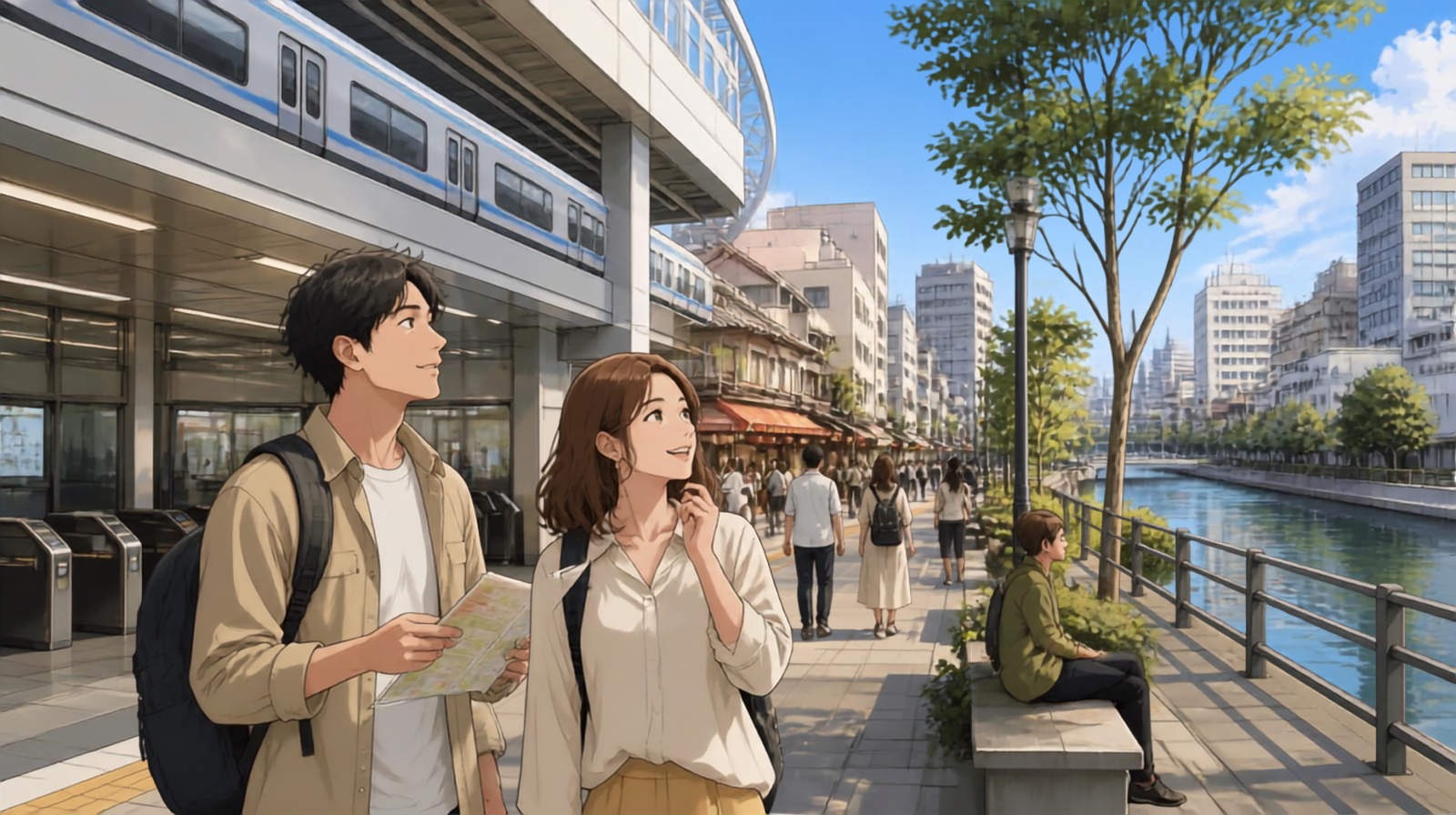
Some rail journeys through southern Kumamoto remain affected by the 2026 earthquake. If your trip continues beyond Fukuoka, check the current Kyushu travel update before finalizing transportation.
Start With the Role Fukuoka Will Play in Your Trip
Fukuoka is sometimes treated only as an arrival point for Kyushu. That misses much of its value. The city combines a large transport hub with historic Hakata streets, contemporary shopping districts, parks, coastal areas, and a food culture that works especially well after the formal sightseeing day has ended.
Before choosing attractions, decide which of these roles matters most.
| Role in your trip | Practical starting point | What it changes |
|---|---|---|
| Fukuoka city stay | Give the city two full days | Stay near Tenjin or between Tenjin and Hakata; leave time for food and evening walks |
| Gateway to Kyushu | Stay near Hakata Station | Prioritize Shinkansen and limited-express access; avoid unnecessary cross-city travel with luggage |
| Short stop between flights or trains | Choose one compact area day | Do not try to combine the whole city with a distant day trip |
| Base for nearby excursions | Plan three full days | Choose day trips based on the station you are staying near and the transport they require |
For a first visit focused mainly on the city, the strongest default is two full days and three nights. This gives you one day for historic Hakata and the central districts, one day for parks and modern neighborhoods, and two evenings for dining without turning every meal into another appointment.
How Many Days Do You Need in Fukuoka?
One full day can introduce Fukuoka, but it usually forces you to choose between the older eastern side of the city and the parks and neighborhoods farther west. Two days creates a much better balance.
| Time available | What fits comfortably | Main limitation |
|---|---|---|
| One full day | Hakata Old Town, central Fukuoka, and one evening food area | Little room for the coast, slower neighborhoods, or a day trip |
| Two full days | Historic areas, Tenjin and Daimyo, Ohori Park, local food, and unplanned walking | You will still need to be selective about outer areas |
| Three full days | Two city days plus Dazaifu, Itoshima, Yanagawa, or another focused excursion | The best third day depends on your interests and transport choice |
| Four days or more | A slower city stay or the beginning of a wider Kyushu route | Consider changing base instead of making every regional destination a return day trip |
Fukuoka Airport is unusually close to the city, so an arrival day may be more usable than it is in Tokyo or at Kansai Airport. Still, immigration, baggage, the transfer from the international terminal, and hotel check-in can take longer than expected. Treat an arrival evening as time for dinner and a walk near your accommodation, not as one of your two main sightseeing days.
Understand Fukuoka by Area
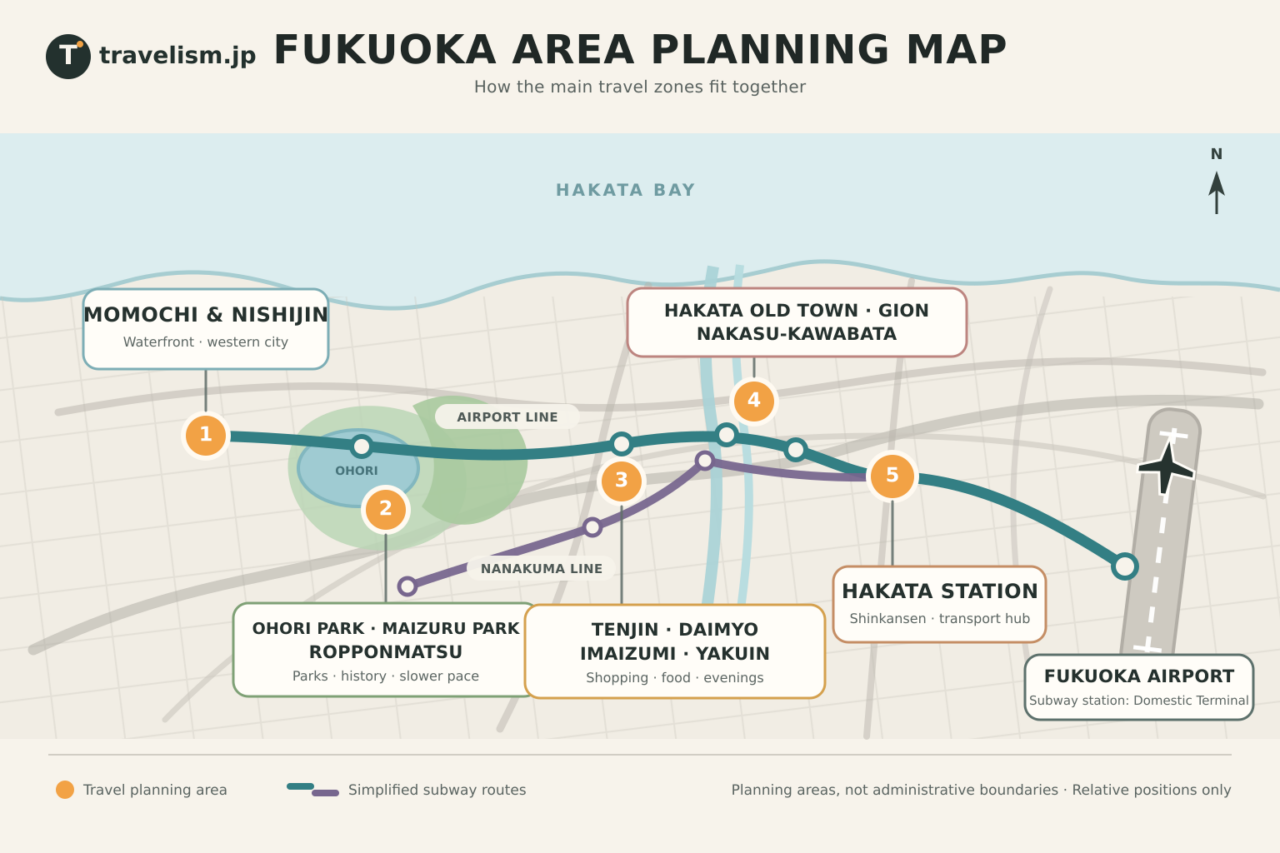
Fukuoka does not require the same amount of rail planning as Tokyo, but it is not one continuous sightseeing district. It is easier to build the trip around a few practical zones.
| Travel zone | Think of it first for | Comfortable use of time |
|---|---|---|
| 博多駅 / Hakata-eki / Hakata Station | Airport access, Shinkansen journeys, shopping, and a convenient transport base | Arrival or departure time, meals, shopping, and onward travel |
| 博多旧市街・祇園・中洲川端 / Hakata Kyūshigai, Gion, Nakasu-Kawabata / Hakata Old Town, Gion & Nakasu-Kawabata | Temples, shrines, merchant-city history, riverside streets, and access between Hakata and Tenjin | Half a day to one unhurried day |
| 天神・大名・今泉・薬院 / Tenjin, Daimyo, Imaizumi & Yakuin | Shopping, cafés, restaurants, smaller streets, and evening energy | Half a day plus dinner and the evening |
| 大濠公園・舞鶴公園・六本松 / Ōhori-kōen, Maizuru-kōen, Ropponmatsu / Ohori Park, Maizuru Park & Ropponmatsu | Green space, the Fukuoka Castle site, museums, and a slower city day | Half a day, longer with a museum or relaxed meal |
| 百道・西新 / Momochi & Nishijin | Waterfront space, modern city views, family stops, and a more residential western district | A focused half day rather than an automatic must-see |
Hakata Station: The Transport Side of Fukuoka
Hakata Station is Fukuoka’s main JR and Shinkansen station. The station complex also contains shops, restaurants, department-store floors, and practical services, so it can absorb spare time on an arrival or departure day.
Do not confuse Hakata Station with 西鉄福岡(天神)駅 / Nishitetsu Fukuoka (Tenjin)-eki / Nishitetsu Fukuoka (Tenjin) Station. The latter is in Tenjin and serves Nishitetsu trains, including the direction used for Dazaifu and Yanagawa. In route searches, enter the exact station name rather than simply “Fukuoka Station.”
Hakata Old Town, Gion, and Nakasu-Kawabata
The older side of Fukuoka appears around shrines, temples, traditional shops, and streets between Hakata Station and the river. 櫛田神社 / Kushida-jinja / Kushida Shrine and the surrounding Hakata Old Town area provide more historical context than a station-and-shopping visit alone.
Continue toward Nakasu-Kawabata for covered shopping streets, cultural stops, and riverside access. Nakasu is known for nightlife, but the wider area also works during the day and forms a useful bridge between Hakata and Tenjin.
Tenjin, Daimyo, Imaizumi, and Yakuin
Tenjin is one of the city’s main commercial and transport centers. Department stores and underground passages make it practical in poor weather, while nearby Daimyo, Imaizumi, and Yakuin bring the scale down to cafés, small shops, bars, and restaurants.
This part of the city works best when it is not reduced to a shopping checklist. Walk a few streets away from the largest buildings, stop for coffee or a meal, and let the area carry the evening. Staying nearby allows you to return to your room before dinner or continue walking without planning another train journey.
Ohori Park, Maizuru Park, and Ropponmatsu
Ohori Park gives the trip a slower rhythm. The pond, walking paths, nearby art museum, and adjoining Maizuru Park make this more than a short photo stop. The Fukuoka Castle ruins are here, but the value of the area is the combination of history, greenery, and ordinary city use.
Nearby Ropponmatsu has cafés, restaurants, and cultural facilities without the intensity of Tenjin. This is a useful area for travelers who want a quieter part of Fukuoka rather than another full day in commercial districts.
Momochi and Nishijin
Momochi adds waterfront space, broad views, and modern attractions. Nishijin offers a more lived-in western district with local shopping and food. The two can complement each other, but they are not essential to every first visit.
Choose this area when the coast, a specific museum or family attraction, or a western neighborhood interests you. Do not add it only because it appears on a list of famous Fukuoka sights.
Where Should You Stay in Fukuoka?
The most useful accommodation decision can be reduced to one question: will you make several long-distance rail journeys?
- If yes, start with Hakata Station.
- If no, and Fukuoka itself is the main experience, start with Tenjin, Daimyo, or the surrounding central neighborhoods.
| Base | Best for | Main trade-off |
|---|---|---|
| Hakata Station | Airport access, Shinkansen travel, early departures, luggage convenience | The immediate station environment feels more commercial and transport-oriented |
| Tenjin and Daimyo | Restaurants, shopping, nightlife, cafés, and evenings on foot | Long-distance JR journeys begin with a subway ride to Hakata |
| Gion and Nakasu-Kawabata | A central compromise between Hakata, historic streets, and Tenjin | Block-by-block atmosphere varies, especially around nightlife areas |
| Ohori Park and Ropponmatsu | Quieter mornings, green space, and a more residential stay | Less convenient for repeated Shinkansen journeys and some late-night plans |
| Momochi and Nishijin | Waterfront or western-city priorities, families, and a slower base | Longer travel to Hakata and some central evening areas |
Check the actual walking route from the station to the property, not only the neighborhood name. Underground passages, large intersections, bridges, and station exits can change how convenient a hotel feels with luggage or in summer rain.
Also consider what happens outside sightseeing hours. Hakata makes an early Shinkansen easier. Tenjin and Daimyo keep dinner and late-evening streets close. Ohori can turn the first hour of the morning into a park walk rather than a train journey. The accommodation location shapes the quiet parts of the trip as much as the scheduled ones.
How to Get to Fukuoka
From Overseas
Fukuoka has direct international flights from cities across East and Southeast Asia, including Seoul, Taipei, Hong Kong, Bangkok, Singapore, and Kuala Lumpur. Travelers from Europe, North America, and most other regions will usually need to connect through another major airport.
From Fukuoka Airport
福岡空港 / Fukuoka Kūkō / Fukuoka Airport has separate domestic and international terminals. The Domestic Terminal is directly connected to 福岡空港駅 / Fukuoka-kūkō-eki / Fukuoka Airport Station on the subway Airport Line. The subway journey is approximately five minutes to Hakata and eleven minutes to Tenjin.
The International Terminal is not directly attached to the subway station. International arrivals can use the free inter-terminal shuttle bus to the Domestic Terminal and then take the subway, or compare a direct bus or taxi to their accommodation. Allow time for this transfer instead of applying the domestic-terminal subway time to the entire airport journey.
Check the official Fukuoka Airport access information shortly before travel because terminal routes, bus stops, and operating details may change.
From Tokyo
For most travelers coming directly from Tokyo, a domestic flight to Fukuoka Airport is the practical default. The rail journey is long, while Fukuoka Airport’s city access reduces the usual disadvantage of landing far from the center.
Choose the Shinkansen instead when Fukuoka is the end of a rail route with stops such as Kyoto, Osaka, or Hiroshima, when avoiding airports matters to you, or when your ticket arrangement makes the full rail journey sensible. Compare the complete door-to-door journey rather than flight time alone.
From Kyoto, Osaka, or Hiroshima
For a journey from Kyoto, Shin-Osaka, or Hiroshima, a direct or connecting Shinkansen journey to Hakata is normally the simplest starting point. From Shin-Osaka and Hiroshima, the route follows the Sanyo Shinkansen and arrives in the city’s main transport district without an airport transfer at either end.
If you are not familiar with the ticket choices, the guide to buying Shinkansen tickets in Japan explains station machines, counters, online booking, seats, and luggage considerations.
Getting Around Fukuoka
For most first-time visitors, the default combination is subway, walking, and an IC card. Add a bus when it serves a particular destination better, and use a taxi when luggage, weather, children, or an awkward final section makes the extra cost worthwhile.
Use the Subway for the Main Urban Spine
The Airport Line connects Fukuoka Airport, Hakata, Nakasu-Kawabata, Tenjin, Ohori Park, and western districts. It covers many of the journeys a first-time visitor is most likely to make.
Fukuoka’s subway card is はやかけん / Hayakaken, but you do not need to buy a new regional card if you already have a compatible Suica, PASMO, ICOCA, or another card carrying the nationwide mutual-use mark. The guide to IC cards in Japan explains physical and mobile options.
Walk Between Nearby Central Areas
Some of Fukuoka’s character appears between stations. Hakata Old Town, Kushida Shrine, Kawabata shopping streets, Nakasu, and Tenjin can be connected selectively on foot. Do not walk the entire central city simply to avoid one subway fare; use walking when the streets themselves are part of the day.
Use Buses and Taxis Selectively
Buses fill gaps between rail stations and destinations such as parts of the waterfront. They are useful, but dense central routes and similar stop names can create more work than the subway. Start with rail, then choose a bus when the route is clearly more direct.
A short taxi can be a sensible choice for a family or small group, especially with bags, in heavy rain, or late in the evening. Fukuoka’s compact center means a targeted taxi ride may solve one difficult section without becoming the transport plan for the whole day.
Do Not Buy a Pass Before Planning the Day
Subway and tourist passes can be worthwhile for a transport-heavy day, but many Fukuoka days combine walking with only a few rides. Sketch the route first, then compare the current pass coverage and price. An IC card is usually the easier default when saving a small amount would require changing the way you want to explore.
Build Your Fukuoka Days Around Areas, Not a Checklist
A fixed itinerary is not necessary, but two area-based days give a first visit a reliable shape.
| Area day | A practical route | Best for |
|---|---|---|
| Historic and central Fukuoka | Hakata Old Town → Gion → Kawabata → Nakasu or Tenjin in the evening | Shrines, temples, merchant history, covered streets, food, and an easy first orientation |
| Parks and modern neighborhoods | Ohori Park → Maizuru Park → Ropponmatsu or Tenjin and Daimyo | Green space, museums, cafés, shopping streets, and a slower second day |
| Western city option | Nishijin → Momochi waterfront | Families, architecture, coastal space, or a specific western-city interest |
| Excursion day | Choose one of Dazaifu, Itoshima, Yanagawa, or Mojiko | A third day when you want a clear change of setting |
You do not need to complete every stop in a row. A temple visit, lunch, a coffee break, and time in one shopping street may create a better day than crossing the city to collect another landmark. Fukuoka’s compactness is most valuable when it reduces pressure, not when it becomes permission to schedule more.
Food Is Part of the Schedule, Not an Afterthought
Hakata ramen may be the city’s most recognizable dish, but building every meal around ramen gives a narrow picture of Fukuoka. Look for 明太子 / Mentaiko / Spicy cod roe, もつ鍋 / Motsunabe / Beef offal hot pot, 水炊き / Mizutaki / Chicken hot pot, ごまさば / Goma saba / Mackerel with sesame dressing, udon, gyoza, and seafood as well.
Some dishes suit groups better than solo travelers, and some restaurants require reservations. Instead of making a long list of famous shops, decide which one or two local dishes matter most, reserve only where necessary, and leave another meal open for something found near your accommodation.
How to Approach Fukuoka’s Yatai
屋台 / Yatai / Food stalls are a distinctive part of Fukuoka’s evening scene. Many begin opening around 6:00 p.m., but weather and the operator’s circumstances can affect whether a stall opens. Seating is limited, so large groups may have difficulty sitting together.
Treat a yatai as one possible meal or drink, not as an obligation. Check the menu and prices before ordering, avoid occupying seats for an unnecessarily long time when others are waiting, and keep another restaurant option nearby. Tenjin and Nakasu both have stalls, but the experience varies from one operator to another.
Which Day Trip Should You Choose?
If you have only two full days, stay in Fukuoka unless one nearby destination is a major reason for the trip. With a third day, choose one excursion according to the experience you want and the transport you are willing to use.
| Day trip | Choose it for | Planning reality |
|---|---|---|
| 太宰府 / Dazaifu | A major shrine, historic setting, museums, and an easy cultural excursion | The simplest first day trip for many visitors; Nishitetsu trains normally involve a change at Nishitetsu Futsukaichi Station |
| 糸島 / Itoshima | Coast, cafés, scenery, and a change from the city | It is a broad area, not one compact station district; a rental car can connect scattered coastal and mountain stops more effectively |
| 柳川 / Yanagawa | Canal scenery, a slower pace, and regional food | Nishitetsu access makes it a natural choice from Tenjin |
| 門司港 / Mojiko | Port architecture, waterfront walking, and a different urban atmosphere | It is a longer rail day; check the exact ticket coverage because the Hakata–Kokura Shinkansen section is operated by JR West |
Dazaifu is the best default when you want one straightforward cultural day trip. Choose Itoshima instead when the coast matters more and you are comfortable planning local transport or driving. Choose Yanagawa for a slower excursion reached naturally from Tenjin.
Destinations such as Nagasaki, Beppu, Yufuin, Kumamoto, and Kagoshima may appear possible as day trips on a route-search screen. The question is not only whether you can reach them and return. If the destination deserves an evening, an early morning, or time beyond one central attraction, continue the journey and stay overnight rather than turning it into a long commute from Fukuoka.
Fit Fukuoka Into a Wider Japan Itinerary
Fukuoka fits most naturally at the western end of a route through Kyoto, Osaka, Hiroshima, or western Honshu, or at the beginning or end of a Kyushu journey. Hakata Station connects the Sanyo Shinkansen from the east with Kyushu rail services to the south and west.
If your first trip already includes Tokyo, Kyoto, and Osaka, add Fukuoka only when you can give it at least two full days or when it improves the wider route. Traveling all the way to Fukuoka for one rushed afternoon usually adds more transport than experience.
An open route can work particularly well: travel west by Shinkansen and fly from Fukuoka to Tokyo or onward, or arrive in Fukuoka by air and continue east by rail. Check your actual flight options before committing, but avoiding unnecessary backtracking can save more time than choosing the fastest train on one isolated segment.
For a wider comparison of rail, flights, buses, taxis, and rental cars, see Getting Around Japan: Which Transportation Should You Use?
When Is the Best Time to Visit Fukuoka?
Fukuoka works throughout the year, but the weather changes how much of the trip you will want to spend walking. Spring and autumn often suit long days between historic streets, parks, and commercial districts. They can also bring stronger accommodation demand during holidays, weekends, and major events.
Summer is hot and humid, and periods of heavy rain or severe weather can affect outdoor plans and transportation. Build in indoor stops and avoid assuming that every day can support continuous walking. Winter is generally milder than northern Japan, but it still requires warm clothing and can feel cold near the waterfront or after sunset.
Major recurring events such as 博多どんたく / Hakata Dontaku and 博多祇園山笠 / Hakata Gion Yamakasa can change the atmosphere of the city and increase demand. Check the dates and event arrangements for your travel year before booking around them.
If your dates are still flexible, Best Time to Visit Japan: A Season-by-Season Guide explains how weather, crowds, seasonal experiences, and travel pace differ across the country.
Common Fukuoka Planning Mistakes
- Using “Fukuoka Station” when you mean JR Hakata Station.
- Treating Fukuoka only as an airport and missing the city itself.
- Choosing Hakata automatically when evenings in Tenjin matter more than long-distance rail.
- Assuming the International Terminal is directly connected to the subway.
- Planning Itoshima as if its coast and inland sights were grouped around one station.
- Buying a city or regional rail pass before deciding the actual route.
- Turning several distant Kyushu destinations into return day trips from one hotel.
- Filling every meal with famous restaurants and leaving no room for what you find locally.
- Expecting every yatai to open regardless of weather or seat availability.
Leave Time for Fukuoka After the Sights
Fukuoka’s strength is not a single landmark. It is the way a shrine visit, a park walk, a small shopping street, dinner, and the route back to your accommodation can fit into one day without the city feeling like a race between stations.
Plan the transport decisions that matter, choose two or three areas that fit your interests, and leave part of the evening open. The city becomes more rewarding when its compactness gives you time rather than another reason to add stops.
Frequently Asked Questions
- How many days do I need in Fukuoka?
-
Two full days is the best starting point for most first-time visitors. Add a third day if you want a day trip to Dazaifu, Itoshima, Yanagawa, or another nearby destination.
- Should I stay near Hakata Station or Tenjin?
-
Stay near Hakata Station if airport and Shinkansen access are your priority. Stay around Tenjin if restaurants, shopping, nightlife, and evenings on foot matter more.
- Is Fukuoka worth visiting on a first trip to Japan?
-
Yes, especially if you want a compact city with food, neighborhood life, easy airport access, and a natural connection to Kyushu. If your itinerary is already crowded, add Fukuoka only when you can give it enough time or use it to improve the overall route.
- Does the subway connect directly to Fukuoka Airport’s International Terminal?
-
No. The subway station is connected to the Domestic Terminal. International passengers can use the free terminal shuttle to reach the subway or compare a direct bus or taxi to their accommodation.
- Do I need a rental car in Fukuoka?
-
No car is needed for a typical Fukuoka city stay. A rental car becomes more useful when you want to connect scattered coastal and mountain locations in Itoshima or build a wider rural Kyushu route.
- What is the best day trip from Fukuoka?
-
Dazaifu is the easiest default for many first-time visitors because it provides a clear cultural change of setting and practical rail access. Choose Itoshima for coastal scenery or Yanagawa for canals and a slower regional day.
- Can I use Suica, PASMO, or ICOCA in Fukuoka?
-
Compatible nationwide transportation IC cards can generally be used on Fukuoka City Subway and other participating local services. You do not need to buy Hayakaken simply because you are in Fukuoka.
- Is Fukuoka easy to visit without speaking Japanese?
-
Major stations, the airport, and central transport are generally manageable with English signs and a route app. Save the exact Japanese name and address of your accommodation, especially when using a taxi or staying on a smaller street.