Osaka Hotel Prices Have Cooled Since Expo 2025
The clearest change in 2026 is that Osaka is no longer being priced against the exceptional demand of Expo 2025.
Japan Tourism Agency accommodation statistics (Japanese) show how strong the market became. Osaka Prefecture recorded a room occupancy rate of 75.8% in 2024 and 78.8% in 2025, the highest prefectural rate in Japan for 2025. By May 2026, the Osaka rate was 72.8%.
There is an important caution when reading that decline. The Japan Tourism Agency changed part of the survey methodology from January 2026, so year-over-year differences may include some effect from the change in how properties are grouped. Occupancy should therefore be read together with hotel-rate data rather than used on its own.
Rate data points in the same general direction. MetroEngines Research (Japanese) estimated that Osaka city-hotel ADR in June 2026 was ¥10,769, down 26.3% from June 2025. Business hotels were estimated at ¥7,884, down 32.8% year on year.
Those figures look dramatic until 2024 is used as the comparison. In April and May 2026, estimated city-hotel ADR was still 7.2% above the same months in 2024. June was the first of those three months to fall below the 2024 level, at about 6% lower.
The most useful interpretation is not that Osaka hotels have collapsed in price. The Expo premium has faded, and the market is moving back toward a more normal pattern in which weekdays, weekends, events, seasonality, location, and room availability matter again.
What Our 2026 Price Check Found
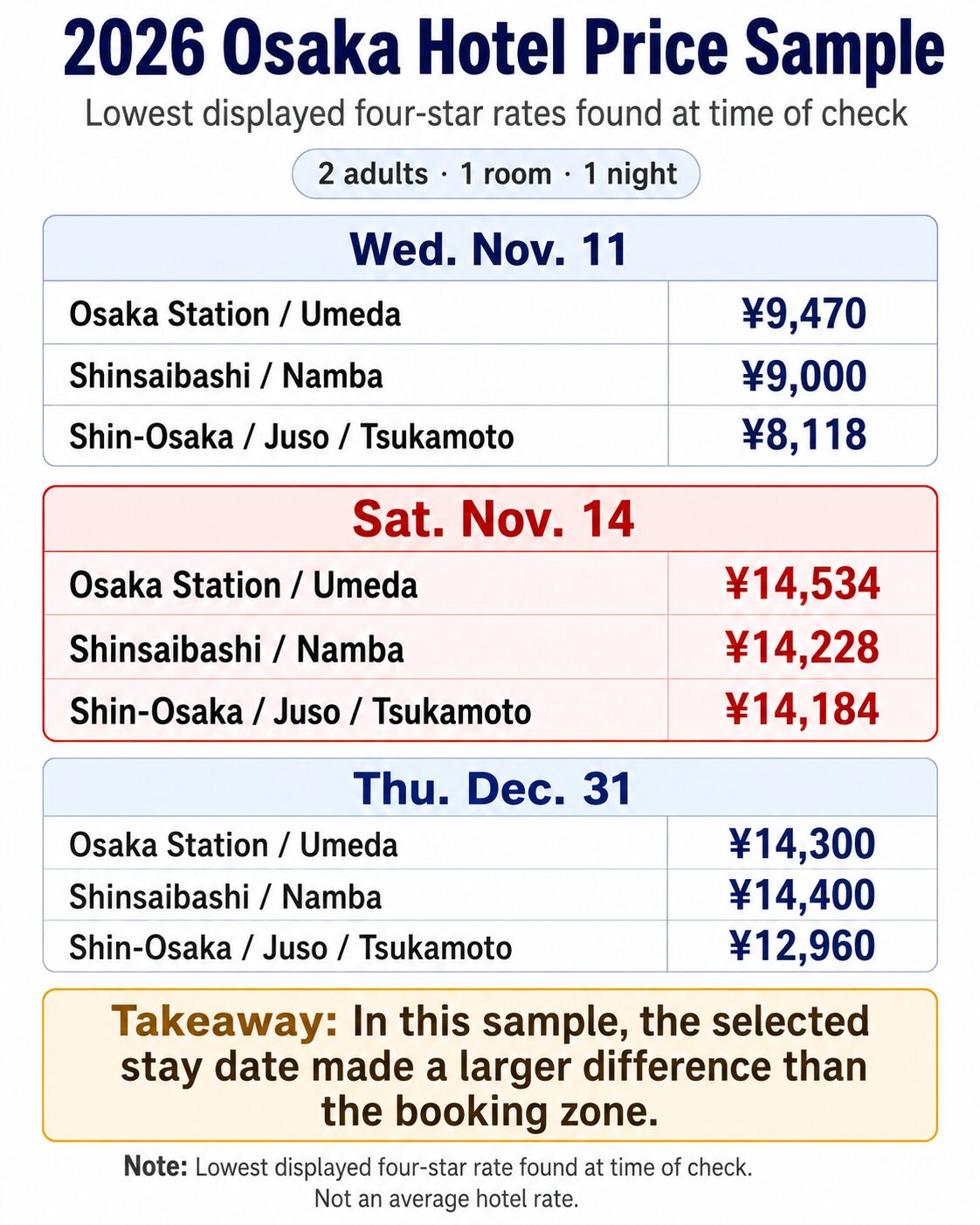
Market averages explain the direction of travel, but they do not show what a visitor may actually see on a booking screen. To make the comparison more practical, we checked the lowest displayed four-star hotel rate in three Osaka booking zones under the same basic search conditions: two adults, one room, one night, with taxes and fees shown by the comparison site.
| Booking zone | Wed. Nov. 11 | Sat. Nov. 14 | Thu. Dec. 31 |
|---|---|---|---|
| Osaka Station / Umeda | ¥9,470 | ¥14,534 | ¥14,300 |
| Shinsaibashi / Namba | ¥9,000 | ¥14,228 | ¥14,400 |
| Shin-Osaka / Juso / Tsukamoto | ¥8,118 | ¥14,184 | ¥12,960 |
These figures are a snapshot, not an average hotel rate. They show the lowest four-star price found in each booking zone at the time of checking. The hotel, room type, cancellation conditions, payment terms, and remaining inventory can differ by date.
Even with that limitation, the pattern is useful. On the selected Wednesday, the lowest displayed rates were roughly ¥8,100–¥9,500. On the selected Saturday, all three zones were around ¥14,200–¥14,500. The gap between neighborhoods became much smaller than the gap between the two selected dates.
Your Dates Can Matter More Than Your Neighborhood
It is tempting to solve a high hotel price by immediately moving your search from Umeda to Namba or Shin-Osaka. Sometimes that works. Sometimes it does not.
In our sample, changing from a Wednesday to a Saturday had a much larger effect on the lowest displayed price than changing among the three booking zones. This does not mean every Saturday will be expensive or every weekday will be cheap. It means the date deserves to be checked before you assume the neighborhood is the problem.
If your itinerary is flexible, moving a stay by one night may occasionally save more than moving to a less convenient part of the city. If your dates are fixed, widening the search area can still help, but only if the new location works with the trip you actually want to take.
Price Is Only One Part of Hotel Value
A cheaper room is not automatically better value if it adds an extra transfer every morning, makes late-night returns difficult, or lacks something you will use every day.
Before comparing prices, decide what the Osaka part of your trip is for and what you need from the accommodation. The answer changes what is worth paying for.
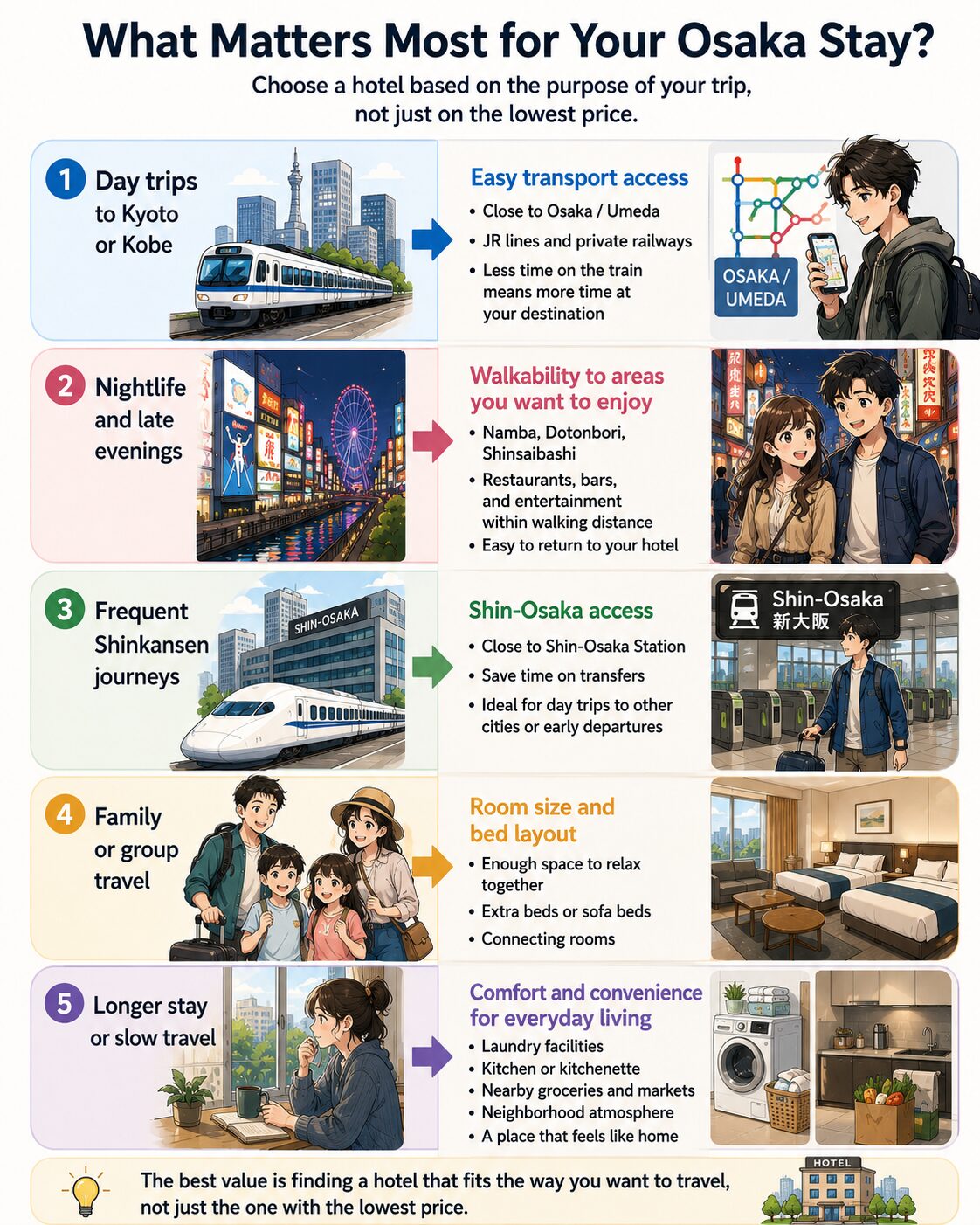
The same principle applies to the room itself. A larger room, washing machine, kitchen, bathtub, breakfast, luggage storage, staffed front desk, or quieter street may be worth more to one traveler than another.
The goal is not to pay as little as possible. It is to avoid paying for things you do not need while keeping the location and facilities that will make the trip easier.
If you are still deciding where to base yourself, our Where to Stay in Osaka: Best Areas for First-Time Visitors guide compares the main Osaka stay zones by transport, atmosphere, and travel style.
Does Changing Area Actually Save Money?
It can, but there is no Osaka district that is always the budget choice.
Shin-Osaka may offer useful rates on some dates, especially when the Shinkansen is central to your itinerary. In our selected Saturday sample, however, its lowest four-star rate was almost the same as the lowest rates around Umeda and Namba.
If Umeda or Namba looks expensive, it is reasonable to widen the search. Yodoyabashi, Higobashi, Tennoji, Shin-Osaka, and other well-connected areas may provide a better combination of price and convenience for your dates.
Do not move simply because a different district has a cheaper headline price. Check how that location changes your daily transport, airport journey, evening plans, and time spent carrying luggage.
Travelers who want a quieter central alternative can also read our Yodoyabashi, Higobashi & Edobori area guide.
Should You Book an Osaka Hotel Now or Wait?
For most travelers with fixed Osaka dates, the safest default is to book a room you are happy with when you find it, provided the price is reasonable for your budget and the cancellation terms give you enough flexibility.
Waiting is not only a price decision. The risk is not just that the same room may cost more later. The room itself may no longer be available.
This matters most when you need something specific: a family room, a larger room, several beds, a kitchen, laundry facilities, a bathtub, a quiet location, or accommodation close to a particular station. These rooms may have much less inventory than a standard double room.
Book sooner if your dates or requirements are fixed
- You need a Saturday night or another popular date.
- You are traveling during a holiday, event, or busy seasonal period.
- You want a specific neighborhood or station.
- You need a family room, larger room, kitchen, laundry, or another limited room feature.
- You have found a room that fits the trip well and has acceptable cancellation conditions.
In these situations, booking a flexible rate can protect the room while leaving you free to recheck prices later.
You can keep comparing if you have real flexibility
You have more room to wait and compare when you are staying on ordinary weekdays, can shift your dates, and are willing to use several different Osaka neighborhoods.
Even then, do not assume waiting will automatically produce a lower rate. Recheck the same room or a genuinely comparable room, and compare the cancellation and payment conditions as well as the price.
Compare the Final Price, Not Just the Room Rate
Two rooms showing similar prices on a search-results page may not cost the same by the time you finish booking.
Before deciding which offer is cheaper, compare the same conditions: number of guests, room type, breakfast, cancellation policy, payment timing, taxes and fees, and any amount due at the property.
Hotel stays are also subject to consumption tax
Hotel accommodation in Japan is generally subject to the standard 10% consumption tax. Foreign visitors cannot claim this tax back on a hotel stay because accommodation is a service used in Japan. The National Tax Agency guidance (Japanese) specifically treats hotel accommodation used in Japan as a service that is not exempt for non-residents.
This is different from Japan’s tax-free shopping system, which applies to eligible goods that meet the tax-free purchase rules. It does not make hotel stays tax-free, and consumption tax paid on accommodation is not refunded when you leave Japan. For more detail, see our Tax-Free Shopping in Japan guide.
Osaka’s accommodation tax may be included or collected separately
大阪府の宿泊税 / Shukuhaku-zei / Osaka Accommodation Tax is separate from consumption tax. It is charged according to the taxable accommodation rate per person, per night. For this threshold, consumption tax and other taxes are excluded from the accommodation charge. The current rates have applied to stays from September 1, 2025.
| Accommodation charge per person, per night | Accommodation tax |
|---|---|
| Under ¥5,000 | No tax |
| ¥5,000 to under ¥15,000 | ¥200 |
| ¥15,000 to under ¥20,000 | ¥400 |
| ¥20,000 or more | ¥500 |
The important booking detail is that the tax may not be handled the same way on every reservation. Osaka Prefecture notes that accommodation tax is sometimes not included in an amount prepaid through a booking site. When it is not included, the payment method depends on the accommodation and the tax may be collected separately.
Check the price breakdown and any “pay at property” amount before deciding that one room is cheaper than another. For the current rules, see the Osaka Prefectural Government accommodation tax information (Japanese).
Last verified: August 25, 2026 (JST)
Frequently Asked Questions
- Are Osaka hotels cheaper in 2026 than in 2025?
-
Generally, yes compared with the Expo period of 2025. However, April and May 2026 market-rate estimates were still above the same months in 2024, so the change is better understood as a normalization from an unusually expensive year rather than a citywide collapse in hotel prices.
- Are Osaka hotels more expensive on Saturdays?
-
They often can be, but the size of the difference depends on the date and available inventory. In our November 2026 sample, the lowest displayed four-star rate in all three booking zones was substantially higher on the selected Saturday than on the selected Wednesday.
- Is Shin-Osaka cheaper than Umeda or Namba?
-
Not always. Shin-Osaka can be good value on some dates and is especially practical for frequent Shinkansen travel, but our selected Saturday sample showed very similar lowest four-star rates across Shin-Osaka, Umeda, and Namba.
- Should I book an Osaka hotel now or wait?
-
If your dates or room requirements are fixed, booking a room you like with reasonable cancellation terms is usually the safer choice. Waiting can mean losing the room itself, not just paying a higher price later.
- Is Osaka accommodation tax included in hotel prices?
-
Sometimes, but not always. Osaka Prefecture notes that accommodation tax may not be included in a prepaid booking-site amount, and the accommodation may collect it separately. Check the final price breakdown and any amount payable at the property.
- Can foreign visitors get a consumption tax refund on hotel stays in Japan?
-
No. Hotel accommodation is a service used in Japan and is generally subject to the standard 10% consumption tax. Japan’s tax-free shopping system applies to eligible goods under its own rules, so consumption tax paid on a hotel stay is not refunded when you leave Japan.