Start With the Part of Hokkaido You Actually Want to Experience
The biggest Hokkaido planning mistake happens before any hotel or train is booked: treating the island as if it were one city with several nearby attractions. Sapporo, Hakodate, Furano, and Shiretoko may all appear on the same map, but combining them can require long rail journeys, domestic flights, or several hours of driving.
Choose the main experience first. The route should follow from that decision.
| Main reason for visiting | Best starting region | Practical first route |
|---|---|---|
| City life, food, and an easy introduction | Sapporo and Otaru | Stay mainly in Sapporo and add Otaru as a day trip or one-night stop |
| Rural scenery, flower fields, and photography | Asahikawa, Biei, and Furano | Combine Sapporo with a second base in central-northern Hokkaido |
| Port history, architecture, and a slower city stay | Hakodate and southern Hokkaido | Use Hakodate as a dedicated base rather than a rushed return trip from Sapporo |
| Skiing and snow resorts | Niseko, Rusutsu, or another chosen resort | Book the resort first, then add Sapporo before or after it |
| Wildlife, national parks, and broad landscapes | Eastern Hokkaido | Fly into or out of a regional airport and focus on one eastern route |
| Remote islands, hiking, and far-northern scenery | Wakkanai, Rishiri, and Rebun | Build a dedicated northern journey with weather and ferry margins |
For a general first visit, Sapporo and Otaru form the most manageable core. They offer city transport, food, museums, shopping, historic streets, and a straightforward airport connection. The strongest next step is usually one additional region, not the whole island.
How Many Days Do You Need in Hokkaido?
Five to seven nights is a useful default for a first Hokkaido trip. It allows enough time for Sapporo and Otaru plus one clearly different area without making every second day a long transfer.
| Time available | What fits comfortably | Main limitation |
|---|---|---|
| Three to four nights | Sapporo with Otaru, or one focused stay in Hakodate or a ski resort | Choose one compact area; do not attempt a wider island route |
| Five to seven nights | Sapporo and Otaru plus Hakodate, Biei and Furano, a resort, or another second region | One major regional addition is usually enough |
| Eight to ten nights | Two well-connected regions or one deeper self-drive route | Transfer days still need to be treated as part of the itinerary |
| Two weeks or more | A broader multi-region journey with slower stays | The entire island still does not need to be covered in one trip |
Count usable days, not only hotel nights. A late arrival at New Chitose Airport, a resort transfer, or a long journey between Sapporo and Hakodate can consume much of a day. In winter, allow more margin for weather, slower walking, and transport changes.
If you have only three or four nights, staying in one accommodation can work well. With five nights or more, a second base becomes worthwhile when it gives you early or late access to the landscape, food, or activity that brought you to Hokkaido.
Understand Hokkaido by Region
Regional names are useful only when they help you choose a base. For first-trip planning, think of Hokkaido as a group of travel regions connected by a limited number of major rail, road, and air corridors.
| Travel region | Main bases | Choose it first for |
|---|---|---|
| Sapporo and nearby central Hokkaido | Sapporo, Jozankei | Food, museums, shopping, city life, and the easiest general introduction |
| Otaru, Niseko, and the western resort belt | Otaru, Kutchan, Niseko | Historic port streets, skiing, outdoor activities, and mountain stays |
| Asahikawa, Biei, and Furano | Asahikawa, Biei, Furano | Rural scenery, flowers, farms, photography, and a slower landscape-focused route |
| Southern Hokkaido | Hakodate, Onuma | Port history, architecture, seafood, night views, and Shinkansen access from Honshu |
| Eastern Hokkaido | Kushiro, Lake Akan, Abashiri, Shiretoko, Obihiro | Wildlife, wetlands, national parks, drift ice, lakes, and long scenic routes |
| Northern Hokkaido | Wakkanai, Rishiri, Rebun | Remote coasts, islands, hiking, and a trip built around the far north |
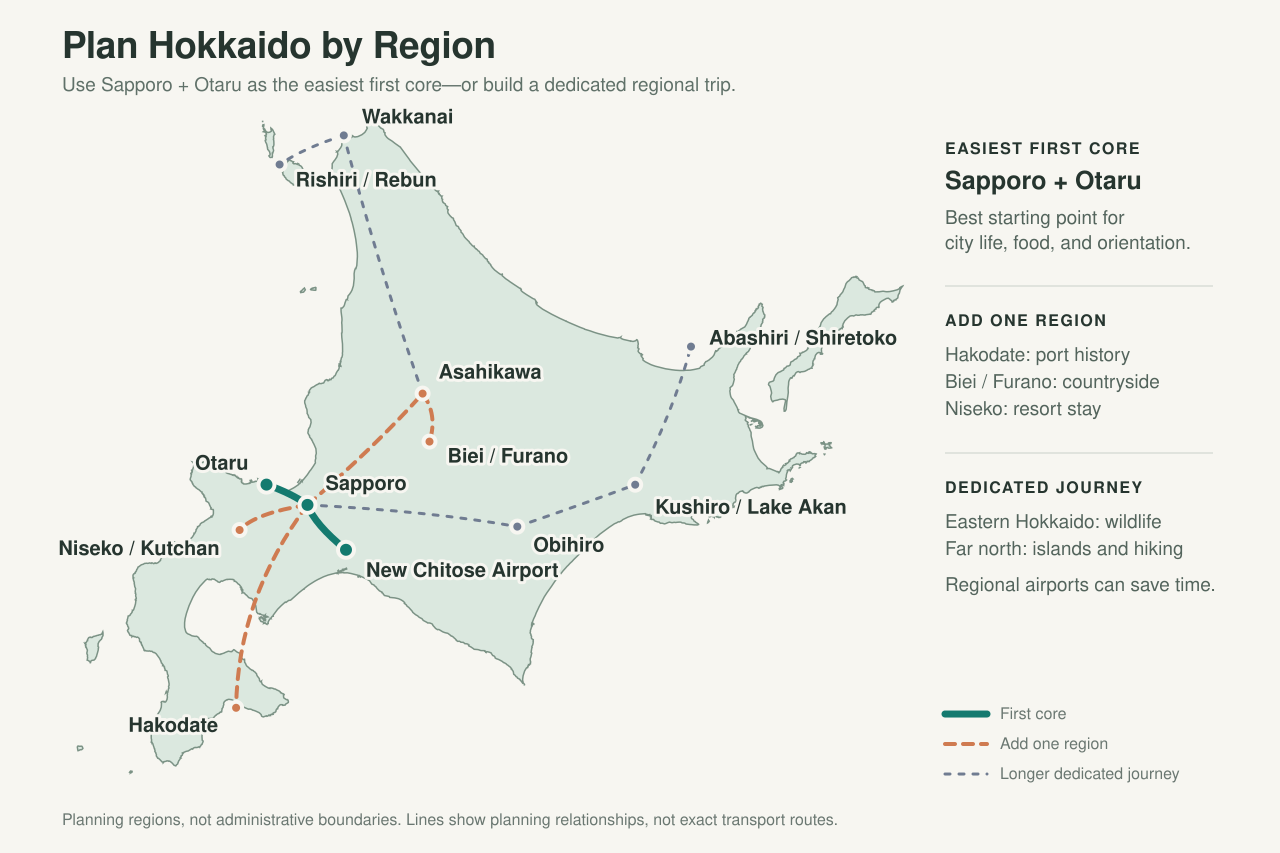
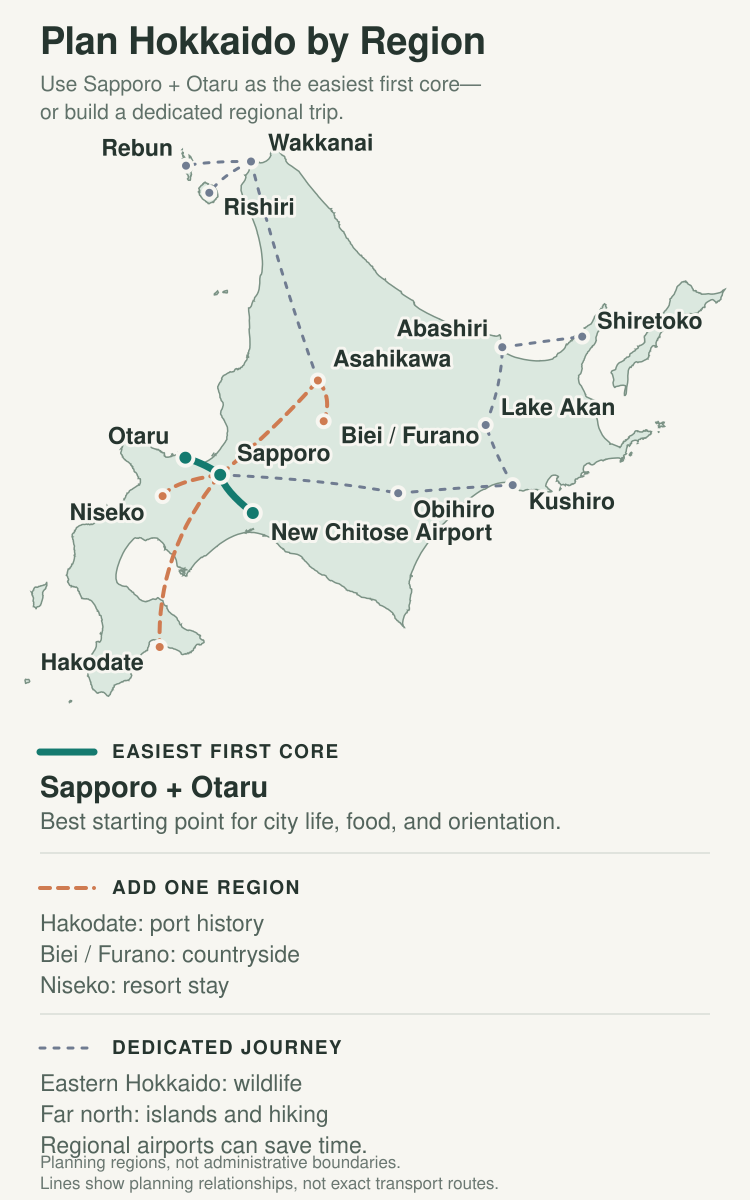
The regions above are planning zones, not a list of places that belong in every itinerary. Sapporo and Otaru are the easiest first core. Central countryside, southern Hokkaido, ski resorts, and eastern or northern routes should be added only when they support the trip you want.
Sapporo: The Most Flexible First Base
札幌 / Sapporo is Hokkaido’s largest city and the most adaptable base for a first visit. It combines restaurants, markets, museums, parks, shopping streets, and evening neighborhoods with direct rail access from New Chitose Airport.
Two full days is a useful starting point. One day can introduce the central city around Sapporo Station, Odori, and Susukino. A second day gives room for a museum, a park, food-focused stops, or a half-day outside the center. Sapporo is also a practical place to recover after a long flight or prepare for a resort or regional transfer.
Do not make Sapporo the automatic base for every Hokkaido destination. Otaru is close enough for a day trip, but Hakodate, Furano, and much of eastern Hokkaido are better understood as separate travel sections or overnight stays.
Otaru: The Easiest Change of Setting From Sapporo
小樽 / Otaru is the simplest addition to a Sapporo-centered trip. Its canal area, historic commercial buildings, slopes, glass shops, music-box shops, and seafood create a clear contrast with the capital.
A day trip is enough for a first introduction. Stay overnight if you want the streets before and after the main visitor hours, plan a slower food-focused visit, or continue toward Yoichi, Kutchan, or Niseko. In winter, check walking conditions and leave more time for snow and ice.
Asahikawa, Biei, and Furano: Choose a Countryside Base
旭川 / Asahikawa, 美瑛 / Biei, and 富良野 / Furano are often grouped together, but they do not function as one compact attraction. Asahikawa is the larger transport and hotel base. Biei and Furano place you closer to rural scenery, fields, farms, and seasonal landscapes.
Public transport can work for selected stations and attractions, especially when seasonal services match your plan. A rental car gives more flexibility for dispersed countryside stops, but it should solve a route you have already designed. Do not rent a car merely because Hokkaido is large, and do not assume summer flower fields or scenic roads look the same in every month.
Hakodate and Southern Hokkaido: A Separate City Stay
函館 / Hakodate has a distinct port-city identity shaped by hillside streets, historic architecture, markets, waterfront areas, and the view from Mount Hakodate. It works best as a two-night stay rather than a rushed return journey from Sapporo.
Hakodate is also the Hokkaido city most naturally connected to northern Honshu by Shinkansen. The Hokkaido Shinkansen currently reaches Shin-Hakodate-Hokuto Station, not central Hakodate and not Sapporo. A connecting Hakodate Liner links Shin-Hakodate-Hokuto with Hakodate Station.
If your route includes both Sapporo and Hakodate, compare train and flight options using the full door-to-door journey. The rail trip is scenic but long enough to shape the day. A flight may be quicker in the air but adds airport transfers and check-in time.
Niseko and Other Ski Resorts: Plan Around the Mountain
ニセコ / Niseko is internationally known, but “Niseko” can refer to a wider resort area rather than one walkable center. Accommodation may sit near a lift, village, bus stop, or station with very different convenience.
Choose the resort and accommodation before deciding daily transportation. Check how you will travel from the airport, how close the property is to the lifts or activities you will use, and whether restaurants and shops are reachable without a car. In winter, a direct resort bus or arranged transfer may be more practical than combining several local connections with luggage.
Niseko is not the only winter-sports option. Rusutsu, Furano, Sapporo-area ski hills, and other resorts suit different experience levels and routes. Compare the mountain, lesson availability, accommodation, and transport as one package.
Eastern Hokkaido: Build a Dedicated Nature Route
道東 / Dōtō / Eastern Hokkaido includes several different travel areas: Kushiro and its wetlands, Lake Akan and the inland lakes, Obihiro and Tokachi, Abashiri and the Okhotsk coast, and Shiretoko. These places offer some of Hokkaido’s strongest wildlife and landscape experiences, but they should not be compressed into a single “east Hokkaido day.”
Regional airports can make an eastern route much more efficient. An open-jaw journey—arriving through one airport and leaving through another—may remove a long return to Sapporo. Public transport works for some corridors, but bus frequency, seasonal operations, and the final connection to a park or accommodation require advance checking.
For Shiretoko, wildlife tours, winter drift ice, or remote lake areas, treat the activity provider’s access instructions and weather policy as part of the booking. The natural setting is the reason to go, so it deserves more time than the minimum route-search result.
Northern Hokkaido: Save It for a Focused Journey
稚内 / Wakkanai and the islands of 利尻 / Rishiri and 礼文 / Rebun reward travelers who actively want far-northern scenery, coastal weather, hiking, and ferry travel. They are not efficient additions to a short first itinerary centered on Sapporo.
Choose this region when it is one of the main purposes of the trip. Build in a weather margin for flights and ferries, and check the seasonal operating period of trails, buses, accommodation, and island services.
Where Should You Stay in Hokkaido?
Choose accommodation by the earliest or most difficult journey you need to make, not by the center point of a map.
| Base | Best for | Main trade-off |
|---|---|---|
| Sapporo Station | Airport rail, long-distance trains, luggage, and early departures | Some dining and nightlife areas are farther south |
| Odori | A central balance of sightseeing, subway access, shopping, and walking | Hotel convenience varies by the exact block and station entrance |
| Susukino | Restaurants, nightlife, and late evenings close to the hotel | Less convenient than Sapporo Station for repeated early intercity trains |
| Otaru | Quieter mornings and evenings, port atmosphere, and onward western travel | Less flexible as a general base for other Hokkaido regions |
| Hakodate | Southern Hokkaido, markets, port history, and the Mount Hakodate evening | Too far from Sapporo for a casual return day trip |
| Regional or resort base | Early access to landscapes, ski lifts, tours, ferries, or rural driving routes | Fewer restaurants, shops, and backup transport options may be available |
In Sapporo, staying near Sapporo Station is the safest default for a transport-heavy trip. Odori is a strong compromise for travelers who want to walk around the center, while Susukino works well when dinner and nightlife matter more than an early train.
Outside the city, inspect the exact access instructions. “Near Niseko,” “in Furano,” or “close to Shiretoko” does not guarantee that a property is close to the station, lift, tour pickup point, or restaurant area you need. In winter, the final walk from a stop to the property can matter as much as the main journey.
How to Get to Hokkaido
Fly to the Airport That Fits the Route
新千歳空港 / Shin-Chitose Kūkō / New Chitose Airport is the normal starting point for Sapporo and the broadest range of domestic connections. JR airport trains connect the terminal with Sapporo, and some services continue toward Otaru.
New Chitose should not be automatic when the trip focuses on another part of the island. Hakodate, Asahikawa, Kushiro, Memanbetsu, Obihiro, Wakkanai, and other regional airports can reduce backtracking. Flight schedules and seasonal routes vary, so compare the complete itinerary before booking.
An open-jaw route is often the most effective Hokkaido planning tool. For example, you might arrive through New Chitose, travel through Sapporo and another region, then fly out of a regional airport rather than returning to the starting point.
Use the Shinkansen for Southern Hokkaido, Not Sapporo
The Hokkaido Shinkansen connects northern Honshu with Shin-Hakodate-Hokuto. From there, the Hakodate Liner continues to Hakodate Station. This makes rail especially logical when Hakodate is the first or last Hokkaido stop.
The Shinkansen does not currently continue to Sapporo. A Tokyo-to-Sapporo journey therefore requires another long conventional-rail section after the Shinkansen. For most travelers going directly from Tokyo to Sapporo, a flight is the practical starting point.
If you choose rail, the guide to buying Shinkansen tickets in Japan explains booking methods, seat choices, and station use.
Getting Around Hokkaido
Hokkaido is not a choice between “train trip” and “road trip.” Many good routes use rail in cities and along a major corridor, then add a bus, taxi, tour, or rental car for the final section.
Use Rail for Major Corridors
Rail is a strong default between New Chitose Airport, Sapporo, and Otaru, and it also connects Sapporo with cities such as Asahikawa, Hakodate, Obihiro, Kushiro, Abashiri, and Wakkanai. The farther routes are long-distance journeys, not extensions of the Sapporo subway system.
All JR Hokkaido limited-express trains currently use reserved seating. Reserve before boarding, particularly on a fixed transfer day or during a busy travel period. Check JR Hokkaido’s current operation information before long or weather-sensitive journeys.
Do Not Assume One IC Card Covers Every Journey
Compatible IC cards such as Suica, PASMO, ICOCA, and Kitaca can be used on the New Chitose Airport–Sapporo–Otaru corridor and other participating services. Coverage is not island-wide. For example, IC cards cannot be used beyond Otaru toward Yoichi, Kutchan, or Niseko on that rail route.
Check whether both the departure and arrival stations are inside the same IC-card area. Buy the appropriate paper or reserved ticket when they are not. The guide to IC cards in Japan explains how the nationwide cards work and where their limits begin.
Use Buses, Taxis, and Tours for the Final Connection
A railway station near a lake, park, resort, or rural town does not guarantee frequent onward transport. Check the final connection before booking the main train. In some areas, a local bus may run only a few times a day or change its schedule by season.
A taxi can solve a short gap, but availability and cost become important over rural distances. A guided tour can be the better tool when a route combines several dispersed stops, winter roads, or wildlife activities that already require a specialist operator.
Rent a Car Only When It Improves a Specific Route
You do not need a car for a typical Sapporo, Otaru, or central Hakodate stay. A rental car becomes valuable for dispersed stops around Biei and Furano, parts of eastern Hokkaido, rural onsen areas, scenic coastlines, or a multi-stop route where public transport creates long waits.
Compare driving time with the total day, including parking, meals, viewpoints, rest breaks, and returning the vehicle. Distances that look manageable on a small map can produce a full day behind the wheel.
Treat Winter Driving as a Separate Decision
Winter changes the calculation. Roads that look merely wet or dark may be frozen, snow can reduce visibility, and braking distances increase significantly. A first-time visitor without current snow-and-ice driving experience should normally start with trains, resort buses, taxis, or tours rather than learning winter driving during the trip.
If you do drive, confirm winter tires, weather, road closures, parking, fuel, daylight, and the rental company’s procedures. Build a route that can be shortened when conditions change.
Choose a Rail Pass After the Route Is Fixed
JR Hokkaido and area passes can be useful when several eligible long-distance journeys fall inside the pass period. They are not automatic purchases for every visitor. A Sapporo-and-Otaru stay may not justify a broad pass, while a carefully timed multi-city rail route might.
List the actual journeys first, confirm which operator runs each segment, and compare the current pass price and rules with individual tickets. Do not add distant stops simply to make a pass appear worthwhile.
Choose the Route by Season
Hokkaido’s seasons do more than change the view. They change road conditions, daylight, clothing, transport reliability, which activities operate, and where accommodation demand concentrates.
| Season | Travel character | Plan around |
|---|---|---|
| Spring | Late snow in some areas, thawing landscapes, blossoms later than much of Japan, and a gradual start to outdoor routes | Seasonal road and trail openings, mixed conditions, and regional blossom timing |
| Summer | Longer outdoor days, farms, flower areas, hiking, cycling, and broad rural routes | Popular accommodation, rental-car demand, heat where it occurs, and flower timing that varies by location |
| Autumn | Harvest food, cooler walking weather, and foliage that can begin early in mountains and northern areas | Fast regional changes, colder mornings, shorter days, and weather-sensitive scenic routes |
| Winter | Snow cities, skiing, ice and drift-ice experiences, hot springs, and a trip shaped by full winter conditions | Footwear, transfer margins, short daylight, cancellations, icy walking, and resort access |
Choose a specific place and experience, not only a season name. “Summer in Hokkaido” does not guarantee peak flowers in every field. “Winter in Hokkaido” may mean city snow in Sapporo, deep resort conditions, drift ice on the Okhotsk coast, or a quieter southern port trip. Each requires a different route.
If your dates are flexible, Best Time to Visit Japan: Weather, Seasons, and Crowds compares the wider seasonal trade-offs. For a snow-focused journey, Winter in Japan: December to February, Weather, Snow & Where to Go explains how winter differs across the country.
Build the Trip Around Hokkaido Food and Culture
Hokkaido is widely associated with seafood and dairy, but each region has its own food logic. Sapporo is known for miso ramen, soup curry, jingisukan, and a broad restaurant scene. Otaru and Hakodate make seafood easy to encounter. Tokachi is closely connected with agriculture and dairy, while Furano and Biei place farms and seasonal produce inside the landscape of the trip.
Do not turn every meal into a famous-restaurant appointment. Choose a few regional dishes, then leave space for a market breakfast, a bakery, a local café, an izakaya, or the restaurant attached to an onsen or rural accommodation. Outside major cities, check closing days and dinner arrangements before arrival.
Hokkaido is also the homeland of the Indigenous Ainu people. Museums and cultural institutions can provide an important introduction, but approach Ainu culture as a living culture rather than a decorative theme. Choose places that explain history, language, craft, food, and contemporary life with appropriate context.
An onsen stay can add another useful rhythm to the route. Read the guide to onsen etiquette in Japan before visiting, especially if you are unsure about bathing procedures, towels, tattoos, or shared facilities.
Fit Hokkaido Into a Wider Japan Itinerary
Hokkaido usually works best as a distinct flight or rail section of a wider Japan trip, not as a quick side trip from Tokyo, Kyoto, or Osaka. Give it enough nights to justify the travel and to experience more than an airport, hotel, and one famous street.
From Tokyo, flying to New Chitose is the standard starting point for Sapporo. Use the Shinkansen when Hakodate fits naturally after Tohoku or when the rail journey itself is part of the route. From Kyoto or Osaka, compare direct domestic flights with a longer sequence through Tokyo or northern Honshu.
Avoid unnecessary backtracking. A route such as Tokyo → Hakodate → Sapporo → flight onward can be more coherent than flying to Sapporo, traveling south to Hakodate, then returning to New Chitose. An eastern Hokkaido trip may work better with Kushiro or Memanbetsu at one end.
For a wider comparison of trains, domestic flights, buses, taxis, ferries, and rental cars, see Getting Around Japan: Which Transportation Should You Use?
Common Hokkaido Planning Mistakes
- Treating Sapporo, Hakodate, Furano, and Shiretoko as nearby stops on one city itinerary.
- Choosing New Chitose Airport automatically for a route focused on eastern, northern, or southern Hokkaido.
- Assuming the Hokkaido Shinkansen currently reaches Sapporo.
- Using Sapporo as a return base for every distant region.
- Renting a car without first checking whether rail and one local transfer already solve the route.
- Planning winter self-driving without current snow-and-ice driving experience.
- Assuming an IC card works across every rural railway and bus route.
- Buying a rail pass before listing the journeys it must cover.
- Choosing a hotel by town name without checking the station, lift, ferry, tour pickup, or final walking route.
- Planning seasonal scenery from a generic Hokkaido calendar instead of the exact location and year.
A Simple First-Hokkaido Planning Method
Start with the one experience you would regret missing. Choose the nearest sensible airport and overnight base. Add Sapporo and Otaru if they improve the route, not because every Hokkaido trip must begin there. Then check the longest transfer, the final local connection, and what the season changes.
For most first-time visitors, five to seven nights with two bases is enough to create contrast without turning Hokkaido into a transport project. The goal is not to prove that the island can be crossed. It is to give a city, landscape, winter experience, or regional culture enough time to become part of the trip.
Frequently Asked Questions
- How many days do I need in Hokkaido?
-
Five to seven nights is a useful starting point for most first-time visitors. It allows time for Sapporo and Otaru plus one additional region. With three or four nights, choose one compact route rather than trying to cross the island.
- Where should I go on my first trip to Hokkaido?
-
Sapporo and Otaru are the easiest general introduction. Add one region that matches your main interest: Hakodate for port history, Biei and Furano for countryside, a chosen resort for skiing, or eastern Hokkaido for wildlife and national parks.
- Do I need a rental car in Hokkaido?
-
No car is needed for a typical Sapporo, Otaru, or central Hakodate stay. A car becomes useful for dispersed rural stops, parts of Biei and Furano, eastern Hokkaido, and routes where infrequent local transport would consume too much time.
- Can I visit Hokkaido without driving?
-
Yes. A first trip can combine airport trains, limited-express rail, local buses, taxis, and tours. Choose bases along useful transport corridors and check the final connection to rural attractions before booking.
- Does the Shinkansen go to Sapporo?
-
No. The Hokkaido Shinkansen currently reaches Shin-Hakodate-Hokuto. A connecting train serves Hakodate, while travel to Sapporo requires a further conventional-rail journey or another transportation choice.
- Can I use Suica, PASMO, or ICOCA throughout Hokkaido?
-
No. Compatible IC cards work in participating areas, including the main New Chitose Airport–Sapporo–Otaru corridor, but coverage is not island-wide. Check both stations or services before relying on an IC card.
- Is winter a good time for a first Hokkaido trip?
-
Yes, when snow, winter food, skiing, hot springs, or northern scenery is one of the main reasons for visiting. Allow extra transfer time, choose accommodation carefully, prepare for icy walking, and avoid self-driving unless you have appropriate winter-road experience.
- Is a JR Hokkaido rail pass worth it?
-
It depends on the exact route and pass period. List your eligible journeys, compare current individual fares, and confirm operator coverage before buying. Do not add distant travel only to make a pass pay off.