Is January a Good Time to Visit Japan?
Yes. January can be an excellent month to visit Japan, especially if you like crisp winter weather, hot springs, seasonal food, snow scenery, or skiing.
For most first-time visitors, there is no need to abandon the classic Tokyo–Kyoto–Osaka route simply because it is January. These cities remain practical for sightseeing, but you should expect cold mornings and evenings, shorter daylight hours, and a greater need to combine outdoor time with warm indoor stops.
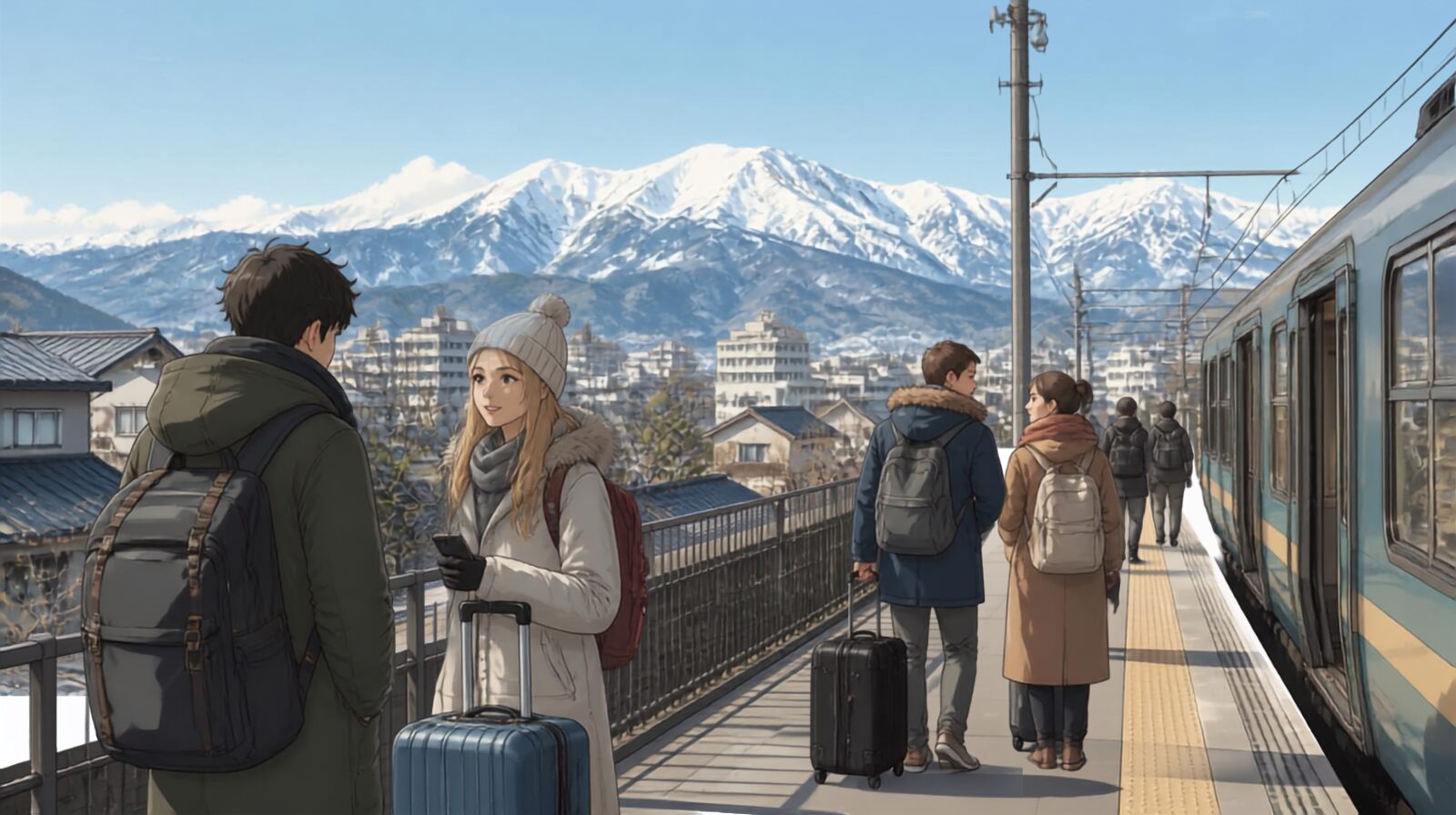
If snow is one of the main reasons for your trip, January becomes more distinctive. Snow conditions are generally much more established than in early winter across major ski and snow regions, so a colder destination can become a deliberate part of the itinerary rather than a gamble.
If you are still deciding between December, January, and February, start with our Winter in Japan guide before choosing the month.
Early, Mid, or Late January: What Changes During the Month?
January is not a uniform travel month. The biggest dividing line is the New Year period at the beginning of the month.
| Part of January | What It Feels Like | Best For | Main Planning Point |
|---|---|---|---|
| Early January | New Year traditions, holiday schedules, winter travel demand | Cultural atmosphere, hatsumōde, city stays, snow trips with advance planning | Check transport, opening hours, meals, and accommodation carefully |
| Mid-January | Deep winter with more normal day-to-day operations | Classic first trips, onsen stays, skiing, snow-country travel | The second Monday is Coming of Age Day, but the month is otherwise less dominated by nationwide holidays |
| Late January | Established winter conditions continue | Snow-focused travel, skiing, city sightseeing, regional winter stays | Popular ski and snow destinations can still have strong weekend demand |
Early January: New Year Changes the Trip
元日 / Ganjitsu / New Year’s Day on January 1 is a national holiday, and the wider year-end and New Year period can affect transportation, opening hours, meals, and accommodation.
Early January also has a distinctive cultural atmosphere. 初詣 / Hatsumōde / the first shrine or temple visit of the year is an important New Year tradition, and major shrines and temples can be especially lively. The practical details of traveling during this period are covered later in this guide.
Mid-January: Deep Winter Without the Same New Year Rhythm
By the middle of the month, most travelers can plan around a more normal winter routine. Snow regions are well into the season, while Tokyo, Kyoto, and Osaka work well for regular sightseeing with winter clothing and shorter outdoor days.
成人の日 / Seijin no Hi / Coming of Age Day falls on the second Monday of January. Travelers may notice young adults in formal clothing and local ceremonies, but it should not be treated as a nationwide shutdown comparable with the New Year period.
Late January: Winter Is Still Fully Established
Late January remains deep winter in Hokkaido, northern Honshu, and many mountain and snow-country destinations. It is a strong period for travelers who want skiing, snow scenery, or an overnight winter stay.
In the major Pacific-side cities, the trip may feel much more like a normal city visit than a snow holiday. This contrast is one of the most important things to understand about January in Japan.
Japan Weather in January: How Cold Is It?
January is one of the coldest months of the year across much of Japan, but the temperature difference between regions is large.
The table below uses Japan Meteorological Agency climate normals for 1991–2020. These are long-term averages, not a forecast for a particular trip.
| Destination | Average High | Mean Temperature | Average Low | What It Means for Travelers |
|---|---|---|---|---|
| 札幌 / Sapporo / Sapporo | −0.4°C | −3.2°C | −6.4°C | Full winter conditions; snow and icy walking surfaces are part of daily travel |
| 東京 / Tōkyō / Tokyo | 9.8°C | 5.4°C | 1.2°C | Cold city sightseeing; snow is possible but not dependable |
| 京都 / Kyōto / Kyoto | 9.1°C | 4.8°C | 1.5°C | Cold mornings and evenings; temples and outdoor districts can feel especially chilly |
| 大阪 / Ōsaka / Osaka | 9.7°C | 6.2°C | 3.0°C | Cold but practical for urban sightseeing with a warm coat and layers |
| 福岡 / Fukuoka / Fukuoka | 10.2°C | 6.9°C | 3.9°C | Milder than northern Japan, but still a winter city climate |
| 那覇 / Naha / Naha | 19.8°C | 17.3°C | 14.9°C | Much warmer than mainland Japan and a different type of January trip |
Source: Japan Meteorological Agency climate normals (1991–2020). Kyoto values are from the JMA Kyoto observatory normals. Actual conditions vary by year and day.
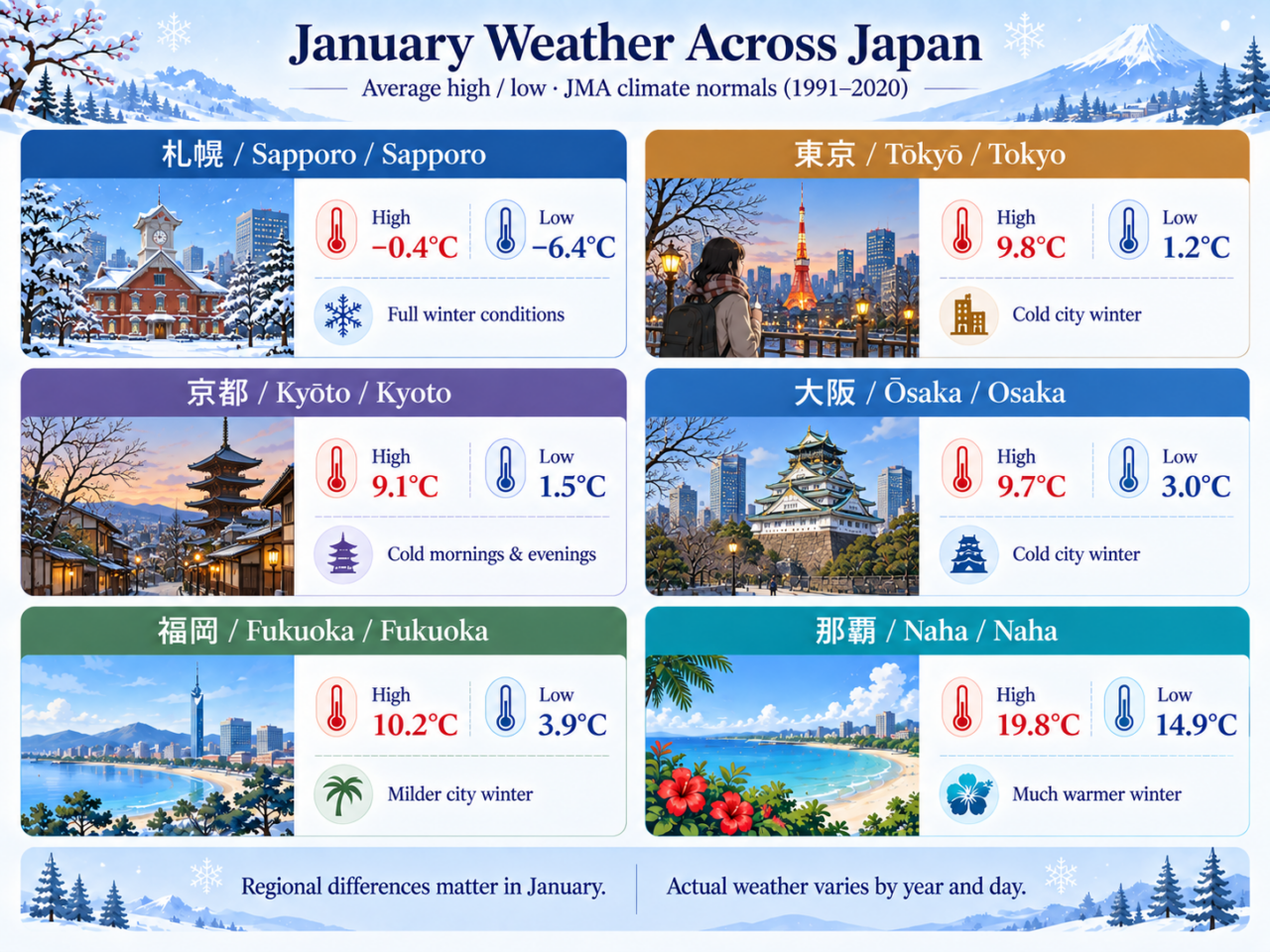
For a multi-region trip, pack for the coldest destination rather than the city where you land. A Tokyo–Kyoto–Osaka itinerary and a Tokyo–Hokkaido itinerary may happen in the same month but require very different footwear and outerwear.
Does It Snow in Japan in January?
Yes, but not everywhere.
January is one of the strongest months for established snow in Hokkaido, northern Japan, the Sea of Japan side, and mountain regions. Japan’s major ski season is also well underway, with January and February generally offering the most consistent snowfall at many resorts.
Tokyo, Kyoto, and Osaka are different. Snow can fall, but you should not plan a January trip to these cities expecting a permanent white landscape.
If seeing snow matters, choose a destination where winter conditions are part of the regional climate rather than hoping for a lucky snowfall in a major city.
If snow is optional, a short stay in a Honshu snow region can add a genuine winter experience without replacing the main Tokyo–Kyoto–Osaka route. If snow or skiing is a main purpose, give a major winter region more time.
January is one of the peak months for skiing in Japan. If a specific resort is important, confirm its current snow report, lift operations, access, and accommodation before making non-refundable plans. The next section explains how to choose between the classic cities, Hokkaido, and Honshu snow country.
Where to Go in Japan in January
The best January destination depends less on a universal ranking and more on how much winter you want.
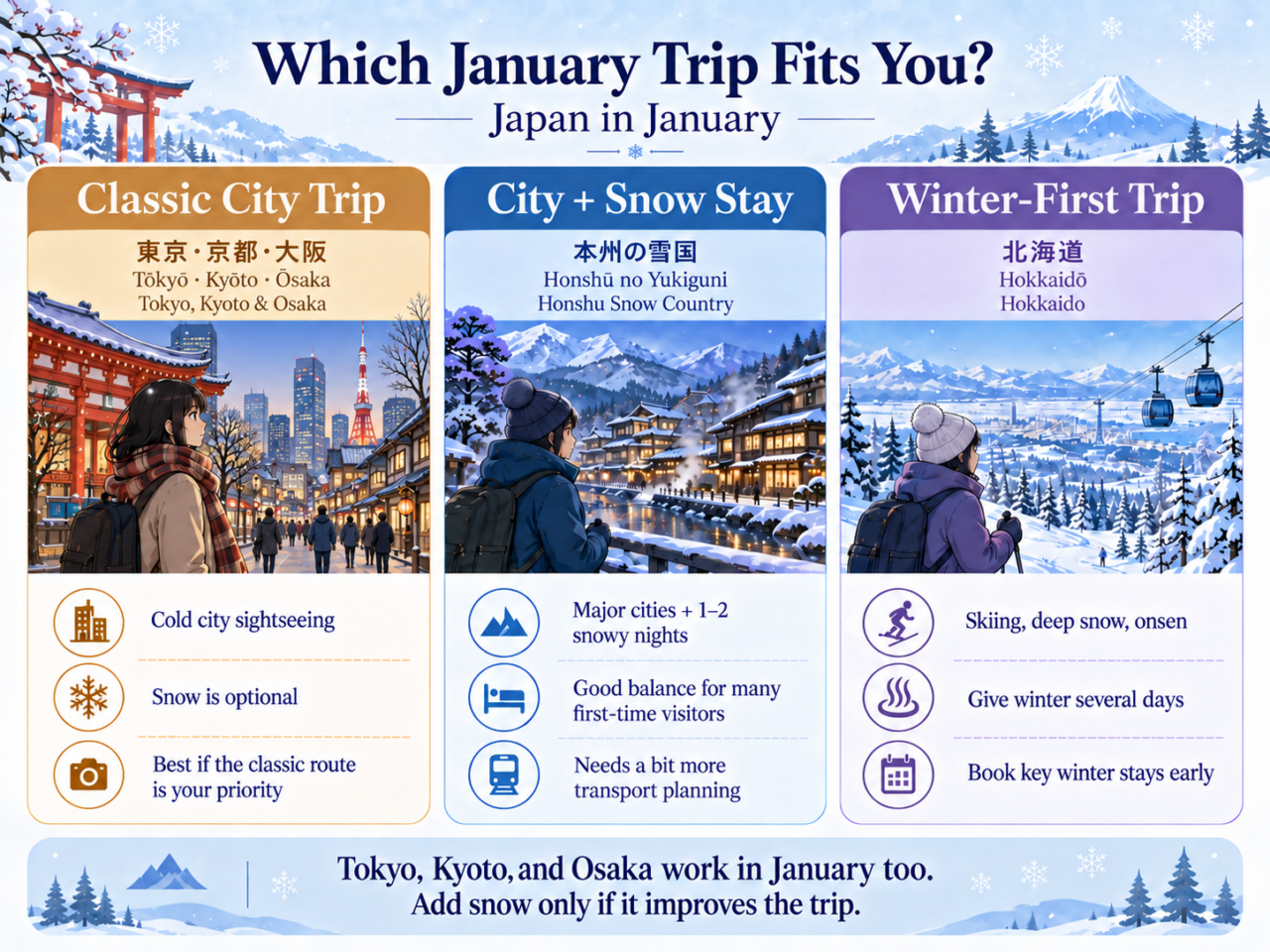
Tokyo, Kyoto, and Osaka: Keep the Classic Route if It Is Your First Priority
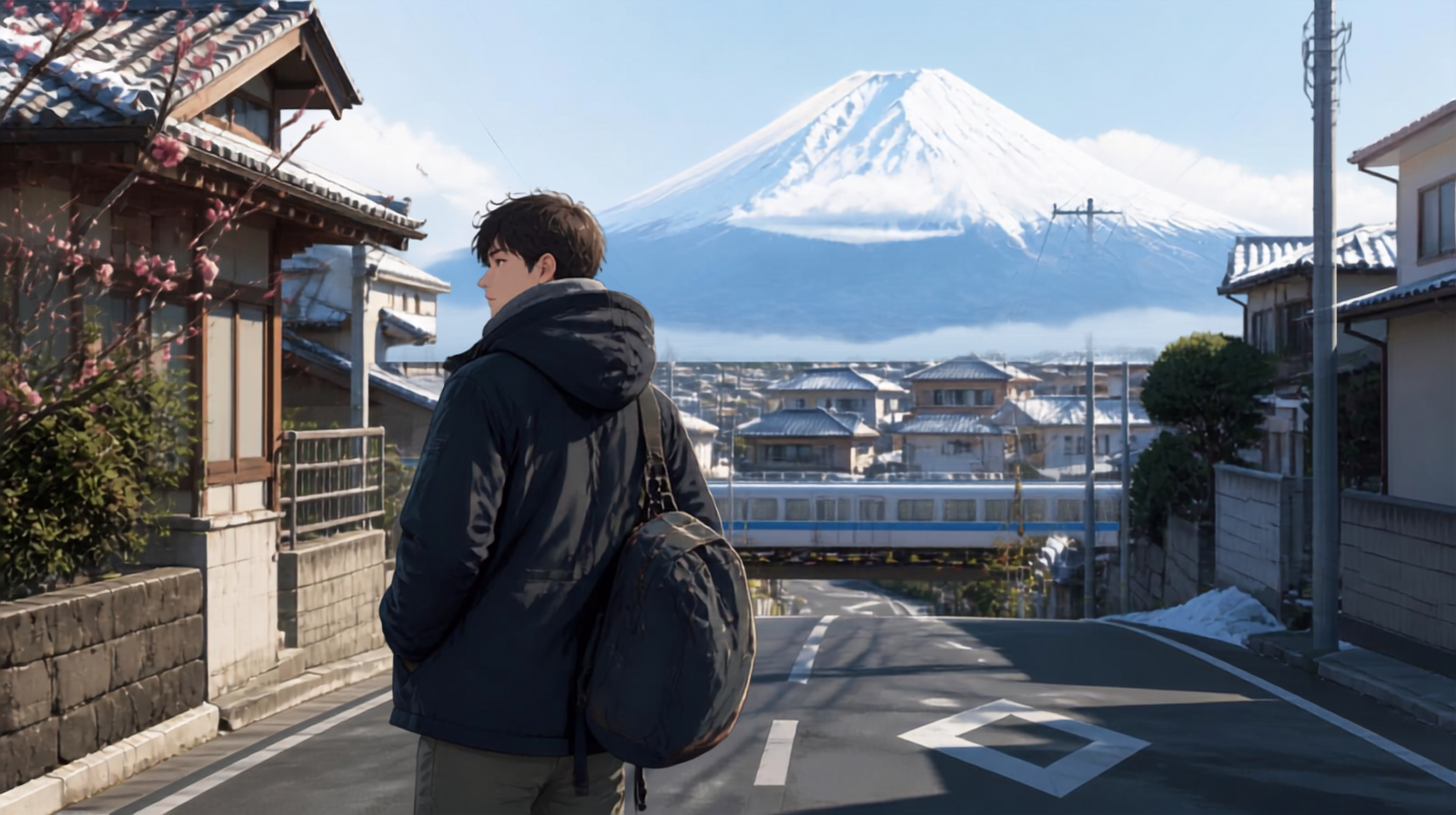
For many first-time visitors, Tokyo, Kyoto, and Osaka should remain the core itinerary in January.
Use daylight for gardens, temple districts, parks, and longer outdoor walks. After dark, move naturally into restaurants, museums, shopping, cafés, illuminations, or the neighborhood around your accommodation.
Do not add a distant snow destination simply because January sounds like a “winter trip.” Add one only if snow, skiing, or an overnight winter stay is worth changing the route for.
Hokkaido: Choose It When Winter Is a Major Purpose
Hokkaido is one of the clearest choices for a January trip built around winter itself. Snow affects walking, luggage, transportation, footwear, and the value of staying close to the places you actually plan to use.
札幌 / Sapporo / Sapporo can work as an urban base, while ski areas and smaller winter destinations require more careful transport planning. Avoid treating all of Hokkaido as one easy day-trip zone; distances are large and winter movement takes time.
Honshu Snow Country: The Easier Add-On for Many First Trips
For travelers already visiting Tokyo, Kyoto, or Osaka, a snow-country stay on Honshu can offer a more efficient winter contrast.
The important decision is not simply “Nagano or Niigata.” Choose a specific town, ski area, onsen stay, or mountain destination, then check the final transport connection and walking conditions around the accommodation.
Kyushu and Okinawa: Milder Alternatives to a Snow-Focused Route
九州 / Kyūshū / Kyushu is generally milder than northern Japan, although mountain and inland areas can still become cold and may experience winter weather.
沖縄 / Okinawa / Okinawa is much warmer than mainland Japan and works best for travelers who actively want a different winter climate. It should not be treated as merely a warmer version of the Tokyo–Kyoto–Osaka route.
What to Wear in Japan in January
The most useful packing rule is simple: dress for the coldest part of your itinerary and use removable layers for heated trains, shops, restaurants, and hotels.
| Route | Clothing Approach | Footwear |
|---|---|---|
| Tokyo / Kyoto / Osaka | Warm coat, knit or fleece layer, long pants, scarf or gloves for colder mornings and evenings | Comfortable closed walking shoes |
| Hokkaido / snow country | Insulated outerwear, warm base layers, gloves, hat, and protection from wind and wet snow | Water-resistant footwear with useful grip for snow or ice |
| Kyushu city route | Normal winter layers with extra warmth for mornings, evenings, and inland areas | Comfortable closed shoes |
| Okinawa | Lighter layers than mainland winter, with a jacket for wind and cooler periods | Normal walking shoes |
Snow-country footwear deserves special attention. A warm coat cannot compensate for shoes that become wet or have poor grip on packed snow and ice.
Also remember that indoor spaces can be warm. Layers are usually more practical than wearing one extremely heavy outfit all day.
New Year Travel: What First-Time Visitors Should Know
New Year is the main January planning exception.
January 1 is a national holiday, and the surrounding period is one of Japan’s major family and travel periods. Some businesses close or shorten their hours, while shrines and temples may be extremely active because of hatsumōde.
Transportation and accommodation can also be in high demand around New Year. If your trip begins in the first days of January, do not assume that a normal weekday schedule applies to every train, restaurant, museum, or attraction.
Plan the essentials first: your intercity transport, accommodation, arrival-day meal options, and any attraction that would seriously affect the trip if it were closed.
After that, leave room to experience the season rather than treating holiday schedules only as an inconvenience. A neighborhood shrine visit, New Year food, or a quieter evening near your accommodation can become part of the trip itself.
January Accommodation Matters More in Snow Regions
In a city, staying near a useful station and a neighborhood with restaurants can reduce unnecessary cold-weather travel after dark. In a snow destination, the final route to the property matters more: check the station or bus stop connection, uphill walking, shuttle availability, and how you will move luggage in snow.
Popular ski areas and well-known winter stays can have strong demand in January. If one particular snow destination is central to the trip, secure that accommodation before assuming you can remain flexible.
An Onsen Stay Can Be Part of the January Experience
温泉 / Onsen / hot springs work especially well as an overnight experience in January. Arriving before dark, bathing before dinner, and spending the evening at the property or in the surrounding town can make the stay itself part of the winter journey.
If shared bathing is unfamiliar, our Onsen & Sento Etiquette in Japan guide explains the basic bathing sequence and rules.
Snow Can Change Transportation Plans
Transport systems in snow-country regions are accustomed to winter conditions, but heavy snow can still cause delays or suspensions.
Build extra time around important connections, especially when leaving a mountain or snow region for an international flight. Avoid planning a final winter transfer with no margin for disruption.
Pacific-side cities can also be affected when unusual snow or ice reaches areas that do not experience it as frequently.
If weather begins to affect your route, Natural Disasters in Japan: What Every Traveler Should Know explains how to check disruptions and respond when plans change.
Plan a January Trip in This Order
A January trip becomes much easier when you make the decisions in the right order.
- Check whether your dates overlap with New Year. If they do, verify the transport, opening hours, meals, and accommodation that are essential to the trip.
- Decide whether January snow is optional or essential. Keep the classic city route if snow is a bonus. Give a genuine winter region more time if snow or skiing is one of the reasons you chose January.
- Secure the winter-critical stay. Popular ski areas, onsen towns, and snow destinations can have strong January demand and limited final transport connections.
- Pack for the coldest destination and leave transport margin. January rewards good preparation more than an overly complicated itinerary.
For most first-time visitors, the best January plan is not to chase winter everywhere. Keep the places you most want to see, then let January change the parts of the journey where cold, snow, food, hot springs, or where you stay genuinely improve the experience.
Frequently Asked Questions
- Is January a good month to visit Japan?
-
Yes. January is a strong month for winter travel, skiing, snow scenery, hot springs, seasonal food, and cold-weather city sightseeing. The main extra planning issue is the New Year period at the beginning of the month.
- How cold is Japan in January?
-
Conditions vary greatly by region. Long-term January mean temperatures are about −3.2°C in Sapporo, 5.4°C in Tokyo, 4.8°C in Kyoto, 6.2°C in Osaka, 6.9°C in Fukuoka, and 17.3°C in Naha. Check the forecast for every major destination before departure.
- Does it snow in Tokyo, Kyoto, or Osaka in January?
-
Snow is possible, but these cities are not reliable snow destinations. If seeing substantial snow is important, choose Hokkaido, northern Japan, a mountain region, or a destination on the Sea of Japan side.
- Is January good for skiing in Japan?
-
Yes. January is one of Japan’s peak ski months, with established winter conditions in many major resorts. Exact snowfall, lift operations, and access vary by destination and year, so check the current resort information before booking around one specific ski area.
- Are things closed in Japan in early January?
-
Some restaurants, shops, museums, attractions, and other businesses may close or operate reduced hours around New Year, while shrines and temples can be very active. There is no single schedule for every business, so check anything essential individually.
- What should I wear in Japan in January?
-
For Tokyo, Kyoto, and Osaka, bring a warm coat and removable layers for heated indoor spaces. Snow regions require stronger insulation and water-resistant footwear with good grip, while Okinawa needs much lighter winter clothing.
- Should I visit Hokkaido in January on a first trip?
-
Choose Hokkaido if snow, skiing, or a full winter experience is one of your main priorities. If Tokyo, Kyoto, and Osaka matter more, a shorter Honshu snow-country stay may be easier to add without redesigning the whole trip.