Is December a Good Time to Visit Japan?
For many first-time visitors, yes.
December is cooler and generally easier for long days of city walking than Japan’s hot and humid summer months. Winter food becomes part of everyday travel, evenings work naturally with illuminations and restaurants, and colder weather makes an overnight stay with 温泉 / Onsen / hot springs especially appealing.
For most first trips, Tokyo, Kyoto, and Osaka remain the best starting point.
Change that plan only when December itself is one of your main reasons for visiting—for example, if you want deep snow, skiing, or a much milder winter farther south.
Late December needs slightly more preparation because transportation demand and opening schedules begin to change around New Year.
If your dates are still flexible across winter, see our Winter in Japan guide to compare December, January, and February, including snow reliability, regional differences, and which part of the season best fits your trip.
What Kind of December Trip Do You Want?
Rather than starting with a long list of winter destinations, choose the type of trip first.
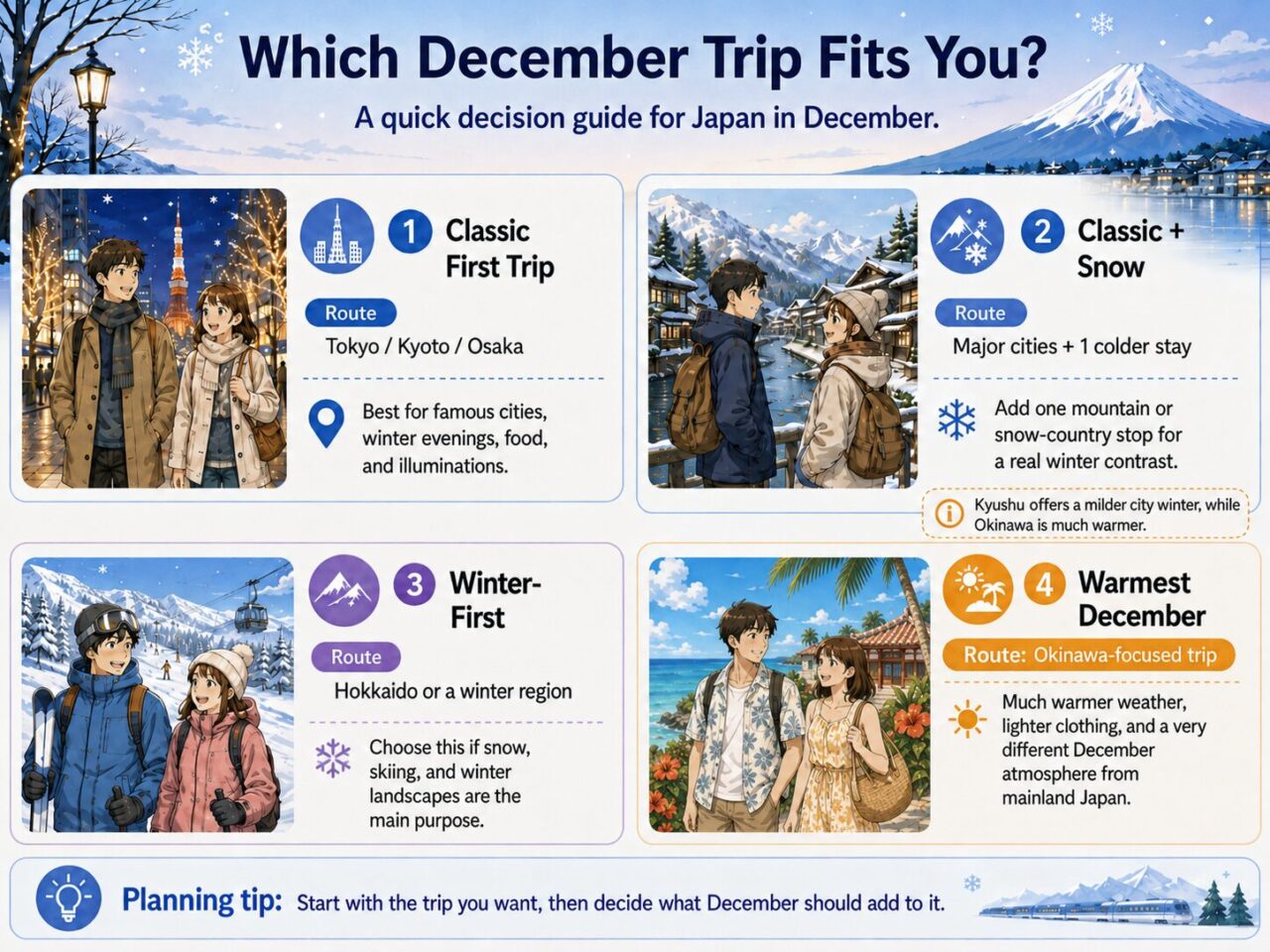
A Classic First Trip: Tokyo, Kyoto, and Osaka
If 東京 / Tōkyō / Tokyo, 京都 / Kyōto / Kyoto, and 大阪 / Ōsaka / Osaka are the places you want to see, keep them.
December gives each city a different rhythm without forcing you to redesign the journey.
Tokyo works well for daytime sightseeing followed by illuminated streets, shopping districts, restaurants, and indoor attractions after dark.
Kyoto’s temples, gardens, and older neighborhoods can feel very different on a cold morning or quiet winter evening. Osaka remains strong for food, nightlife, shopping, and regional day trips.
For this kind of trip, add one winter-specific experience rather than changing the entire route. A good addition might be one onsen overnight, one colder mountain stay, or an evening deliberately left open for winter streets and seasonal food.
A First Trip Plus Snow
If you want the classic cities and a real winter landscape, adding one colder stop is often more practical than turning the whole trip into a snow itinerary.
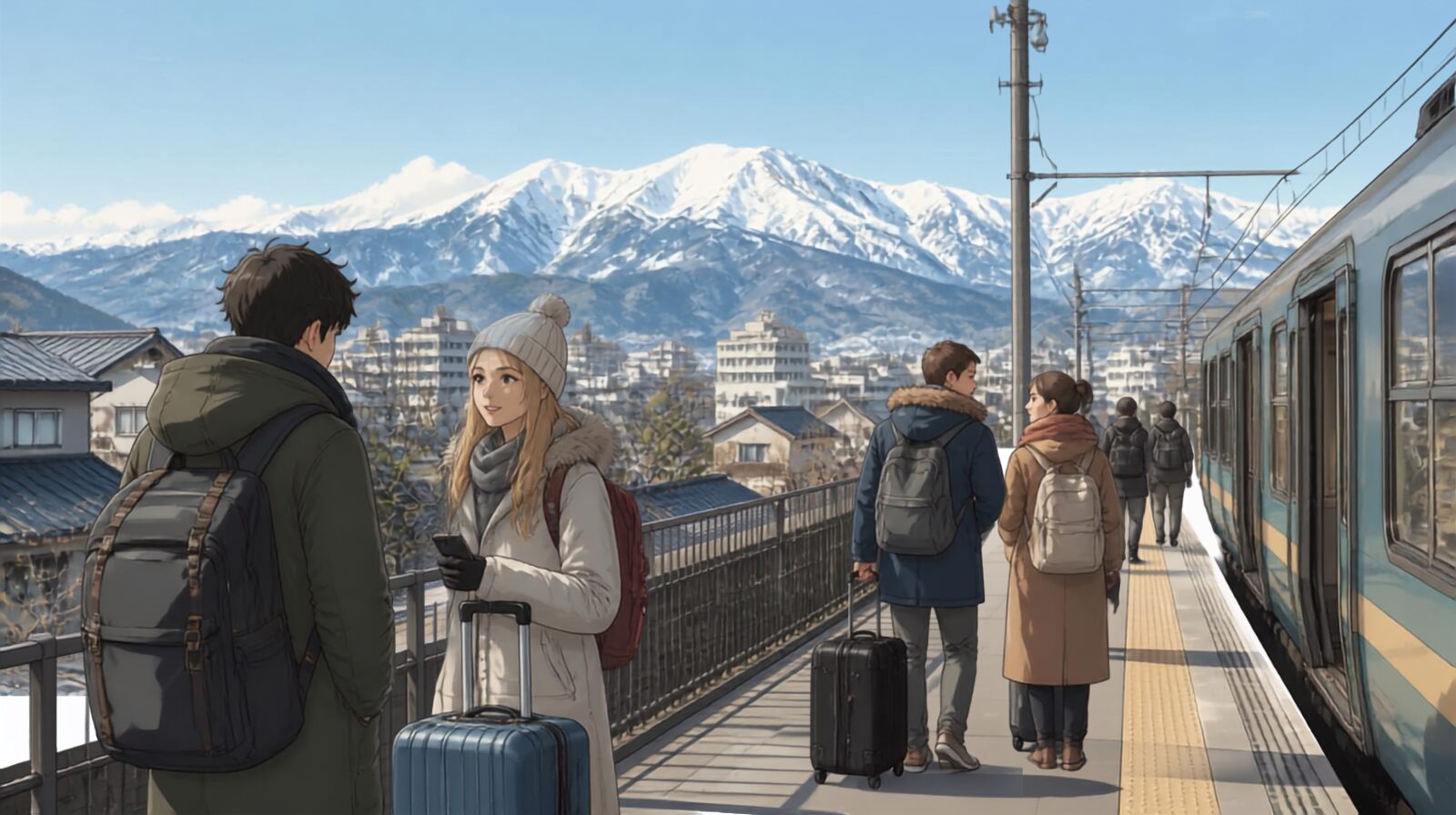
For a Tokyo-based journey, mountain areas of 長野県 / Nagano-ken / Nagano Prefecture can provide a natural contrast with the capital. 新潟県 / Niigata-ken / Niigata Prefecture and parts of 東北 / Tōhoku / Tohoku are other possibilities when the route allows more time.
The important distinction is between a snow-region name and a specific winter destination. Conditions vary with elevation and location, so simply entering Nagano or Niigata Prefecture does not guarantee the same experience as staying in a ski or mountain area.
For many first-time visitors, one or two nights in a genuinely colder destination can provide enough contrast without making the trip complicated.
If Winter Is the Main Purpose: Hokkaido
北海道 / Hokkaidō / Hokkaido deserves a larger share of the itinerary when snow itself is one of the main reasons for visiting Japan.
A Hokkaido trip is not simply the classic route with colder weather. Snow affects footwear, walking speed, transport margins, outdoor activities, and how much time you spend indoors. Winter food, snow-covered streets, ski areas, and hot springs can become central parts of the journey rather than occasional additions.
If that is the experience you want, it may make more sense to spend several days in Hokkaido than to squeeze one northern stop into a long Tokyo–Kyoto–Osaka itinerary.
If You Prefer a Milder Winter: Kyushu or Okinawa
Not every December traveler wants more snow.
福岡 / Fukuoka / Fukuoka and lower-elevation parts of 九州 / Kyūshū / Kyushu remain winter destinations, but they are generally milder than northern Japan. That can suit travelers who want to spend more time walking through cities, visiting smaller towns, eating locally, or staying in an onsen area.
沖縄 / Okinawa / Okinawa is different again. December there is much warmer than Tokyo, Osaka, or Hokkaido, so choosing Okinawa changes the character of the trip rather than simply making a mainland itinerary slightly warmer.
Early, Mid, or Late December: What Changes?
The part of December you choose affects both winter conditions and travel logistics.
| Timing | What to Expect | Best For |
|---|---|---|
| Early December | Major cities are entering winter; snow conditions are still developing in some mountain areas | City travel, illuminations, early-winter atmosphere |
| Mid-December | Winter is more established in colder regions | Combining cities, onsen, and a colder side trip |
| Late December | Stronger winter conditions in many snow areas, but New Year travel begins | Snow-focused travel and year-end experiences, with more advance planning |
There is no single best period.
Early or mid-December is the easier default if you want a straightforward first trip. Late December becomes more attractive when stronger winter conditions matter to you, but transport reservations and opening schedules require more attention.
What Is the Weather Like in Japan in December?
Japan has a very large winter climate range.
The figures below are 1991–2020 climate normals from the Japan Meteorological Agency. Kyoto uses the JMA’s Kyoto station climate normals (Japanese). They are long-term averages, not forecasts for a particular trip.
| City | Average | Average Daily High | Average Daily Low |
|---|---|---|---|
| Sapporo | −0.9°C | 2.0°C | −4.0°C |
| Tokyo | 7.7°C | 12.0°C | 3.8°C |
| Kyoto | 7.2°C | 11.6°C | 3.5°C |
| Osaka | 8.7°C | 12.3°C | 5.3°C |
| Fukuoka | 9.1°C | 12.6°C | 5.8°C |
| Naha | 19.0°C | 21.5°C | 16.8°C |
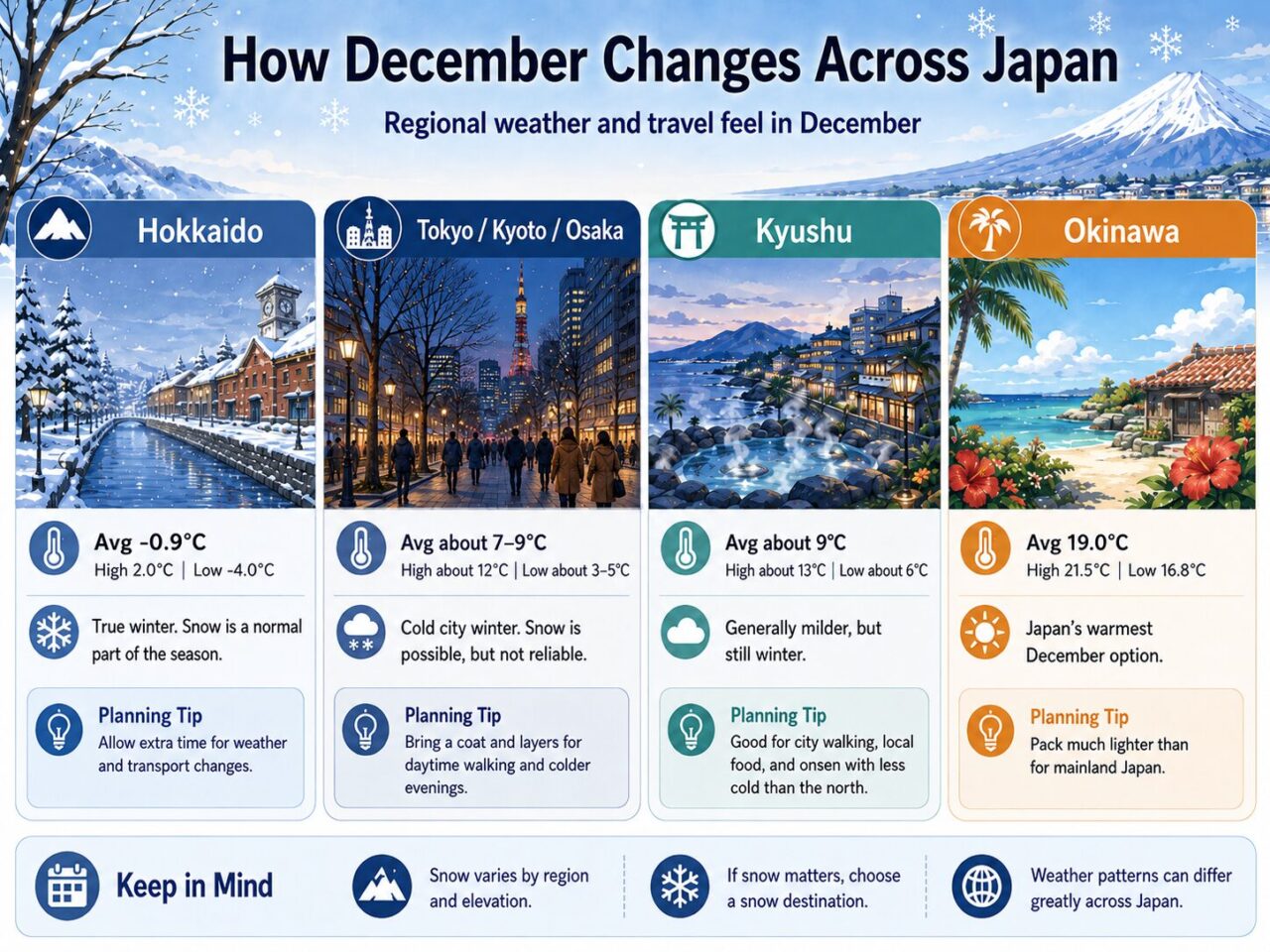
Temperature alone does not explain everything. Sea of Japan-side regions and mountain areas can receive much more winter precipitation and snow than major Pacific-side cities. That is why the place you choose matters more than the word “December” itself.
Where Can You Expect Snow in December?
Snow is already part of December life in some parts of Japan, but it is not a nationwide condition.
If seeing snow is important, focus on places where winter weather is a normal part of the season.
- Hokkaido
- Parts of Tohoku
- Mountain areas of Nagano
- Snow-country areas of Niigata
- Other higher-elevation destinations in central and northern Japan
Tokyo, Kyoto, and Osaka may occasionally see snow, but they should not be chosen as snow destinations.
This distinction removes an unnecessary planning gamble: if snow matters, put snow into the route.
Heavy snow can also affect trains, buses, flights, and roads. If your route includes a snow region, Natural Disasters in Japan: What Every Traveler Should Know explains how weather disruptions can affect a trip and what to check when conditions change.
What About Skiing in December?
December can be part of Japan’s ski season, but the beginning of the month is still early season at many resorts.
A scheduled opening date means that a resort intends to operate if conditions allow. It does not guarantee deep midwinter snow.
If skiing is only one optional activity in a wider Japan trip, early December can still work. If skiing is the main reason for traveling, later December—or the deeper winter months—provides more margin.
Niseko United currently lists November 28, 2026 as the planned opening date for its four main ski areas. It classifies November 28–December 11 as early season, December 12–23 as regular season, and December 24 onward as peak season. Opening dates and operating hours are subject to change.
What Should You Wear in Japan in December?
Pack for the coldest part of your route rather than the city where you arrive.
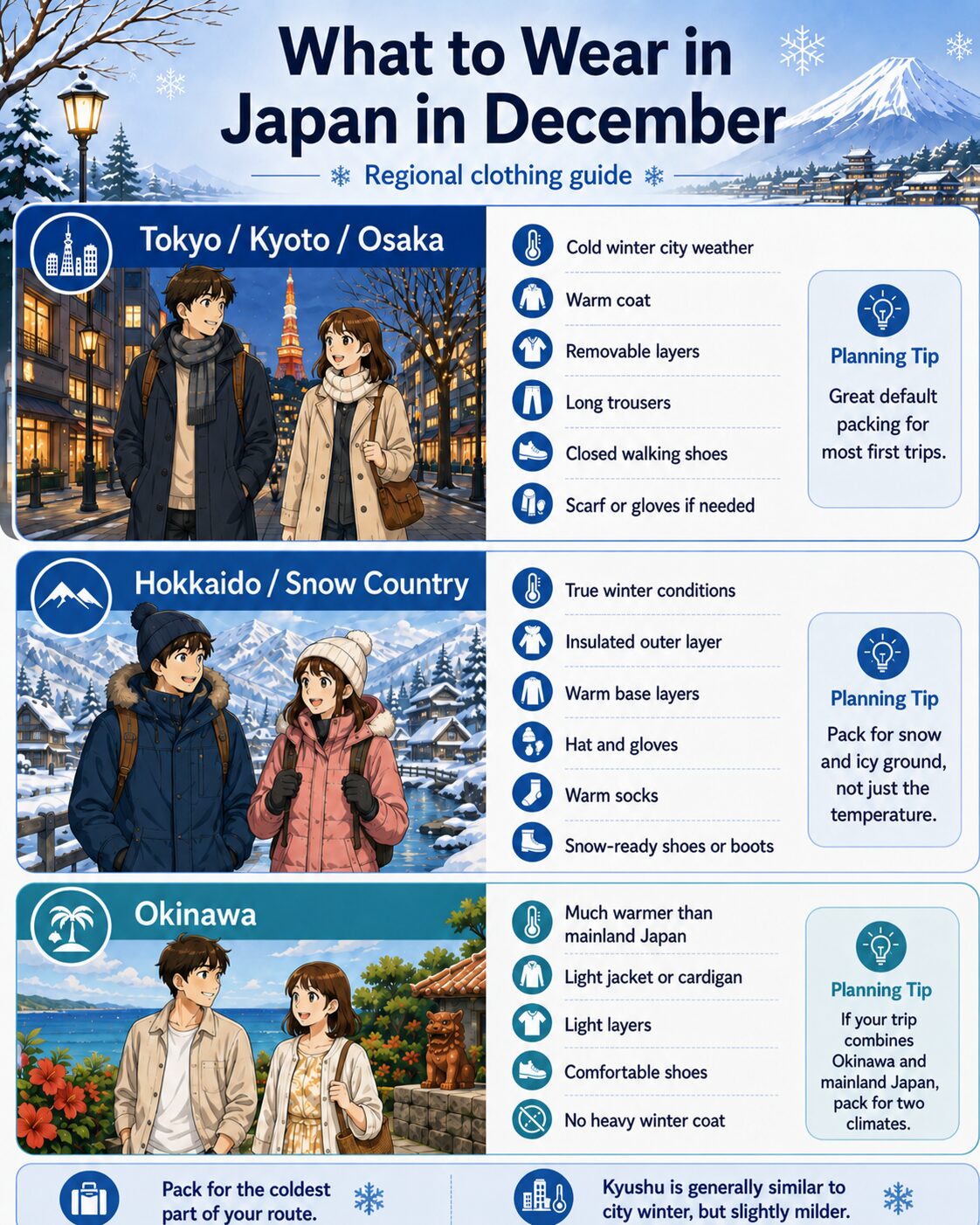
Tokyo, Kyoto, and Osaka
For most travelers:
- A warm coat
- Sweaters, fleece, or other removable layers
- Long trousers
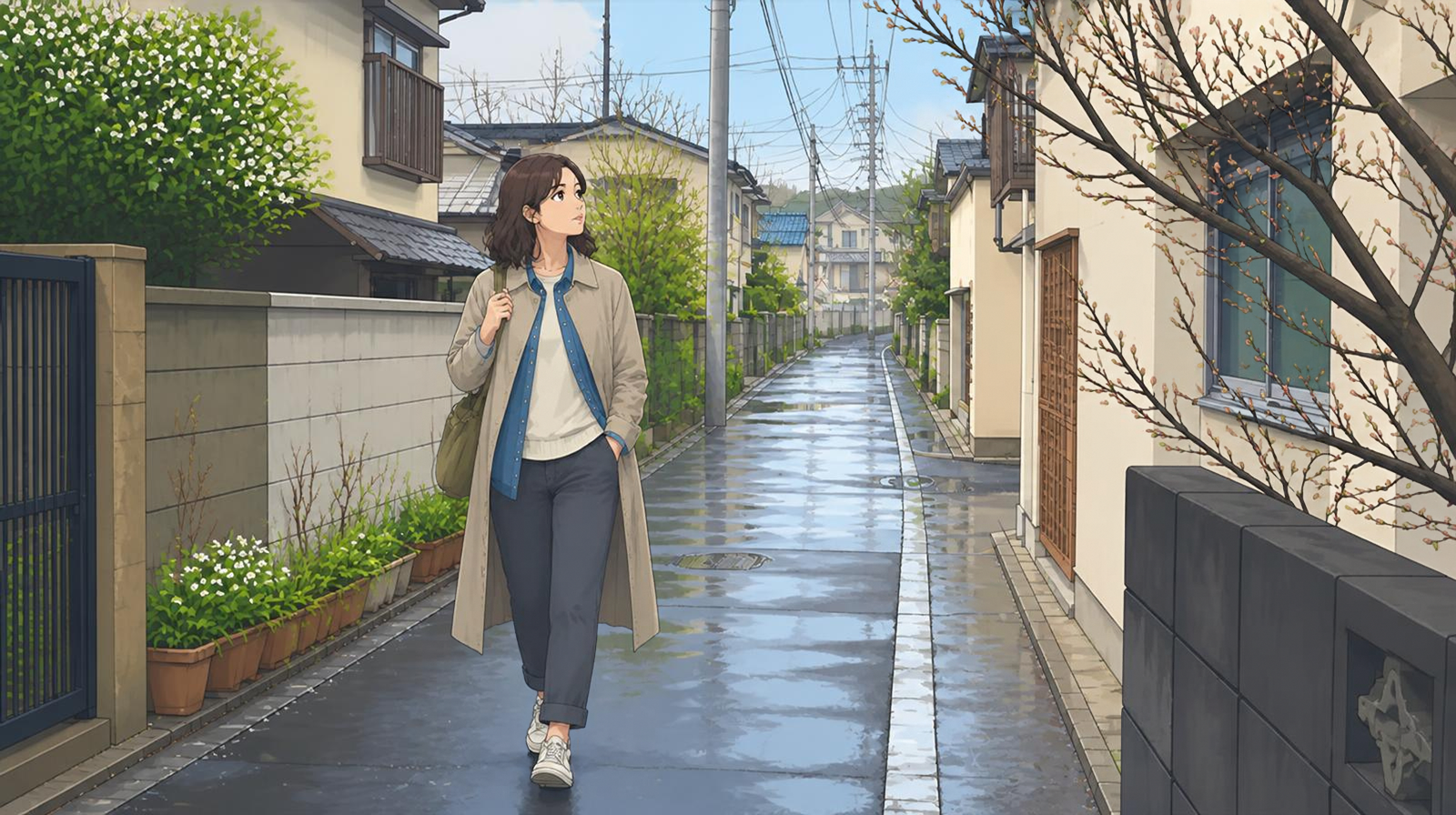
- Comfortable closed walking shoes
- A scarf and gloves if you feel the cold easily
Layering is useful because trains, stations, shops, restaurants, and museums are heated. A very heavy outfit can become uncomfortable once you move indoors.
Hokkaido and Snow Country
Add proper insulation, warm gloves, a hat, thicker socks, and shoes suited to snow or ice.
Footwear matters as much as the coat. A pair of comfortable city sneakers may work perfectly in Tokyo but provide poor grip or water resistance on packed snow.
Kyushu
Fukuoka and much of lowland Kyushu still require normal winter clothing. A coat and layers are appropriate, particularly in the morning and evening.
Do not assume that all of Kyushu is mild: mountain and inland areas can be considerably colder.
Okinawa
Okinawa generally requires much lighter clothing. If your trip combines Okinawa with Hokkaido or central Japan, packing becomes less about “December clothing” and more about preparing for two very different climates.
How December Changes the Way You Spend the Day
December changes more than temperature. It changes the rhythm of travel.
Use Daylight for Outdoor Sightseeing
December days are short. Plan temples, gardens, parks, scenic walks, and other outdoor experiences earlier in the day rather than assuming you can continue sightseeing until early evening.
After sunset, the day can naturally shift rather than end. Illuminated streets, dinner, shopping, indoor attractions, cafés, and the neighborhood around your accommodation become more important parts of the trip.
Winter Evenings Make Accommodation Location More Noticeable
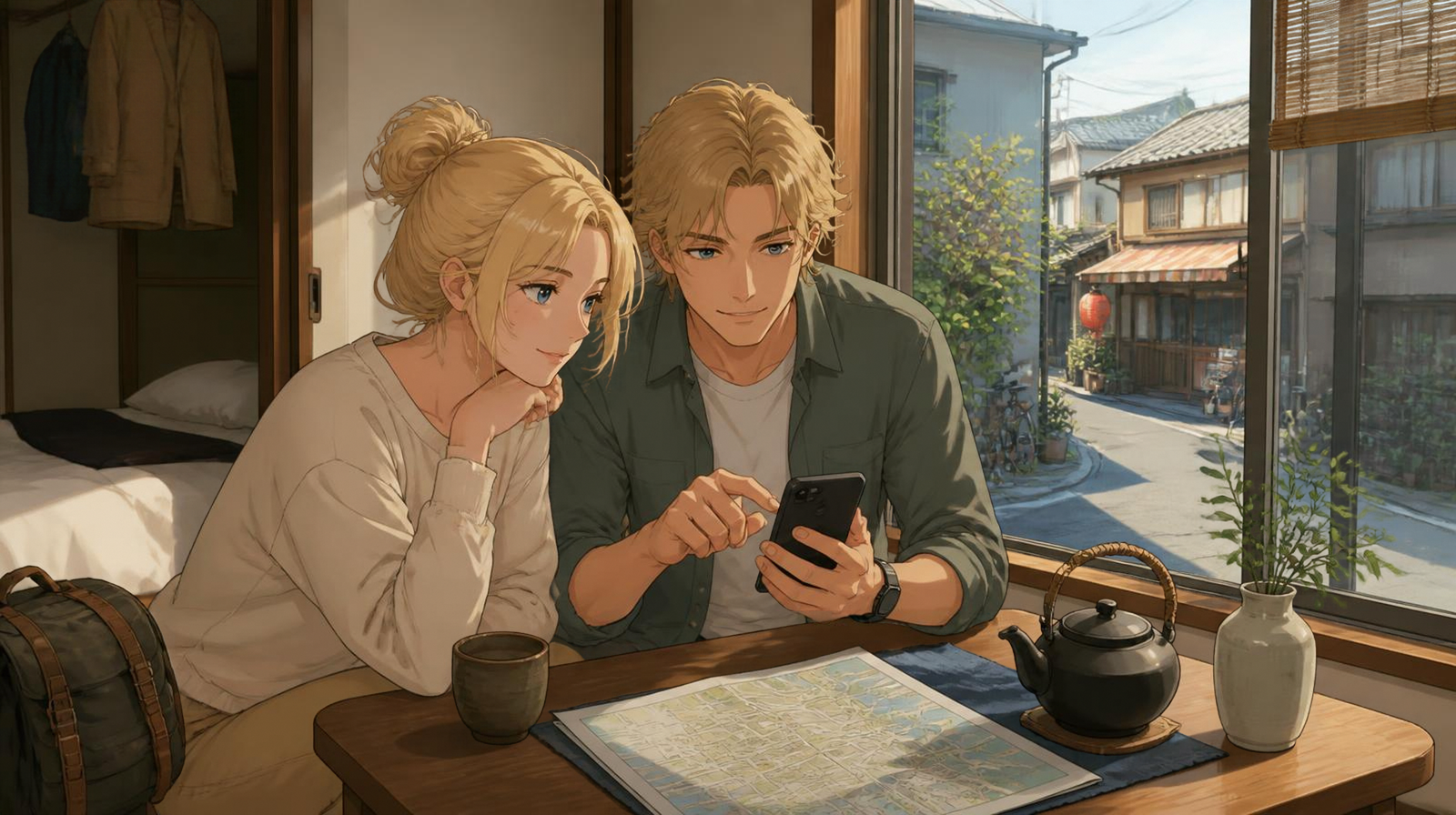
Returning to an area with restaurants, small shops, cafés, illuminated streets, or pleasant neighborhood walks can add more to a December stay than choosing accommodation only for its proximity to one daytime attraction.
A cold evening spent close to where you are staying can be part of the experience rather than empty time between sightseeing days.
Seasonal Food Is Everywhere
December is a good month to notice ordinary winter food.
- 鍋 / Nabe / Hot pot
- おでん / Oden / Simmered ingredients in broth
- Hot noodles and soups
- Seasonal seafood
- Winter sweets and hot drinks
You do not need a famous restaurant reservation to experience this. Supermarkets, convenience stores, department-store food halls, and small neighborhood restaurants all change with the season.
Near the end of December, you may also encounter 年越しそば / Toshikoshi soba / New Year’s Eve soba.
Consider One Onsen Overnight
An onsen stay becomes especially appealing in cold weather.
But an overnight stay offers more than a hot bath. Arriving in the afternoon, bathing before dinner, staying indoors through a cold evening, and stepping outside again the next morning produces a slower rhythm than visiting an onsen area for a few hours.
For a first trip, one night is often enough to add this experience without reorganizing the entire journey. If you have not used a Japanese shared bath before, Onsen & Sento Etiquette in Japan: A First-Time Visitor Guide explains the basic bathing process and the rules that can vary by facility.
Christmas Is Visible, but New Year Matters More
Christmas decorations, illuminations, special menus, and retail promotions are common in December.
However, December 25 is not a Japanese national holiday.
For most travelers, the bigger planning change begins after Christmas, as Japan moves toward New Year.
That distinction matters because late-December difficulties are sometimes mistaken for “Christmas closures.” The issue is generally the approaching year-end and New Year period instead.
Traveling in Late December Requires More Planning
There is no single nationwide closure schedule.
Museums, restaurants, shops, attractions, and cultural sites decide their own year-end opening hours, so anything essential to your trip should be checked individually.
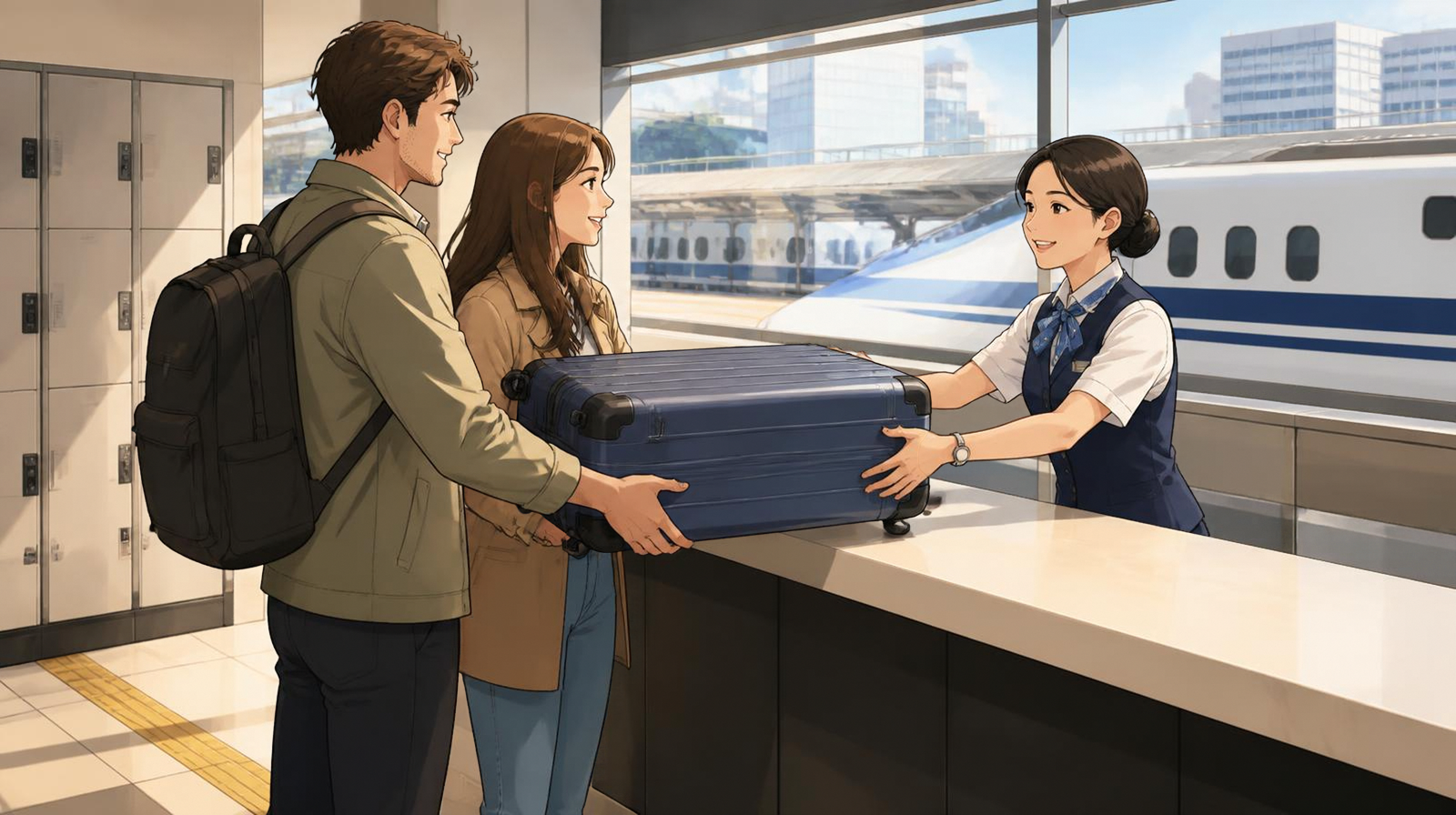
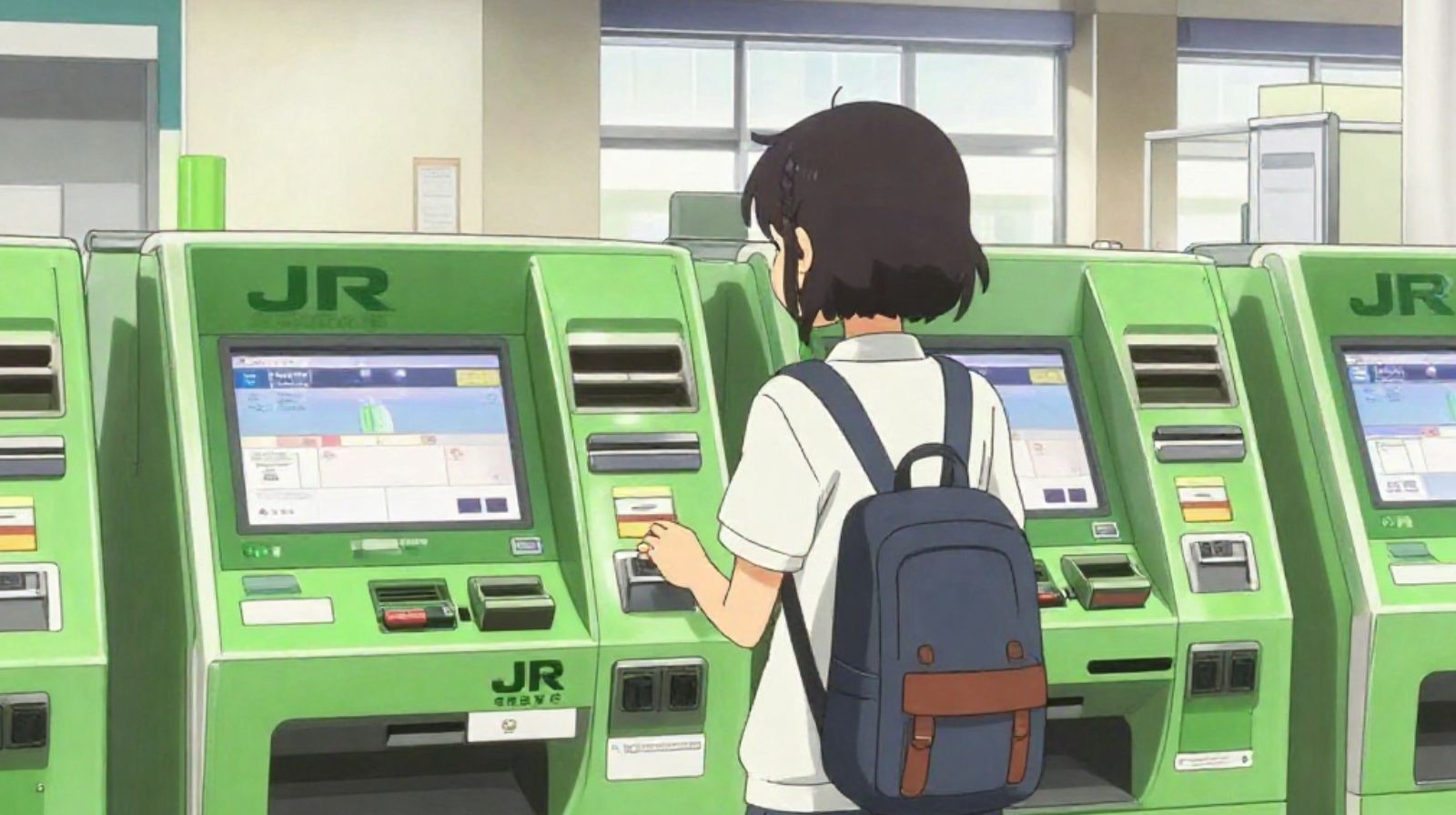
Long-distance transportation also becomes more important to reserve in advance.
The evergreen rule is simple: if you are traveling between major cities in the final week of December, make long-distance transport part of the core booking stage rather than leaving it until the trip is almost complete.
For the 2026–27 New Year travel period, JR Central states that all Nozomi services operating between Tokyo and Hakata will have reserved seating only from December 25, 2026 through January 5, 2027. Hikari, Kodama, Mizuho, Sakura, and Tsubame services continue to have their normal non-reserved seating arrangements.
If your trip overlaps with this period, the next practical step is to understand how and when to reserve your Shinkansen journey.
December 31: Ōmisoka
December 31 is 大晦日 / Ōmisoka / New Year’s Eve.
Some travelers may encounter 除夜の鐘 / Joya no kane / New Year’s Eve bell ringing at Buddhist temples.
This is a religious and cultural tradition rather than simply a midnight countdown event. Participation, access, crowds, and transport vary by temple and city, so check the specific place if this is an important part of your trip.
A Simple December Planning Rule
For most first-time visitors:
Keep the Japan trip you actually want, then let December change one part of it.
Keep Tokyo, Kyoto, and Osaka if they are your priorities. Add a snow-country stay if seeing snow matters. Give Hokkaido more time if winter itself is the purpose. Choose Kyushu for a somewhat milder city winter, or Okinawa for a much warmer trip.
And if you are traveling after Christmas, simplify the route slightly and secure important transport and opening information earlier.
Last verified: August 31, 2026 (JST)
Frequently Asked Questions
- Is December a good time to visit Japan?
-
Yes. December works particularly well for winter city travel, seasonal food, illuminations, onsen stays, and trips into colder regions. Late December requires more advance planning because Japan begins moving into its New Year travel period.
- Is Japan covered in snow in December?
-
No. Snow conditions vary greatly by region. Hokkaido, mountain areas, northern Japan, and snow-country regions are much more reliable choices than Tokyo, Kyoto, or Osaka.
- Can I see snow without going to Hokkaido?
-
Yes. Mountain and snow-country areas in regions such as Nagano, Niigata, and Tohoku can be incorporated into a wider Honshu trip. Choose a specific winter destination rather than assuming an entire prefecture will have the same snow conditions.
- How cold is Tokyo in December?
-
Tokyo’s December mean temperature is 7.7°C based on the Japan Meteorological Agency’s 1991–2020 climate normals. The average daily high is 12.0°C and the average daily low is 3.8°C, so mornings, evenings, and long periods outdoors can feel cold.
- What should I wear in Japan in December?
-
For Tokyo, Kyoto, and Osaka, bring a warm coat, removable layers, long trousers, and comfortable closed shoes. Snow-country itineraries require stronger insulation and footwear suited to snow and ice.
- Can I ski in Japan in December?
-
Yes, but conditions depend heavily on timing and snowfall. Early December remains early season at many resorts, so travelers whose main goal is skiing should not treat a scheduled opening date as a guarantee of full winter conditions.
- Is Christmas a public holiday in Japan?
-
No. December 25 is not a Japanese national holiday. The more important calendar change for travelers usually begins after Christmas as the country approaches New Year.
- Is late December a bad time to visit Japan?
-
No. It can be an interesting time to travel, but transport demand rises and some facilities change their year-end schedules. Reserve important long-distance journeys earlier and confirm anything that is essential to your itinerary.