Is October a Good Time to Visit Japan?
For most first-time visitors, yes.
October is generally much easier for walking and outdoor sightseeing than midsummer. It is also unusually flexible: a classic city itinerary works well, while travelers who care more about autumn colors can head farther north or into higher elevations.
What you should not assume is that October means peak fall foliage everywhere. In Tokyo, Kyoto, Osaka, and many other warmer cities, the strongest colors generally arrive later.
Early, Mid, or Late October: What Changes?
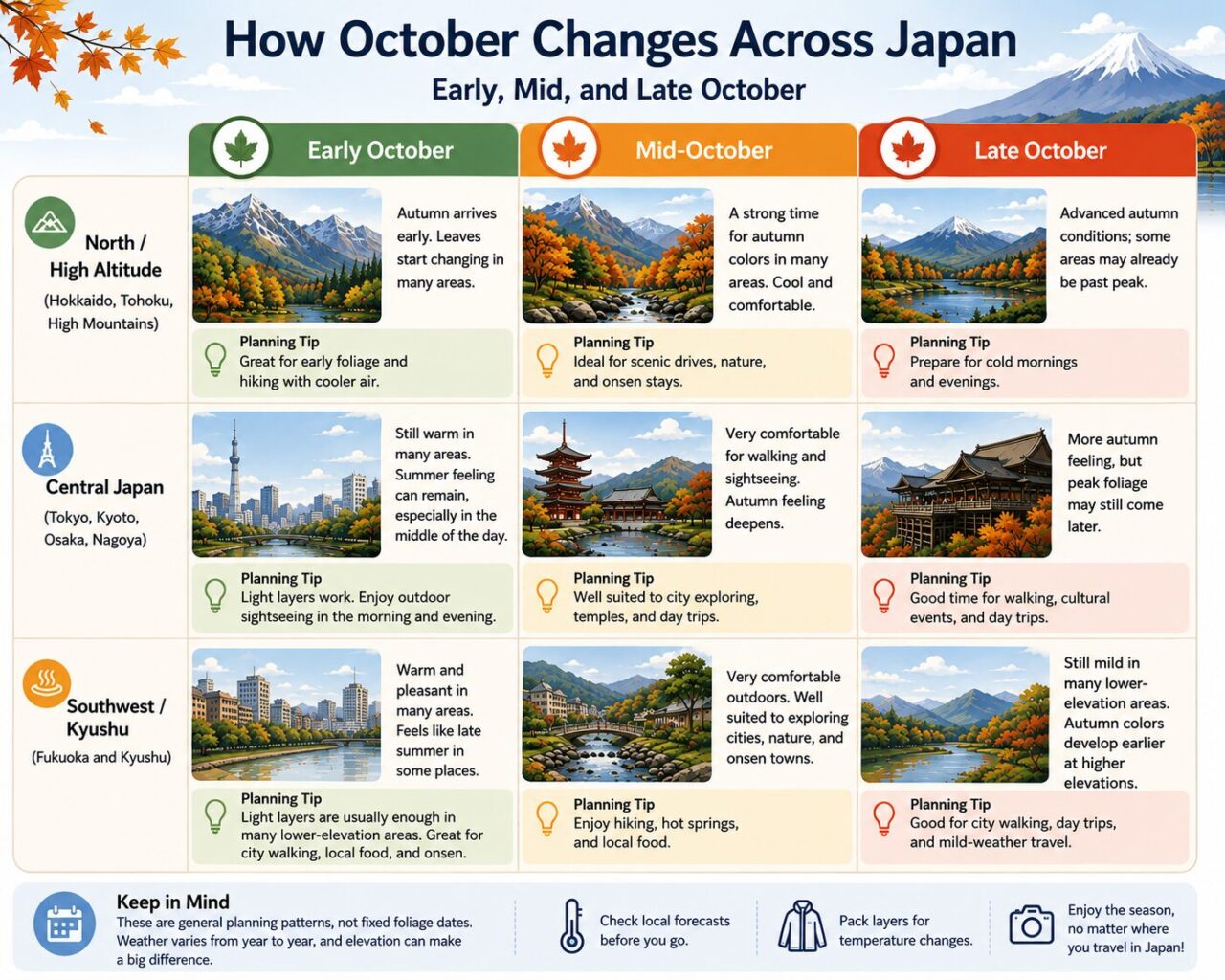
October changes noticeably as the month progresses, particularly when you compare northern Japan with central and southern regions.
| When | What October is generally like | Best approach |
|---|---|---|
| Early October | Central and southern Japan can still feel fairly warm. Autumn is much further ahead in northern and high-altitude areas. | Keep a city itinerary, or travel north if autumn scenery is a priority. |
| Mid-October | Comfortable outdoor weather becomes common across many regions. Cooler areas are well into autumn. | A strong period for city walking, hiking, festivals, and seasonal landscapes. |
| Late October | Autumn continues moving into lower elevations and farther south, although many major cities are still before their strongest foliage. | Combine city sightseeing with a cooler or higher-elevation trip if leaves matter. |
These are planning patterns, not fixed foliage dates. Weather varies from year to year, and elevation can make a significant difference even within the same prefecture.
What Is the Weather Like in Japan in October?
October temperatures differ substantially across Japan.
The table below uses Japan Meteorological Agency climate normals for 1991–2020. These are long-term averages, not a forecast for your individual trip.
| City | Average | Average daily high | Average daily low |
|---|---|---|---|
| Sapporo | 12.1°C | 16.4°C | 8.0°C |
| Sendai | 15.7°C | 19.8°C | 11.9°C |
| Tokyo | 18.0°C | 22.0°C | 14.8°C |
| Kyoto | 18.4°C | 23.4°C | 14.4°C |
| Osaka | 19.5°C | 23.7°C | 16.0°C |
| Fukuoka | 19.6°C | 23.7°C | 16.0°C |
A traveler moving between Fukuoka, Osaka, Tokyo, and Sapporo during the same October trip should not pack as though all four cities will feel alike. Mountain destinations can also be considerably colder than nearby cities.
Rain is still possible, and tropical weather systems can occasionally affect travel. Check the forecast shortly before departure, especially if your plans include mountain routes, ferries, flights, or outdoor festivals.
What Should You Wear in Japan in October?
Layers are the safest approach.
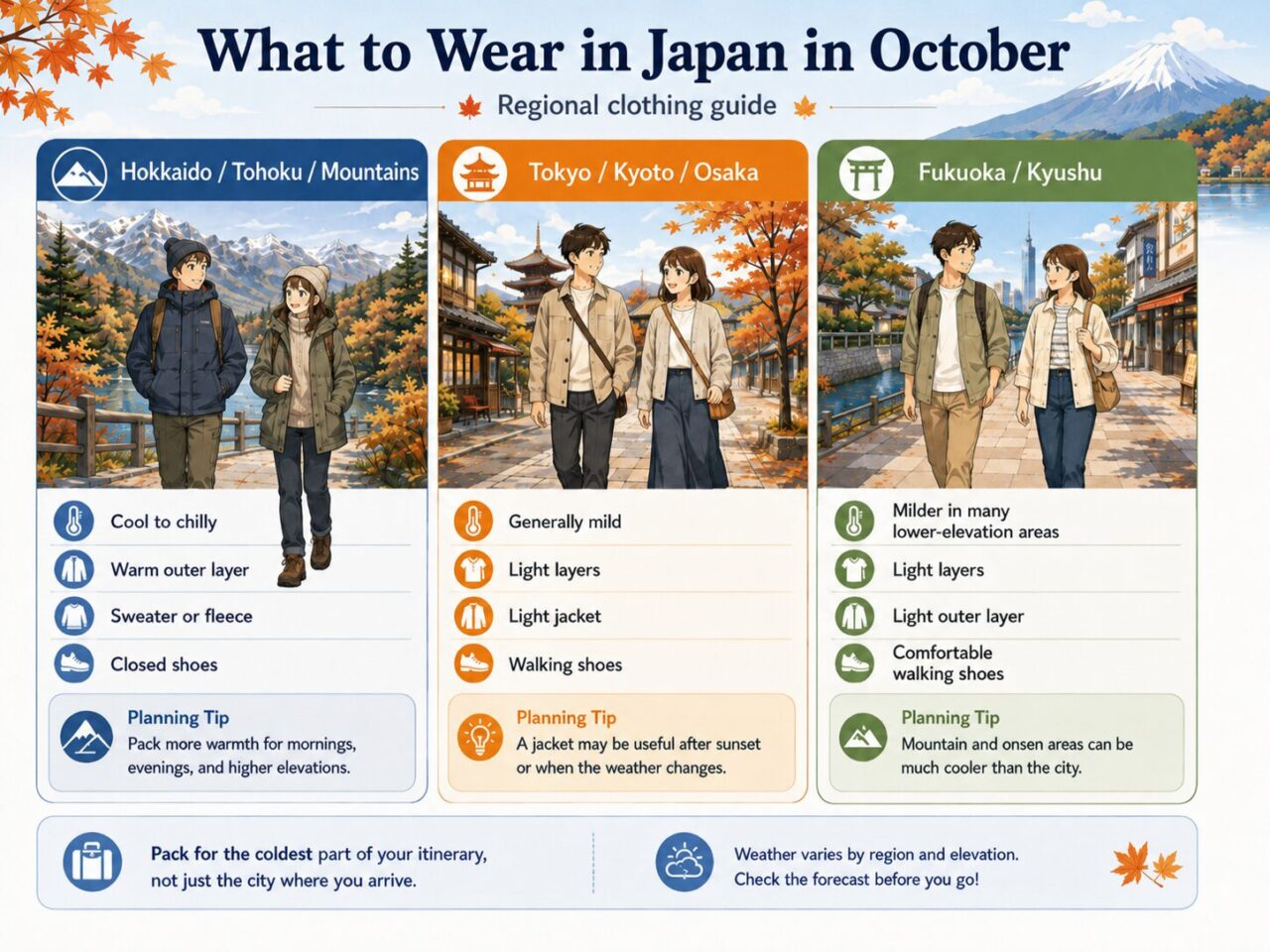
Tokyo, Kyoto, and Osaka
For many October days, start with:
- Long-sleeved tops or light shirts
- Light sweater or cardigan
- Light jacket
- Long trousers or similar comfortable bottoms
- Comfortable walking shoes
- Compact umbrella
You may not need the jacket during a mild afternoon, but it becomes useful after sunset or when the weather changes.
Hokkaido, Tohoku, and Mountain Areas
Pack more warmth if the itinerary includes northern Japan or higher elevations. A warmer jacket, sweater or fleece, and clothing suitable for colder mornings and evenings are more useful here.
Do not use Tokyo’s October weather as the packing reference for Hokkaido or a mountain trip.
Fukuoka and Kyushu
Daytime conditions can remain relatively mild in many lower-elevation areas. Lighter layers may be enough during the day, but keep an outer layer for mornings and evenings. Mountain and onsen areas can be considerably cooler.
If your trip crosses Japan, pack for the coldest part of the itinerary rather than for the city where you land.
Where Should You Go in Japan in October?
The best October destination depends less on finding a single “best place” and more on deciding what you want the month to add to your trip.
For a First Trip: Keep Tokyo, Kyoto, and Osaka
If this is your first visit to Japan, there is usually no need to redesign the classic route simply because peak autumn foliage may not have arrived.
東京 / Tōkyō / Tokyo, 京都 / Kyōto / Kyoto, and 大阪 / Ōsaka / Osaka are all well suited to October. The milder weather makes it easier to spend more of the day outside, walk between neighborhoods, visit parks and temple grounds, and add day trips without structuring the day around summer heat.
October can also make the spaces between major attractions more enjoyable. Walk along a river after breakfast, explore a shopping street between sightseeing stops, or spend more time around the neighborhood where you are staying instead of moving immediately to the next station.
If Tokyo, Kyoto, and Osaka are already the places you most want to see, keep them as the core of the trip.
If Autumn Colors Are a Priority: Go North or Higher
Choose a different strategy if seeing strong autumn foliage is one of the main reasons for your trip.
北海道 / Hokkaidō / Hokkaido, 東北 / Tōhoku / Tohoku, and higher mountain areas enter autumn earlier than Tokyo, Kyoto, and Osaka. Depending on your dates and elevation, October can already bring much more advanced seasonal color in these cooler areas.
You do not necessarily need to rebuild the entire itinerary. Adding one northern or mountain destination may be enough.
For a short first trip, it is usually better to keep the places you genuinely want to visit and add an autumn-focused stop than to chase foliage across several regions.
If You Prefer Milder Weather: Fukuoka and Kyushu
Farther southwest, 福岡 / Fukuoka / Fukuoka and much of 九州 / Kyūshū / Kyushu remain milder than northern Japan.
This direction works well if you would rather spend October walking through cities, eating locally, visiting hot-spring towns, and exploring smaller destinations without making autumn foliage the main purpose of the trip.
Fukuoka can also serve as a practical base for a wider Kyushu itinerary. Kyushu is not uniformly warm, however. Mountain and highland areas can be considerably cooler than Fukuoka city, so pack for the actual route rather than the region name alone.
Can You See Autumn Leaves in Japan in October?
Yes, but the destination matters.
In Hokkaido, Tohoku, and higher-altitude areas, October can be an important part of the foliage season. Tokyo, Kyoto, Osaka, and other warmer major cities usually reach their stronger autumn colors later.
If autumn leaves are simply one part of the trip, there is no need to reorganize everything around them. If strong foliage is a priority, include at least one cooler or higher destination rather than planning the trip around peak colors in central Tokyo or Kyoto.
For the bigger seasonal picture, see Autumn in Japan: Weather, Fall Foliage, What to Wear & Things to Do.
October Festivals Worth Planning Around
October also offers something that cannot be reproduced simply by visiting a garden with colorful leaves: local festivals that temporarily change the rhythm of a city or town.
You do not need to build a trip around every festival. Choose one when it fits naturally into the route.
If You Are Already Visiting Kyoto: Jidai Matsuri
時代祭 / Jidai Matsuri / Festival of the Ages is held in Kyoto each year on October 22.
The large historical procession travels from 京都御所 / Kyōto Gosho / Kyoto Imperial Palace toward 平安神宮 / Heian Jingū / Heian Jingu Shrine, with participants dressed to represent different periods of Japanese history.
For a first-time traveler already staying in Kyoto, it is one of the easiest major October festivals to incorporate because no additional destination is required.
The procession also attracts large numbers of spectators. If seeing it matters to you, do not treat October 22 like an ordinary Kyoto sightseeing day. Check the current official viewing information (Japanese) beforehand and allow extra time for moving around the city.
If You Can Add a Regional Stop: Autumn Takayama Festival
秋の高山祭 / Aki no Takayama Matsuri / Autumn Takayama Festival is held on October 9 and 10 each year in 高山 / Takayama / Takayama, Gifu Prefecture.
The festival centers on 櫻山八幡宮 / Sakurayama Hachimangū / Sakurayama Hachimangu Shrine and includes ornate festival floats, processions, traditional karakuri marionette performances, and a lantern-lit evening procession when conditions allow.
Takayama makes sense if you want the festival itself to become part of a regional stay rather than simply adding an event to a major city itinerary.
If the festival is an important reason for visiting, arrange accommodation before building the rest of the route around it. Takayama is much smaller than Tokyo or Kyoto, and festival dates concentrate visitors into a limited area.
Outdoor parts of the festival can change because of bad weather, so check the official Autumn Takayama Festival information shortly before traveling.
If Your Trip Includes Kyushu: Nagasaki Kunchi
長崎くんち / Nagasaki Kunchi / Nagasaki Kunchi Festival is held every year from October 7 to 9.
The festival has continued since 1634, and its performances reflect Nagasaki’s long history of contact with cultures from outside Japan.
That makes it particularly interesting if a Kyushu trip is meant to go beyond scenery and food. It provides a way to see how the city’s history is still expressed through a living local tradition.
There is little reason to cross Japan solely to add another festival to the itinerary. But if Nagasaki or Kyushu is already part of your route, the dates are worth checking before you finalize accommodation and transportation.
Some viewing areas and performances may involve reserved seating or specific viewing arrangements. If seeing a particular performance matters, check the official Nagasaki Kunchi information rather than assuming that arriving in central Nagasaki will guarantee the experience you want.
Beyond Fall Foliage: Other October Scenery
October scenery in Japan is not limited to red maple leaves.
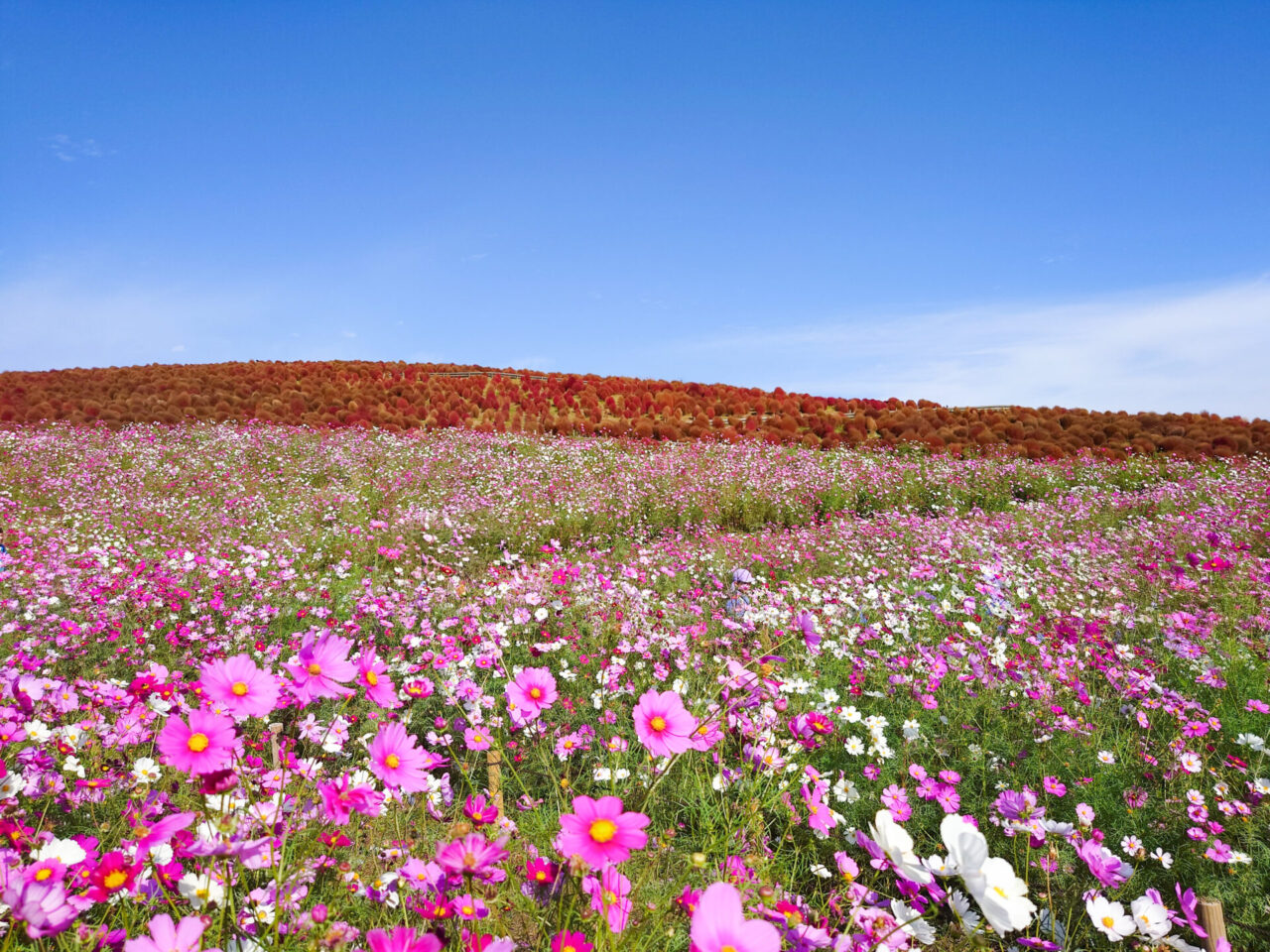
Depending on the region, you may encounter コキア / Kokia / Kochia turning deep red, コスモス / Kosumosu / Cosmos flowers, ススキ / Susuki / Japanese pampas grass, changing mountain vegetation, and agricultural landscapes after the harvest.
One well-known example is 国営ひたち海浜公園 / Kokuei Hitachi Kaihin Kōen / Hitachi Seaside Park in Ibaraki Prefecture. Its large kochia fields typically turn autumn colors around the middle of October, while cosmos also bloom during much of the month. Exact timing varies with the weather.
This is useful when planning because a destination does not have to be at “peak foliage” to look or feel distinctly autumnal. From Tokyo, a seasonal landscape can also work as a day trip rather than a reason to reorganize the entire journey.
What to Eat and Notice During the Harvest Season
October is a good month to notice how the season changes everyday food.
You may encounter 新米 / Shinmai / New-season rice, 柿 / Kaki / Persimmon, 梨 / Nashi / Japanese pear, 栗 / Kuri / Chestnut, さつまいも / Satsumaimo / Sweet potato, and 新そば / Shinsoba / New-season soba.
You do not need a reservation at a famous restaurant to experience this side of autumn.
Look at what has changed in a supermarket near your accommodation. Walk through a department-store food hall. Stop at a neighborhood bakery or café. Seasonal sweets, produce, prepared food, and temporary menu items appear as autumn progresses.
Leaving a few meals unplanned can make it easier to notice these everyday changes.
Why October Is a Good Month to Spend More Time Outside
One of October’s biggest advantages is simply that more of the day can be comfortable outdoors.
Walk More of the City
In midsummer, even a short walk between stations can become tiring. October makes it much easier to experience cities on foot.
Walk one station farther, follow a river, spend a morning in a local park, or explore the streets around your accommodation before beginning the day’s main sightseeing. These are simple activities, but cooler weather makes them much more realistic than during the hottest part of summer.
Add an Outdoor Day Trip
October is also well suited to adding one day outside the city.
That might mean a mountain area, smaller town, large park, lakeside route, or easy walking trail rather than a difficult hike.
A Tokyo–Kyoto–Osaka trip does not need to become an outdoor itinerary. One well-chosen day can be enough to change the pace of the journey.
Consider an Onsen Overnight
Cooler mornings and evenings also make 温泉 / Onsen / Hot spring stays particularly appealing.
Instead of treating a hot spring as another attraction to fit between sightseeing stops, consider staying overnight when it works with your route. Arriving in the afternoon, bathing in the evening, and leaving after a quieter morning creates a different experience from simply adding another city hotel night.
If this would be your first Japanese public bath, Onsen & Sento Etiquette in Japan: A First-Time Visitor Guide explains the bathing process and the rules that can vary by facility.
How to Plan a First Trip to Japan in October
For most first-time visitors, keep Tokyo, Kyoto, and Osaka as the core itinerary if those are the places you most want to visit.
Then add one October-specific experience.
- If autumn foliage matters most, add a northern or higher-elevation destination.
- If a festival matters, see whether Jidai Matsuri, the Autumn Takayama Festival, or Nagasaki Kunchi fits naturally into the route.
- If spending time outdoors matters, reserve a day for a mountain, park, smaller town, or walking route.
- If food and local life matter, leave some meals and evenings unplanned. A supermarket, shopping street, café, or neighborhood near your accommodation can become part of the seasonal experience.
A good October itinerary is not necessarily the one with the most autumn attractions. It is one that uses the season to make the trip easier to walk, easier to vary, and less dependent on moving from one major sight to the next.
Practical Things to Know Before an October Trip
Mountain temperatures can be very different from city temperatures, so check local forecasts before outdoor trips.
Festival dates can bring concentrated crowds and accommodation demand to places such as Takayama and Nagasaki. If a festival is important to your trip, finalize that part of the itinerary earlier than you would for an ordinary sightseeing day.
If strong autumn foliage is one of the main reasons for traveling, check current seasonal conditions close to departure rather than relying only on typical dates.
Daylight is also shorter than in summer. For mountain walks and rural day trips, start earlier rather than assuming you can remain outdoors as late as you would in July or August.
October is generally more settled than September, but tropical cyclones and heavy rain can still affect travel. If severe weather is forecast, Natural Disasters in Japan: What Every Traveler Should Know explains what to check and how transportation may be affected.
Last verified: August 29, 2026 (JST)
Frequently Asked Questions
- Is October a good month to visit Japan?
-
Yes. October is generally a strong month for first-time visitors because many regions have more comfortable conditions for walking and outdoor sightseeing than midsummer. It also brings festivals, seasonal food, and earlier autumn scenery in northern and high-altitude areas.
- Is Japan cold in October?
-
It depends on the region. Tokyo, Osaka, and Fukuoka are generally mild, while Sapporo, Tohoku, mountain areas, and higher elevations can be much cooler. Pack according to your full itinerary rather than one city.
- What should I wear in Japan in October?
-
For Tokyo, Kyoto, and Osaka, light layers, long sleeves, a light jacket, and comfortable walking shoes work for many days. Bring warmer clothing for Hokkaido, Tohoku, and mountain destinations.
- Can I see autumn leaves in Japan in October?
-
Yes, especially in northern Japan and higher-elevation areas. Tokyo, Kyoto, Osaka, and many other warmer cities generally reach stronger autumn colors later, so choose the destination carefully if foliage is a major priority.
- Is Kyoto worth visiting in October before peak foliage?
-
Yes. Kyoto does not need peak autumn foliage to be worth visiting in October. Comfortable walking conditions, temple grounds, neighborhoods, seasonal food, and October events such as Jidai Matsuri still make it a strong part of a first trip.
- Is Japan crowded in October?
-
October can be busy, but crowds are not uniform across the country or throughout the month. Major festivals, popular seasonal landscapes, weekends, and well-known tourist districts can become particularly crowded, while ordinary neighborhoods and many less event-focused destinations may feel very different.
- Is October rainy in Japan?
-
Rain is still possible. October generally brings more settled weather than September in many parts of Japan, but it is not uniformly dry, and local conditions vary. Tropical weather systems can still affect travel, so check the forecast shortly before departure.