Should You Store, Forward or Carry Your Luggage?
Japan does not have one luggage solution that is best for every day of a trip. Start with how soon you need the bag and where it needs to be next.
| Situation | Best Starting Point | Check Before You Rely on It |
|---|---|---|
| You need the bag again later the same day | Accommodation storage, a coin locker or a staffed baggage counter | Opening hours, locker size, collection deadline and whether you must return to the same place |
| You are changing cities with a large or heavy suitcase | Forward the main suitcase to the next staffed accommodation | Delivery date, receiving arrangements and what you need in an overnight bag |
| You have a direct rail journey and one manageable suitcase | Carry it on the train | Where it can be stored and whether an oversized-baggage reservation is required |
| Your next stay has no staffed front desk | Confirm reception before sending anything | Who will physically accept the bag during the carrier’s delivery window |
| You want to send a bag to or from an airport | Use an airport-delivery service if its cutoff fits your flight | Terminal, counter, collection time, delivery area and route-specific deadline |
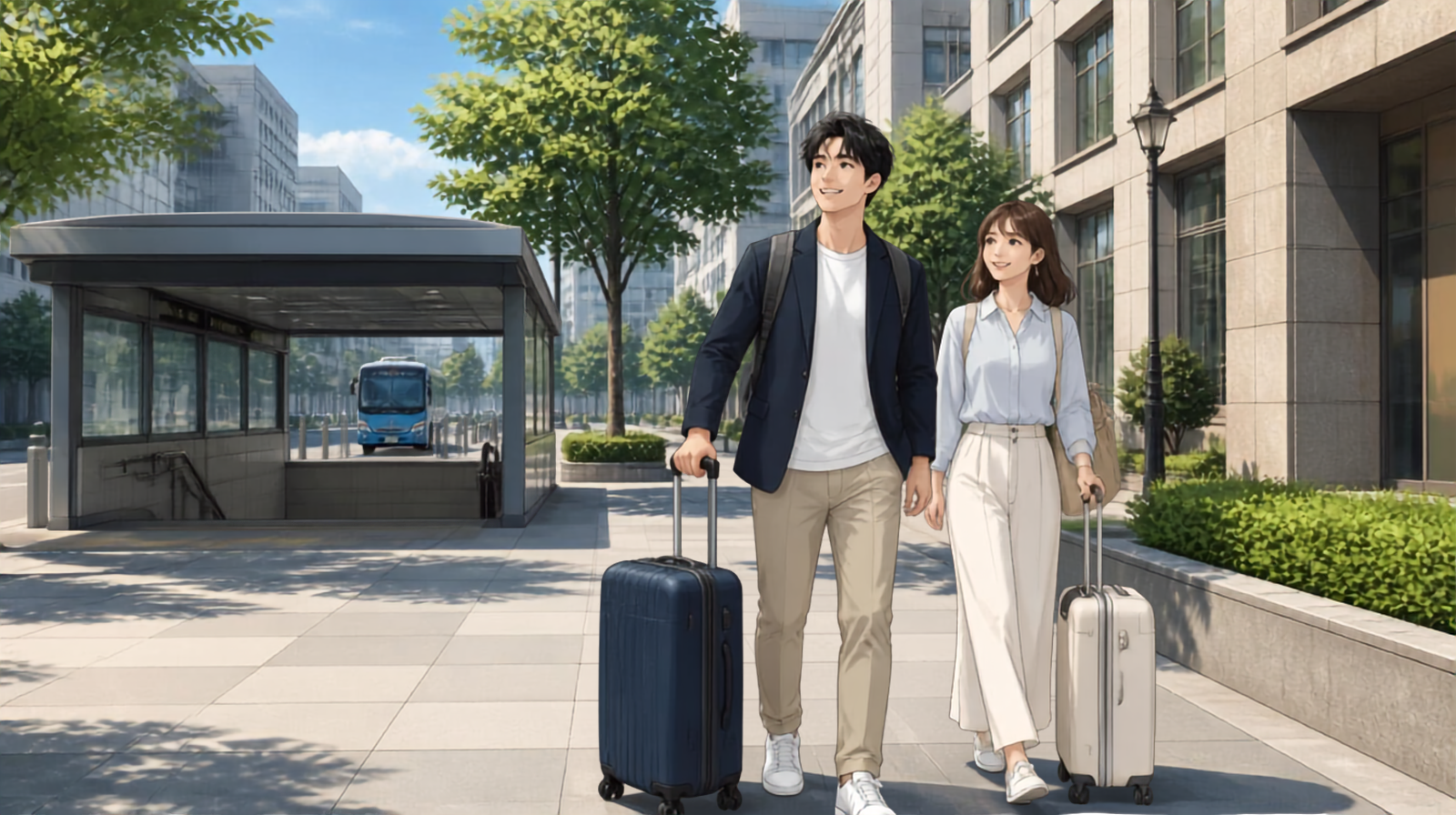
For most travelers, there is no need to forward every bag automatically. Use delivery when it removes a difficult part of the journey. A suitcase you can comfortably handle on a direct train may be easier to keep with you, while the same suitcase may be worth sending ahead if the day includes two local trains, a bus and a long walk.
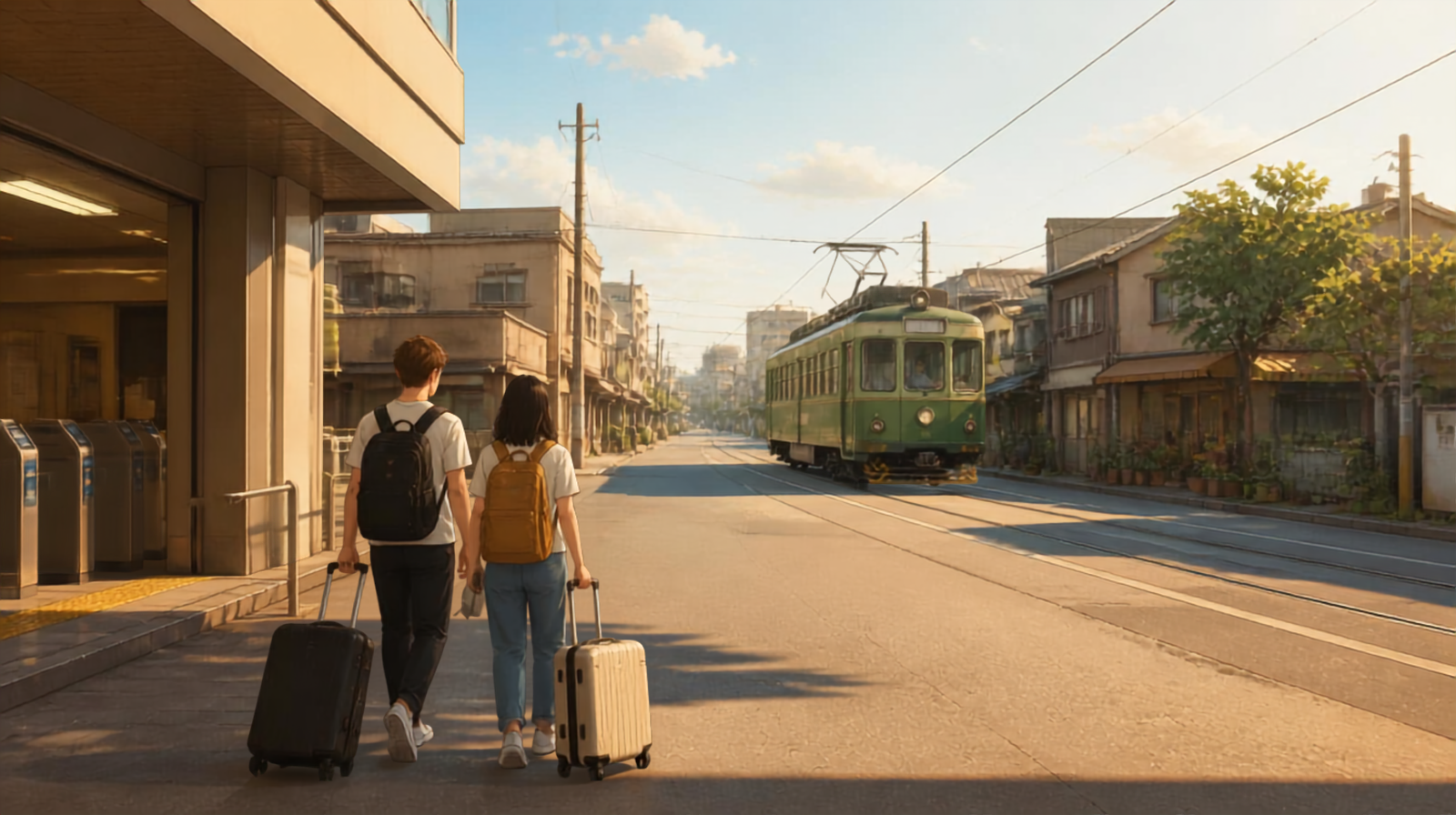
Large luggage is often hardest to manage on the local legs before and after a long-distance train. Avoid peak commuting periods where possible, keep doors and aisles clear, and do not assume an ordinary city bus has a luggage compartment. A short taxi for the final section can sometimes solve more of the problem than forwarding the suitcase for the entire journey.
What Luggage Forwarding Means in Japan
宅配便 / Takuhai-bin / Parcel delivery is the general term for sending luggage or parcels within Japan. 宅急便 / Takkyūbin / TA-Q-BIN is the name of Yamato Transport’s service. Travelers may also see the official Hands-Free Travel logo at participating airport, station and commercial-facility counters.
Hands-Free Travel is not one single nationwide product. It is a broad label covering services such as temporary baggage storage, standard delivery and limited same-day delivery. Availability, size limits, deadlines and prices depend on the carrier and counter. Official service locations are available from Yamato Transport and Sagawa Express.
How to Forward a Suitcase
- Confirm that the destination will accept the suitcase and ask how the label should be written.
- Ask the sending hotel or counter for the expected arrival date, final acceptance time and total price.
- Move everything you will need before delivery into a small overnight or day bag.
- Write the destination’s full address and phone number, your reservation name and your check-in date on the waybill.
- Pay at the sending point unless the receiving property has explicitly agreed to another arrangement.
- Keep the receipt and tracking number until the bag is in your hands again.
At a hotel counter, you can show:
次のホテルへ荷物を送りたいです。 / Tsugi no hoteru e nimotsu o okuritai desu. / I would like to send my luggage to my next hotel.
How Long Does Delivery Take?
Standard delivery is not instant. Yamato advises that delivery takes at least one day and may take two days depending on the distance. Remote islands, long routes, weather and service disruptions can add time. Same-day delivery exists on selected routes, but it should be treated as a location-specific service rather than the default.
For an ordinary intercity move, plan to spend at least one night without the main suitcase and confirm the actual arrival date before handing it over. If a particular item is essential that evening or the next morning, keep it with you.
How Much Does It Cost?
The rate depends on the bag’s size or weight, the distance and the service used. As one current reference, Yamato’s published one-way rate for a size-160 parcel between Kanto and Kansai is ¥2,630. Under that rate table, size 160 means a total length, width and height of up to 160 cm and a weight of up to 25 kg. Airport and counter-specific fees may be added.
This is a price example, not a universal suitcase rate. Measure the bag and check the carrier’s current rates and delivery times for the actual route.
Sending Luggage Between Hotels
If both properties have staffed front desks, hotel-to-hotel delivery is usually the simplest arrangement. Ask the current hotel to help complete the waybill, but contact the receiving property first rather than assuming it will hold an unexpected suitcase.
- Confirm that the receiving hotel accepts luggage before check-in.
- Use the same name as the hotel reservation.
- Add the check-in date and reservation number if the hotel requests them.
- Ask whether the parcel must be prepaid.
- Allow more time than the minimum if a delay would disrupt the trip.
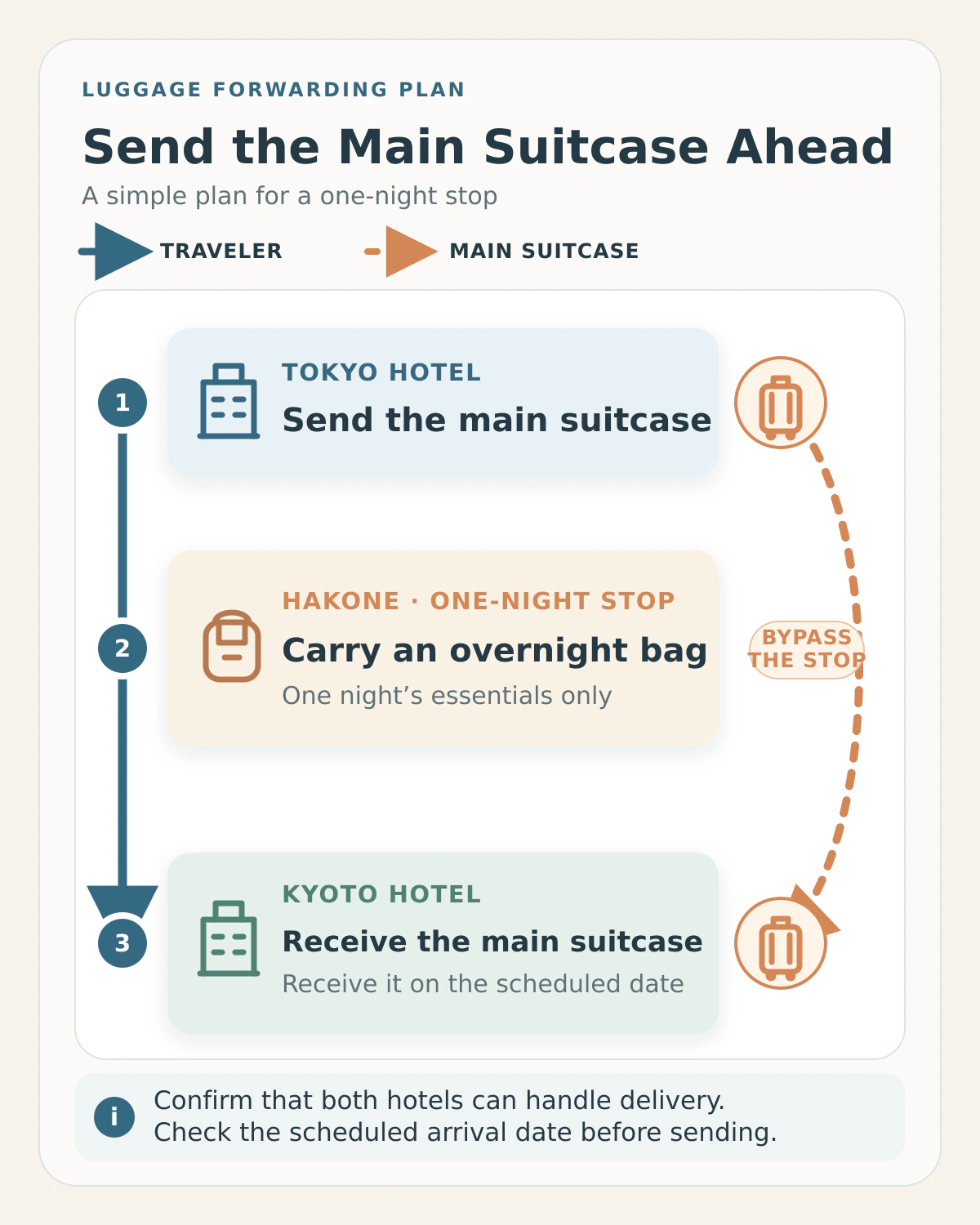
A one-night stop is where forwarding is often most useful. On a route such as Tokyo → Hakone → Kyoto, you could send the main suitcase from the Tokyo hotel directly to the Kyoto hotel and take only an overnight bag to Hakone. This avoids moving a large case through local transport for a stay where you do not need everything you packed.
Airport Luggage Delivery
Major international gateways—including 成田空港 / Narita Kūkō / Narita Airport, 羽田空港 / Haneda Kūkō / Haneda Airport and 関西国際空港 / Kansai Kokusai Kūkō / Kansai International Airport—have luggage-delivery counters. The operators, hours, delivery areas and same-day options differ by airport and terminal.
From the Airport to Your Accommodation
Airport-to-hotel delivery can be useful after a long flight, especially when the final journey involves crowded trains, children or several transfers. Ask the counter when the bag will arrive before sending it. A late arrival does not guarantee late-evening or same-day hotel delivery.
Confirm that the accommodation will receive the suitcase. This matters particularly for apartment stays, vacation rentals and any property with remote or self-service check-in.
From Your Accommodation to the Airport
Airport-bound luggage normally needs an earlier cutoff than ordinary hotel delivery. Yamato, for example, plans for the bag to reach the airport counter one day before departure and sets the shipping cutoff according to the origin. Its example requires a bag sent within Tokyo for a Haneda flight to be handed over by the applicable cutoff two days before departure; a longer route may require more time.
Confirm the airport, terminal, collection counter, opening hours and flight date. Use the carrier’s route-specific airport cutoff rather than relying on a general number of days.
Unstaffed Stays and Vacation Rentals Need a Different Plan
An apartment stay or vacation rental may provide more space, privacy and a closer connection to an ordinary neighborhood. The luggage issue is not the accommodation category itself. It is whether someone will be present to accept the suitcase when the carrier arrives.
Yamato’s private-lodging guidance states that pickup and delivery are not available at an Airbnb-like accommodation without reception staff. Sagawa also excludes unmanned accommodation from its same-day hotel-delivery service. A remotely managed property may have its own partner counter or reception arrangement, but do not assume one exists.
Ask These Questions Before Sending the Bag
- Will a staff member or authorized partner be present to receive it?
- Does the property accept prepaid luggage before check-in?
- What exact name, address, phone number and booking details should appear on the label?
- How early may the bag arrive, and where will it be kept?
If the property cannot receive luggage, use one of these alternatives:
- Send the suitcase to the next staffed hotel later in the itinerary and carry a smaller bag in the meantime.
- Arrange pickup at a carrier sales office only after confirming that the specific office offers the service. Check its hours, holding period, required identification and the exact name to place on the parcel.
- Keep the suitcase with you and use a coin locker or staffed baggage counter for a short gap before check-in.
To send a bag from an unstaffed stay, take it to a carrier sales office or a participating outbound drop-off point. Yamato’s private-lodging guidance allows drop-off at its sales offices and participating convenience stores. Under that arrangement, a convenience store is not a pickup destination, so do not address the parcel to one.
営業所 / Eigyōsho / Sales office is the term commonly used for a delivery-company branch.
Coin Lockers and Staffed Baggage Storage
コインロッカー / Koin rokkā / Coin locker is usually the better choice when you need the bag again in a few hours. 手荷物預かり / Tenimotsu azukari / Baggage storage refers to a staffed storage service and can be more practical when a large suitcase will not fit or the lockers are full.
Ask the accommodation first. If it will hold luggage before check-in or after checkout, that is often easier than taking the bag to a station and returning for it. Use a station locker when its location fits the day’s route rather than because it is the first locker you see.
- Large and extra-large lockers are fewer and may fill early at busy stations.
- Some lockers take coins, some accept a transit IC card and some use another cashless system.
- Check whether the locker is inside or outside the ticket gates and note the nearest exit.
- Photograph the locker number, bank and surrounding signs in a large station.
- Read the displayed fee period and maximum storage time. A new charge may begin at a fixed time rather than after a rolling 24 hours.
- Keep the key, receipt, PIN or IC card used to lock it.
Do not build a tight itinerary around finding an empty large locker at a famous station. If the suitcase is central to the day’s plan, identify a staffed counter or another storage option in advance.
Shinkansen Rules for Large and Oversized Luggage
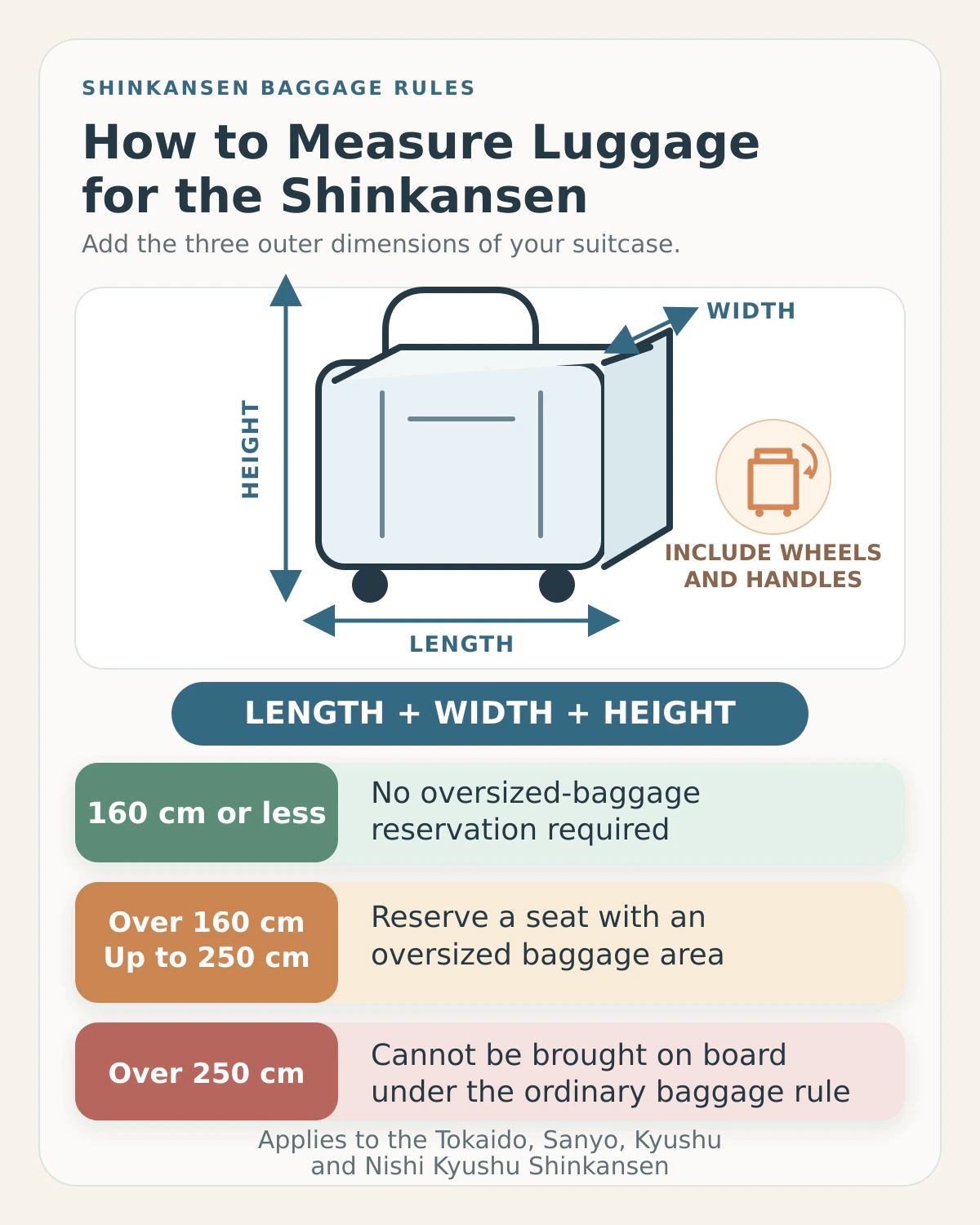
Measure the suitcase before booking. Add its length, width and height, including wheels and handles. The oversized-baggage reservation rule applies to the 東海道 / Tōkaidō / Tokaido, 山陽 / San’yō / Sanyo, 九州 / Kyūshū / Kyushu and 西九州 / Nishi Kyūshū / Nishi Kyushu Shinkansen.
| Total of Three Dimensions | Current Rule on the Applicable Shinkansen Lines | Practical Advice |
|---|---|---|
| 160 cm or less | No special oversized-baggage reservation is required | Use the overhead rack, foot space or available deck storage without blocking the aisle |
| More than 160 cm and up to 250 cm | Reserve a seat with an oversized baggage area | The reservation does not add a separate baggage-space fee; book early because eligible seats are limited |
| More than 250 cm | Cannot be brought on board under the ordinary baggage rule | Use a delivery service or reconsider the baggage |
Bringing oversized baggage on an applicable train without the required reservation can result in a ¥1,000 baggage fee, and the crew will direct where it must be stored. If the eligible seats are sold out, choose another train or forward the suitcase rather than relying on space appearing after boarding.
The same reservation system does not apply universally to every Shinkansen or conventional train in Japan. Storage arrangements still vary by operator and train, and passengers remain responsible for their own luggage. Check the official oversized-baggage rules for the applicable route.
Strollers, sports equipment and musical instruments are treated differently from ordinary oversized suitcases, but you need the appropriate reservation if you want to use a designated oversized-baggage area. A suitcase under 160 cm may also be difficult to lift or fit at your feet. In that case, reserve suitable baggage space where available or send it ahead.
Our guide to buying Shinkansen tickets explains station machines, ticket counters and official online reservation services.
What to Keep With You When Forwarding Luggage
Pack as if the suitcase could arrive later than planned. Keep the following in your day or overnight bag:
- Passport, wallet, cash and payment cards
- Prescription medicine and anything needed for health or accessibility
- Phone, essential electronics, chargers and power bank
- Tickets, reservation details and accommodation access instructions
- Valuables, fragile items and anything difficult to replace
- One change of clothes and basic toiletries
- Items a child will need before the main bag arrives
Large luggage also affects the final part of a journey. A station that feels convenient with a day bag may feel very different with a heavy suitcase, several exits and no direct lift on the route you chose. For the wider station process—platforms, transfers, exits and ticket gates—see How to Use Trains and Subways in Japan.
Plan Where the Suitcase Will Sleep
A useful luggage plan follows the itinerary one night at a time. Decide which accommodation or service counter will physically receive the main suitcase, then pack a smaller bag for any night in between. This is more reliable than deciding at the station after checkout.
A staffed hotel can often help with storage, paperwork and dispatch. A smaller or remotely managed stay may place you closer to neighborhood shops and daily life, but luggage reception may require more preparation. Neither arrangement is automatically better; the important point is to match the luggage plan to the way the property operates.
If your route is still taking shape, use How to Prepare for a Trip to Japan to place luggage decisions after the main route and accommodation bookings, but before final transport reservations and departure checks.
Last verified: September 26, 2026 (JST). Delivery areas, prices, cutoff times, counter hours and railway baggage rules can change. Confirm the carrier, accommodation and train operator that apply to your route.
Frequently Asked Questions
- Is luggage forwarding in Japan reliable?
-
It is a well-established service, but no delivery is risk-free or immune to weather and transport delays. Confirm the scheduled date, keep the tracking receipt and carry anything essential or irreplaceable with you.
- Can I send luggage to an Airbnb or vacation rental in Japan?
-
Only when the property explicitly confirms that someone can receive and store it. Yamato restricts pickup and delivery at an Airbnb-like stay without reception staff, while Sagawa excludes unmanned stays from its same-day hotel-delivery service. Use a staffed hotel, confirmed carrier-office pickup or short-term storage when the property cannot accept the bag.
- Can I send a suitcase from a convenience store?
-
Some participating convenience stores accept outbound parcels for supported carriers and sizes. Under Yamato’s arrangement, a convenience store cannot be used as the destination for collecting a forwarded bag.
- How far ahead should I send luggage in Japan?
-
Standard delivery takes at least one day and may take two or more depending on distance, while remote areas and airport delivery may need longer. Ask for the actual arrival date and cutoff for the route before sending the bag.
- Do I need a Shinkansen luggage reservation?
-
On the Tokaido, Sanyo, Kyushu and Nishi Kyushu Shinkansen, an ordinary suitcase measuring more than 160 cm and up to 250 cm in total requires the appropriate oversized-baggage seat reservation. Other lines and special items follow different arrangements, so check the operator for the train you will use.
- Should I forward every suitcase between cities?
-
No. Carry a manageable suitcase when the journey is direct and storage is arranged. Forward it when doing so removes difficult local transfers, stairs, buses or a short stop where you only need an overnight bag.