Is March a Good Time to Visit Japan?
Yes—especially if you are comfortable with changeable weather and do not need cherry blossoms to define the whole trip. March works well for a classic city route, longer walks on milder days, early spring flowers, and trips that deliberately include remaining snow.
If your dates are still flexible and you are deciding between March, April, and May, compare them first in our Spring in Japan: March to May, Weather, Cherry Blossoms & Where to Go guide. The rest of this article assumes that March is already chosen.
Japan Weather in March: How Warm Is It?
March is warmer than February in long-term averages, but “spring weather” is too broad a description for the whole country. The figures below are Japan Meteorological Agency climate normals for 1991–2020.
| Destination | Average Daily High | Monthly Mean | Average Daily Low | Practical Meaning |
|---|---|---|---|---|
| 札幌 / Sapporo / Sapporo | 4.5°C | 1.1°C | −2.4°C | Winter clothing remains useful; snow and icy walking can still shape the trip |
| 東京 / Tōkyō / Tokyo | 14.2°C | 9.4°C | 5.0°C | Mild afternoons are possible, but mornings and evenings still need layers |
| 京都 / Kyōto / Kyoto | 14.1°C | 8.8°C | 4.3°C | Cold starts and long outdoor days make removable layers useful |
| 大阪 / Ōsaka / Osaka | 14.2°C | 9.9°C | 6.0°C | Transitional city weather; do not assume every day will feel warm |
| 福岡 / Fukuoka / Fukuoka | 15.0°C | 10.8°C | 7.2°C | A milder major-city option, with cool or wet periods still possible |
| 那覇 / Naha / Naha | 21.9°C | 19.1°C | 16.7°C | Much warmer than mainland Japan; light layers and rain protection are useful |
Source: Japan Meteorological Agency climate normals (1991–2020). Kyoto values are from the JMA Kyoto observatory normals (Japanese). These are long-term averages, not a forecast for a particular trip.
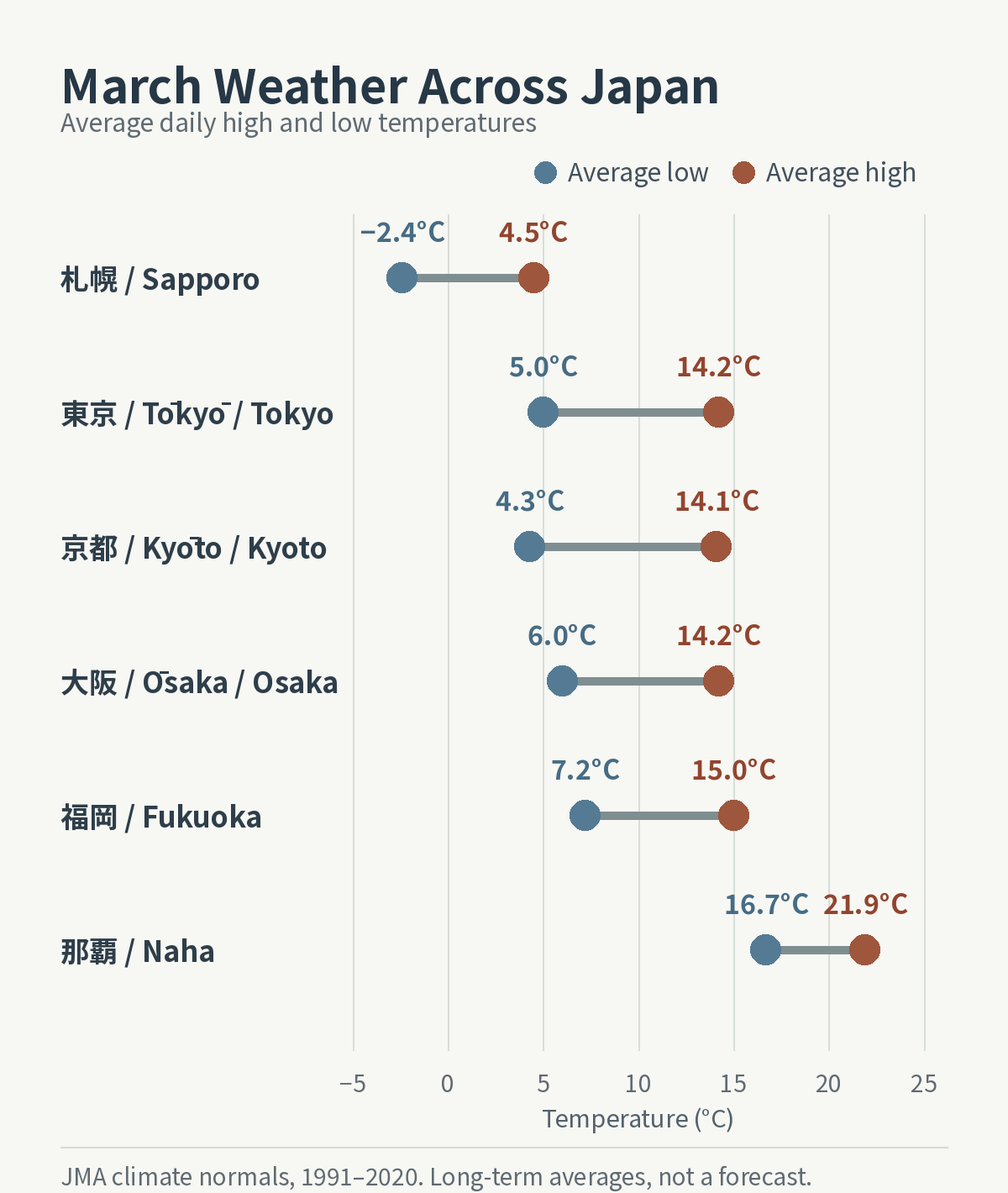
Pack for the morning low and the coldest destination, not only for the afternoon high. Wind, shade, and rain can make a day of outdoor sightseeing feel colder than the number on a weather app suggests.
Several major cities receive more total precipitation in March than in February in the long-term normals. A compact umbrella or light rain shell earns its place even when no rain appears in the early forecast.
Pollen Can Matter in March
花粉 / Kafun / pollen is easy to overlook when planning for temperature alone. In Tokyo, Japanese cedar pollen typically peaks in March, while the timing and intensity vary by region and year.
If pollen affects you, check local pollen information with the daily weather and keep the supplies you normally use in your day bag. The Tokyo Metropolitan Government’s English allergy guidance explains the local season and basic ways to reduce exposure.
Early, Mid, or Late March: What Changes?
A monthly average hides how quickly conditions can change. The part of March matters almost as much as the destination.
| Part of March | Typical Pattern | Best Fit | Main Planning Point |
|---|---|---|---|
| Early March | Late-winter city weather; established winter in northern and mountain regions | Classic cities, plum blossoms, snow trips, skiing | Bring proper layers and do not expect the main cherry-blossom season |
| Mid-March | Milder afternoons become more common, but cold or wet periods still occur | City walking, early flowers, onsen stays, spring skiing | Check the holiday calendar, event dates, and exact resort conditions |
| Late March | Spring becomes more visible in warmer lowlands; colder regions remain wintry | Classic routes with a possible cherry-blossom layer | Protect key accommodation, then keep lower-priority city days flexible |
Early March: Pack for Late Winter
Many major cities are usually easier to walk around than in midwinter, but a thin spring jacket may not be enough after sunset. Plum blossoms and a few early-flowering cherry varieties can add color without indicating that the main cherry-blossom season has begun.
Mid-March: Expect Larger Day-to-Night Changes
Comfortable afternoons become more common in central and western cities, but the same day can still end with a cold walk back to the accommodation. Snow regions remain suitable for winter scenery and skiing, although the exact resort, elevation, and date matter more than they do in midwinter.
春分の日 / Shunbun no Hi / Vernal Equinox Day is a national holiday whose date changes by year. It does not close the country, but a long weekend can increase domestic demand for transport and accommodation. Check the Cabinet Office holiday calendar (Japanese) for the year of your trip.
Late March: Blossoms Become Possible, Not Certain
In warmer lowland destinations, late March may begin to look like the spring many visitors expect. A forecasted opening date, however, is not the same as full bloom, and northern Japan or higher elevations remain on a later calendar.
If blossoms matter, leave one or two local sightseeing days adjustable. Moving a park or neighborhood walk within the same city is usually more practical than adding a long-distance detour to chase an early forecast.
Can You See Cherry Blossoms in Japan in March?
Possibly—mainly in warmer lowland destinations later in the month. March is part of Japan’s wider cherry-blossom season, but it does not guarantee the same stage of bloom in every city.
桜 / Sakura / cherry-blossom timing changes with the year, region, elevation, and tree variety. Northern and mountain destinations generally bloom later than warmer lowlands.
Before using a forecast, check whether it shows 開花 / Kaika / first bloom or 満開 / Mankai / full bloom. Under the Japan Meteorological Agency observation standard, first bloom is recorded when five or six blossoms have opened on a sample tree, while full bloom means about 80% or more are open. Forecast providers may use different definitions, and neither stage means every park or riverside will look the same. Wind and rain can then shorten the viewing window.
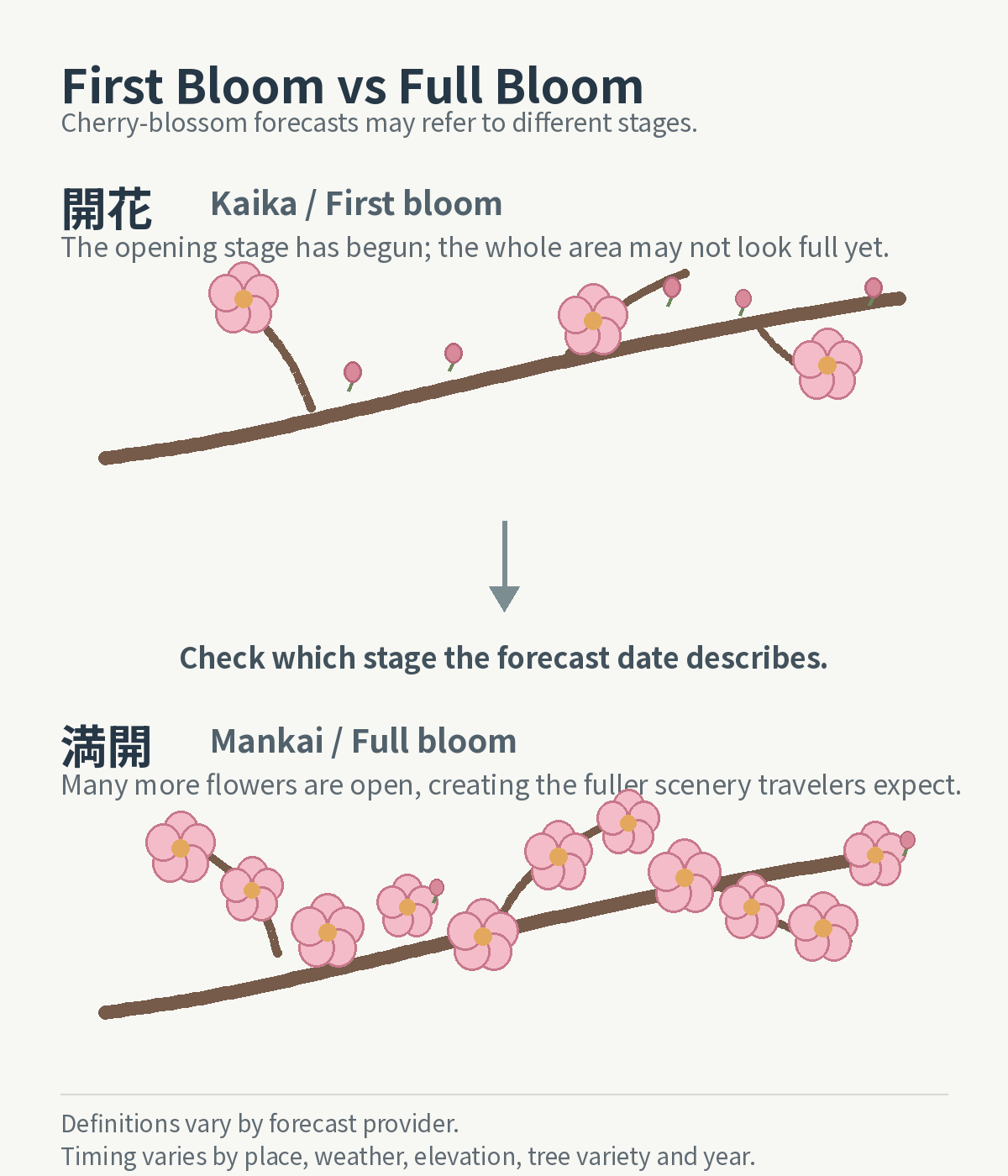
If blossoms are important, check the Japan National Tourism Organization cherry-blossom page when a forecast for your travel year is available. Use it to adjust nearby days, not as a reason to make the entire itinerary depend on one predicted date.
Does It Snow in Japan in March?
Yes. Hokkaido, northern areas of 本州 / Honshū / Honshu, the Sea of Japan side, and mountain regions can remain snowy throughout March. Existing snow may stay deep even as daytime temperatures begin to rise.
Tokyo, Kyoto, Osaka, and Fukuoka are different. Snow can occur, but none is a dependable choice for a lasting white landscape.
March Skiing Depends on the Exact Resort
March can still be a good ski month at major or higher-elevation resorts. Lower and warmer areas may have less terrain open or finish their season earlier, and snow quality can change as the month progresses.
Choose the resort before booking the surrounding route. Check its official lift status, open terrain, snow report, shuttle or bus schedule, and planned closing date for your exact stay. If skiing is only optional, do not make a large detour until those details are confirmed.
Where to Go in Japan in March
The classic city route remains the default for a first trip. Use the table below to identify when another March experience matters enough to justify changing it.
| Main Priority | Best March Fit | Why It Works | Main Caveat |
|---|---|---|---|
| First trip to Japan | Tokyo, Kyoto, and Osaka | The classic route remains practical throughout March | Pack layers and treat blossoms as a bonus, especially before late March |
| Late-March blossoms | Keep the preferred cities and leave local days flexible | Small schedule changes are easier than chasing blooms across the country | Neither first bloom nor full bloom is guaranteed for fixed dates |
| Snow or skiing | A specific Honshu snow destination or a Hokkaido-based route | Winter conditions remain realistic in suitable locations | Operations, snow quality, access, and closing dates vary by resort |
| Fukuoka or Kyushu is already a priority | Fukuoka and a northern Kyushu route | The city is somewhat milder and works well as a Kyushu gateway | The temperature advantage over Tokyo or Osaka is modest; inland and mountain areas remain cooler |
| Much warmer weather | Okinawa | March is considerably warmer than on the mainland | It is a separate island trip with a different seasonal rhythm |
Default: Keep Tokyo, Kyoto, and Osaka
March does not require a special seasonal itinerary. Keep the classic route if these are the places you most want to experience, then adjust what you pack, when you plan longer outdoor periods, and which local days remain flexible for flowers.
Later in the month, a park, riverside, temple district, or neighborhood walk can be moved to the best-looking day. Seasonal scenery close to the accommodation may fit more naturally than crossing the city for one famous viewing spot.
Choose Snow First Only When It Is a Real Priority
If snow or skiing is one of the reasons you chose March, give the destination enough time to be a proper part of the trip. A rushed day trip becomes more fragile when lift operations, mountain transport, or weather change.
For a route already centered on Tokyo, an accessible Honshu snow destination may require less backtracking than Hokkaido. Compare door-to-door travel time from the previous stay to the next stop, not only the destination’s distance from Tokyo.
Hokkaido is the clearest large-region option, but its cities, resorts, and remote areas need different plans. Our Hokkaido Travel Guide: How to Plan Your First Visit explains how to choose a base, airport, number of nights, and transportation.
Fukuoka and Kyushu: Mildness Is a Bonus
Fukuoka is somewhat milder than Tokyo or Osaka in the March averages, but the difference is not large enough to justify rerouting a first trip for temperature alone. Choose it because the city and Kyushu interest you; treat the milder weather and earlier seasonal change as benefits. Mountain and inland areas remain cooler. Our Fukuoka Travel Guide: How to Plan Your First Visit helps you decide whether the city belongs in the route as a stay or as the gateway to a longer Kyushu trip.
Okinawa: Choose It for a Different Kind of March
Okinawa is the warmer choice when an island climate, coastline, and regional food matter more than the standard mainland city journey. Do not choose it as a substitute for mainland cherry-blossom timing.
What Can You Experience Besides Cherry Blossoms?
Early Spring Flowers
梅 / Ume / plum blossoms often continue into March in selected locations. 菜の花 / Nanohana / rapeseed flowers and early-flowering cherry varieties may also appear, depending on the region and year.
These flowers give early-March travelers a genuine seasonal experience without pretending that the main cherry-blossom period has arrived. Check the current bloom status of the specific garden, park, or neighborhood shortly before visiting.
Recurring March Events Worth Checking
These events can deepen a route that already includes the destination. They do not need to become separate long-distance detours by default.
- ひな祭り / Hinamatsuri / Doll Festival: observed on March 3. It is not a national holiday, and public displays or visitor events depend on the individual venue.
- 修二会 / Shuni-e / Shuni-e Ceremony (Omizutori): held at Tōdai-ji’s Nigatsu-dō in 奈良 / Nara / Nara from March 1 to 14. Check the official Tōdai-ji annual event page for current visitor information.
- 大相撲三月場所 / Ōzumō Sangatsu Basho / March Grand Sumo Tournament: held in Osaka, with dates and advance ticket sales published for each year on the official Grand Tournament schedule.
Before making a non-refundable booking around an event, confirm the year’s dates, venue, public access, ticket requirements, and return transportation.
What to Wear in Japan in March
Pack for the coldest destination and use layers that can be removed during a mild afternoon. One fixed “March outfit” will not work in Sapporo, Tokyo, and Naha.
| Route | Clothing Approach | Footwear and Extras |
|---|---|---|
| Tokyo / Kyoto / Osaka | Long sleeves, a knit or fleece mid-layer, and a light insulated jacket or medium-weight coat | Comfortable closed walking shoes; compact umbrella or light rain shell |
| Hokkaido / snow country | Winter outerwear, warm base layers, gloves, and a hat, adjusted to the exact destination | Water-resistant footwear with grip for snow, ice, and wet surfaces |
| Fukuoka / Kyushu city route | Removable city layers, with extra warmth for mornings, evenings, mountains, and inland trips | Comfortable closed shoes and rain protection |
| Okinawa | Lighter layers with a jacket for wind, rain, or cooler evenings | Normal walking shoes; sun and rain protection |
Keep the warmer layer accessible instead of packing it at the bottom of a suitcase. Shaded temple grounds, exposed station platforms, evening walks, and a move to a colder region can feel very different from a sunny city afternoon. For children, carry one removable warm layer in the day bag rather than relying on the day’s expected high.
March Crowds and Accommodation: Book the Hardest Night First
March is not busy everywhere at the same time. Weekends, the Vernal Equinox holiday, the Osaka sumo tournament, ski areas, and the year’s blossom timing can each create demand in a different place.
Book the stay that would be hardest to replace before filling in ordinary city nights. That may be a ski resort, an onsen town with limited rooms, an event date in Osaka, or a late-March stay in a particularly important neighborhood.
In a city, a neighborhood with nearby restaurants and a pleasant walking route gives the day more flexibility when the weather changes. Later in March, staying near a river, park, or temple district also makes it easier to notice seasonal change in the morning without adding another cross-city journey.
In snow country, check the final shuttle or bus, uphill walking, and how luggage will move over snow or wet ground. An overnight 温泉 / Onsen / hot-spring stay can fit naturally, but review the bathing sequence and facility-specific rules in our Onsen & Sento Etiquette in Japan guide before arrival.
Weather and Holiday Weekends Can Affect Transportation
Transportation between Japan’s main cities is generally straightforward in March. Snow, heavy rain, or strong wind can still affect trains, buses, flights, and roads in exposed or mountainous areas.
Leave extra time between a ski or mountain stay and an international flight. If severe weather begins to affect the route, our Natural Disasters in Japan: Earthquakes, Typhoons & What to Do guide explains how to check official warnings and transportation information.
When the Vernal Equinox creates a long weekend, or when a family or group needs seats together on a specific 新幹線 / Shinkansen / bullet train, advance reservations may be useful. Our How to Buy Shinkansen Tickets in Japan guide explains when booking ahead is worth it and which purchase method fits the route.
Plan a March Trip in This Order
- Identify the part of March. Early and late March need different weather and blossom expectations.
- Keep the default route unless a priority justifies changing it. The classic city route remains the best starting point for most first trips.
- Secure the least replaceable stay. Book the snow destination, onsen town, event date, or important late-March neighborhood before ordinary city nights.
- Recheck the conditions that can change. Shortly before departure, review the weather, pollen, current-year blossom forecast, and any resort lift or shuttle status.
- Pack for the coldest stop and protect the final connection. A mild afternoon in one city does not remove winter from a northern or mountain route.
For most first trips, March should shape what you pack and which parts of the day stay flexible—not force an entirely new itinerary.
Frequently Asked Questions
- Is March a good month to visit Japan?
-
Yes. March suits travelers who are comfortable with layers and changeable weather. Tokyo, Kyoto, and Osaka remain practical, while suitable northern and mountain destinations can still provide snow.
- How cold is Japan in March?
-
Conditions vary widely. Long-term March mean temperatures are 1.1°C in Sapporo, 9.4°C in Tokyo, 8.8°C in Kyoto, 9.9°C in Osaka, 10.8°C in Fukuoka, and 19.1°C in Naha.
- Does it snow in Japan in March?
-
Yes. Hokkaido, northern Honshu, the Sea of Japan side, and mountain regions can remain snowy. Tokyo, Kyoto, Osaka, and Fukuoka are not dependable choices for a snow-focused trip.
- Can I see cherry blossoms in Japan in March?
-
Possibly, especially in warmer lowland destinations later in March. Timing changes by year, region, elevation, and variety, and first bloom is not the same as full bloom.
- What should I wear in Japan in March?
-
For Tokyo, Kyoto, and Osaka, bring long sleeves, a removable warm mid-layer, a light insulated jacket or medium-weight coat, and comfortable closed shoes. Snow regions need winter outerwear and water-resistant footwear with grip.
- Is March a good time for skiing in Japan?
-
It can be. Many major or higher-elevation resorts still operate, but open terrain, snow quality, transportation, and closing dates vary. Check the exact resort for your dates before booking the route.
- Is pollen a problem in Japan in March?
-
It can be for sensitive travelers. In Tokyo, Japanese cedar pollen typically peaks in March, although timing and intensity vary by region and year. Check local pollen information together with the weather forecast.
- Is Japan crowded in March?
-
Not everywhere or throughout the month. Demand can rise around weekends, the Vernal Equinox holiday, major events, ski areas, and late-March blossom periods in popular destinations.