
Is April a Good Time to Visit Japan?
Yes. April offers comfortable walking weather in many major destinations, longer daylight than winter, spring gardens, and seasonal scenery that appears in both famous places and ordinary neighborhoods.
The trade-off is demand. Popular cherry-blossom periods can make accommodation and well-known sightseeing areas busy, while travel around April 29 and early May overlaps with Golden Week. Blossom timing also changes each year, so April is a strong travel month but not a promise of one exact scene.
If your trip continues into May, our Japan in May guide explains how Golden Week, warmer weather, fresh greenery, and regional rainy-season differences affect the next part of the journey.
If your dates are still flexible and you are choosing between March, April, and May, start with Spring in Japan: March to May, Weather, Cherry Blossoms & Where to Go. The rest of this guide assumes that April is already chosen or nearly fixed.
Japan Weather in April: How Warm Is It?
April is milder than March across Japan, but the regional gap remains large. The figures below are Japan Meteorological Agency climate normals for 1991–2020, not a forecast for a particular trip.
| Destination | Average Daily High | Monthly Mean | Average Daily Low | Practical Meaning |
|---|---|---|---|---|
| 札幌 / Sapporo | 11.7°C | 7.3°C | 3.4°C | A proper jacket and warm layers remain useful; snow may still affect mountain areas |
| 東京 / Tōkyō / Tokyo | 19.4°C | 14.3°C | 9.8°C | Mild afternoons are common, but mornings, evenings, wind, and rain can feel cool |
| 京都 / Kyōto / Kyoto | 20.1°C | 14.4°C | 9.2°C | Layer for cool starts and warmer daytime walks |
| 大阪 / Ōsaka / Osaka | 19.9°C | 15.2°C | 10.9°C | Light layers suit many days, with a jacket still useful after sunset |
| 福岡 / Fukuoka | 19.9°C | 15.4°C | 11.5°C | Generally mild, but rain and cooler days still require a removable outer layer |
| 那覇 / Naha | 24.3°C | 21.5°C | 19.1°C | Warm and more humid; light clothing and rain protection are more useful |
Source: Japan Meteorological Agency climate normals (1991–2020). Kyoto values are from the JMA Kyoto observatory normals (Japanese).
Pack for the coldest stop and the beginning and end of the day, not only for the warmest afternoon shown in a forecast. A route that includes Tokyo, Sapporo, and a mountain town needs more range than a route limited to Tokyo, Kyoto, and Osaka.
April is not guaranteed to be dry. A compact umbrella or light rain shell is useful, and rain can make a mild day feel much cooler. High-elevation roads, trails, and outdoor attractions may also remain snowy or operate on a seasonal schedule even when nearby cities feel like spring.
Pollen Can Still Affect an April Trip
Do not assume Japan’s pollen season ends with March. The timing and type of pollen vary by region and year, but April can still be uncomfortable for sensitive travelers. Check local pollen information with the daily weather and carry the medication or other supplies you normally use.
Early, Mid, or Late April: What Changes?
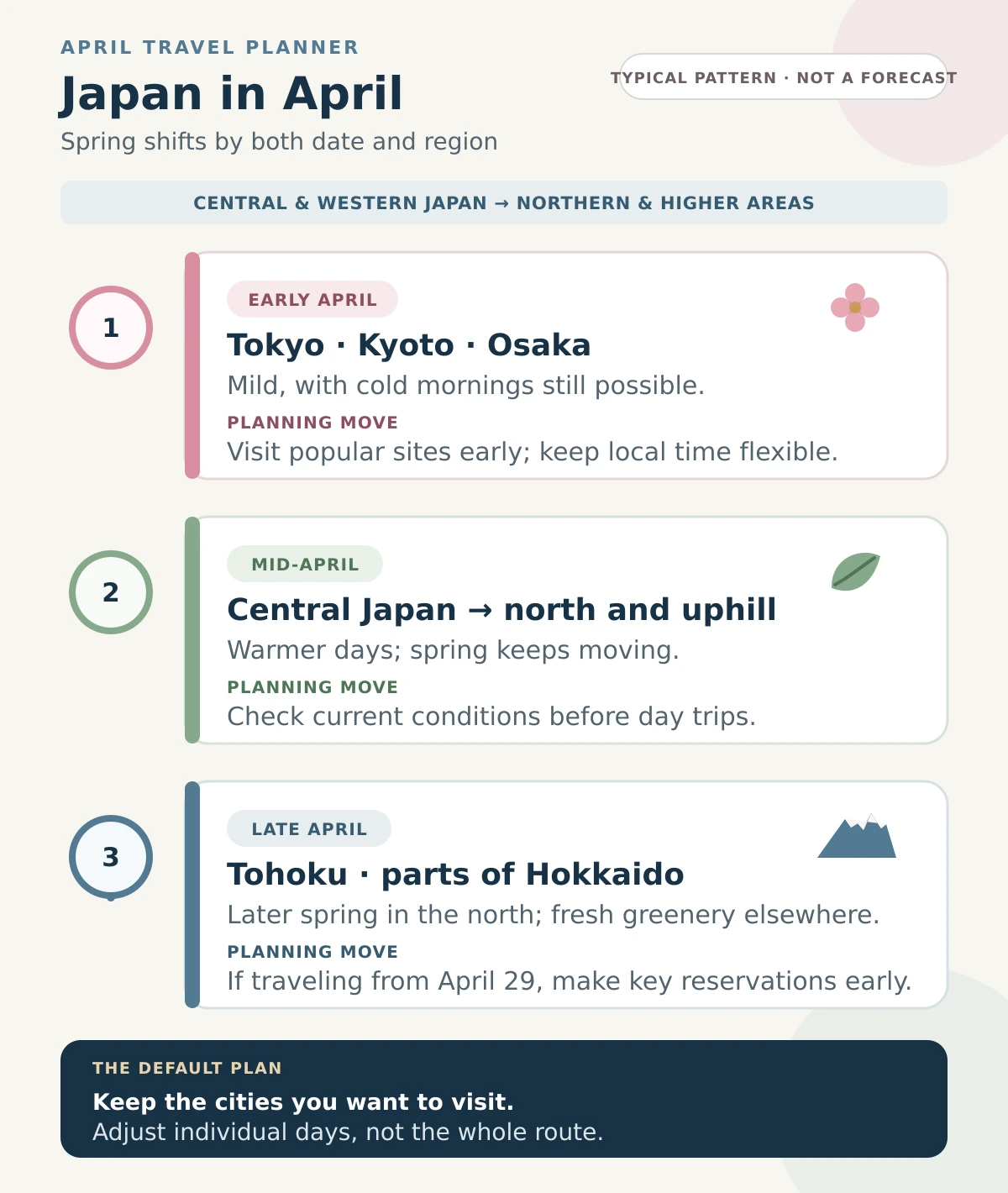
The difference within April matters almost as much as the difference between regions. Use the periods below as planning patterns rather than a flower forecast.
Can You See Cherry Blossoms in Japan in April?
Yes, but not everywhere at the same time. In a typical seasonal progression, the best-known lowland cities in central and western Japan reach their main blossom period earlier than Tohoku and Hokkaido. Elevation, tree variety, and that year’s temperatures can shift the timing within the same region.
桜 / Sakura / cherry-blossom reports also use different stages. The Japan Meteorological Agency defines the opening date as the first day when five or six flowers have opened on a designated sample tree. Full bloom means about 80 percent or more of its buds are open. An “opening” announcement therefore does not mean that an entire city has reached peak scenery.
Long-term JMA data place typical full bloom around late March or early April in Tokyo, Kyoto, and Osaka, later in Tohoku, and later again in much of Hokkaido. Individual years can be noticeably earlier or later. Use the JMA blossom observation pages (Japanese) to check current flowering and full-bloom status once the season is underway.
A Better Way to Plan Around Blossoms
- Choose the cities and regions you would still want to visit without blossoms.
- Keep one or two local periods flexible for parks, riversides, gardens, or a nearby day trip.
- Check current local conditions shortly before and during the trip.
- Change regions only when blossoms are important enough to justify the additional time, cost, and transport.
Use forecasts to adjust a day within the route, not repeatedly rebuild the journey. Neighborhood canals, local parks, and temple paths can offer memorable spring scenery with less schedule pressure.
Where to Go in Japan in April
For a first visit, the classic city route remains the best default. Change the regional emphasis only for a specific April experience.
| Main Priority | Best April Fit | Why It Works | Main Caveat |
|---|---|---|---|
| First trip to Japan | Tokyo, Kyoto, and Osaka | Mild walking weather, strong transport links, and spring scenery within an already useful route | Popular areas can be busy, particularly during blossom periods |
| Blossoms in early April | Keep the preferred central or western cities and leave local time flexible | Small day-level changes are easier than chasing flowers across Japan | Exact stages vary by city, year, and tree variety |
| Blossoms in mid- or late April | Consider Tohoku or parts of Hokkaido after checking current conditions | Spring generally reaches colder regions later | A northern detour needs enough time to justify the journey, and timing remains uncertain |
| A warmer trip | Okinawa | Temperatures are much warmer than in mainland cities | Okinawa’s main cherry-blossom season is earlier, and this becomes a different island-focused trip |
| Mountains, onsen, or remaining snow | A specific accessible mountain or hot-spring destination | April can combine spring at lower elevations with colder scenery higher up | Roads, trails, buses, lifts, and attractions may follow seasonal operating schedules |
Tokyo, Kyoto, and Osaka: Keep the Core Route
For a first visit, Tokyo, Kyoto, and Osaka remain practical whether the trees are approaching full bloom, losing petals, or turning green. Build each day around a district rather than a sequence of famous flower spots, so spring scenery complements the trip instead of controlling every hour.
Tohoku and Hokkaido: Choose Them for More Than a Later Bloom
Northern Japan can be attractive when you are traveling later in April, but it should not be treated as a guaranteed backup plan. Choose Tohoku or Hokkaido because the wider region—its cities, landscapes, food, or onsen—belongs in the trip. Later blossoms can then become part of that route rather than its only reason to exist.
Mountain Areas: Check Access, Not Just Temperature
A warm forecast in Tokyo does not tell you whether a highland trail, mountain road, bus route, or outdoor attraction is fully open. Check the responsible operator for the exact destination and date. If the route is not operating normally, choose a lower-elevation town or make the mountain stop optional.
What to Wear in Japan in April
Removable layers are the safest default. The goal is to handle a cool morning, a mild afternoon, an air-conditioned train, and a damp evening without carrying a winter wardrobe through every city.
| Area | Useful Clothing | Do Not Overlook |
|---|---|---|
| Tokyo, Kyoto, Osaka, and Fukuoka | Long- or short-sleeved base layers, a light sweater or cardigan, a light jacket, long trousers, and comfortable walking shoes | A cooler outer layer for early April, rainy days, and evenings |
| Tohoku, Hokkaido, and mountain areas | Long sleeves, a warm mid-layer, a warmer jacket, long trousers, and closed shoes | Water-resistant footwear and extra warmth where snow or cold wind remains |
| Okinawa | Light, breathable clothing with a thin layer for evenings or indoor air conditioning | Rain protection, sun protection, and footwear suitable for wet conditions |
For a typical Tokyo–Kyoto–Osaka trip, start with long trousers, walking shoes, a light top, one removable mid-layer, and a light jacket. Add or remove layers after checking the short-range forecast. If the itinerary crosses regions, pack for the coldest destination rather than trying to make one city’s average represent the whole trip.
- Comfortable shoes for long city and garden walks
- A compact umbrella or light rain shell
- A bag large enough to hold a removed layer
- Sun protection for longer outdoor days
- Any pollen supplies you normally rely on
April Crowds: Cherry Blossoms and Golden Week Are Different
April has two separate demand patterns. Cherry-blossom crowds depend on the local bloom stage and are often concentrated at famous parks, riversides, temples, castles, and weekend events. Golden Week is a national holiday period that affects domestic travel more broadly.
昭和の日 / Shōwa no Hi / Shōwa Day falls on April 29. It is followed by national holidays on May 3, 4, and 5. Weekends and substitute holidays change the shape of the break from year to year, and some travelers take additional days off between the holidays. Check the Cabinet Office holiday calendar (Japanese) for your travel year.
If your trip overlaps April 29 through early May, settle the fixed parts of the journey first: accommodation, essential intercity travel, domestic flights, and any attraction that requires a reservation. Our guide to buying Shinkansen tickets in Japan explains when advance seat reservations are useful and which official service covers each route.
- Reserve a specific train when the travel date and time cannot move.
- Keep local sightseeing flexible instead of reserving every hour.
- Allow more station time when traveling with children, a group, or large luggage.
- April 30 and May 1–2 are not fixed national holidays, but weekends, substitute holidays, and personal leave can still create a continuous busy travel period.
How Accommodation Changes an April Trip
During busy spring periods, location can matter more than adding another attraction. Staying near a useful station reduces the strain of early starts, rain, and crowded transfers, while nearby restaurants and shops provide an easy fallback when a seasonal site is busier than expected.
Secure route-defining stays before building a blossom schedule. If flexibility matters, compare cancellation and change conditions before paying. For trips overlapping Golden Week, waiting for a blossom forecast creates more risk than it removes.
Enjoy April Without Chasing One Famous Spot
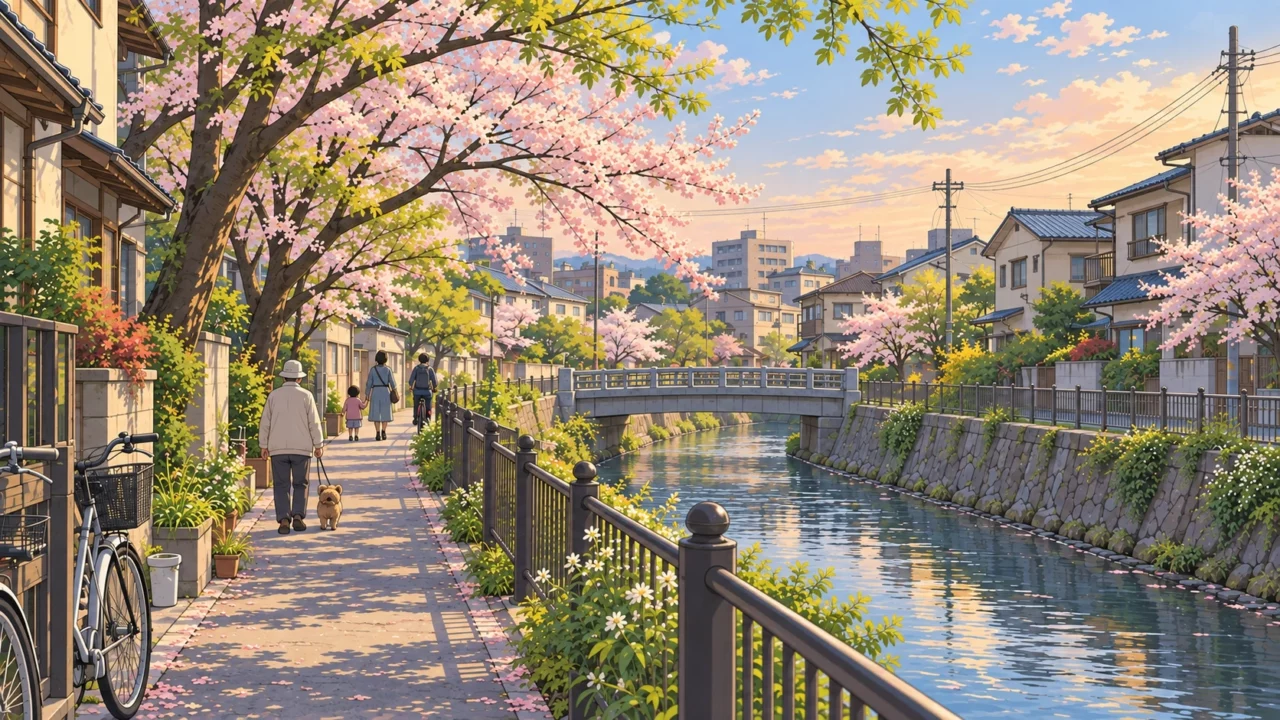
花見 / Hanami / flower viewing does not require a full day in the busiest park. It can be a canal walk, lunch beneath neighborhood trees, petals on a temple path, or an evening stroll near the accommodation.
As cherry blossoms finish, fresh leaves, wisteria, azaleas, and other spring flowers change gardens and streets. Timing still varies, so choose good places to walk rather than depend on one promised stage.
A neighborhood stay makes these smaller seasonal changes easier to notice. Riversides, shopping streets, shrine approaches, and local parks look different from morning to sunset, letting spring become part of the day rather than a single scheduled stop.
Recurring April Events Worth Checking
Use an event to deepen an existing route, not automatically justify a long detour during a high-demand season.
- 都をどり / Miyako Odori: This traditional spring dance performance by the geiko and maiko of Gion Kobu is held in Kyoto during April. Performance times, ticket release dates, prices, and availability are published on the official Miyako Odori website.
- 春の高山祭 / Haru no Takayama Matsuri / Takayama Spring Festival: Held on April 14 and 15, the festival features ornate floats and traditional performances in Takayama. Check the official Hida Takayama visitor information for the year’s schedule, weather-related changes, and access details.
Before making a non-refundable booking, confirm the year’s schedule and ticket or access conditions. Takayama works best as a meaningful regional stop, not a rushed add-on from Tokyo or Kyoto.
Plan an April Trip in This Order
- Check the dates. Note whether the trip includes April 29 or continues into the early-May Golden Week holidays.
- Keep the core route. For a first visit, start with the cities and regions you want even without perfect blossoms.
- Choose the regional exception. Add Hokkaido, Tohoku, Okinawa, or a mountain area only when its wider experience justifies the journey.
- Book the fixed parts. Secure accommodation and essential long-distance travel before filling the days with seasonal stops.
- Pack for the coldest stop. Use layers and bring rain protection rather than relying on one nationwide temperature.
- Check live conditions later. Use short-range weather, local blossom status, and official operating information to adjust individual days.
If you still need to organize flights, accommodation, transport, connectivity, and other preparations, follow How to Prepare for a Trip to Japan: What to Plan Before You Go in dependency order.
Frequently Asked Questions
- Is April a good month to visit Japan?
-
Yes. April offers mild walking weather in many major cities, spring scenery, and longer outdoor days. The main trade-offs are blossom uncertainty, higher demand in popular areas, and Golden Week travel from late April into early May.
- How warm is Japan in April?
-
It depends on the region. Long-term April mean temperatures are 7.3°C in Sapporo, 14.3°C in Tokyo, 14.4°C in Kyoto, 15.2°C in Osaka, 15.4°C in Fukuoka, and 21.5°C in Naha.
- Can I see cherry blossoms in Japan in April?
-
Often, yes, but the best region depends on the date and year. Tokyo, Kyoto, and Osaka may have blossoms around late March or early April, while Tohoku and Hokkaido generally reach their main season later. Check current conditions rather than treating historical dates as a guarantee.
- What should I wear in Tokyo, Kyoto, and Osaka in April?
-
Use removable layers: a light top, sweater or cardigan, light jacket, long trousers, and comfortable walking shoes. Add rain protection and check the short-range forecast, especially for early April and evening plans.
- Is Japan crowded in April?
-
Some places and periods are. Famous blossom sites can be busy when local trees reach their main stage, especially on weekends. From April 29, Golden Week can increase domestic travel demand more broadly.
- Should I avoid Japan during Golden Week?
-
Not necessarily, but do not treat it like an ordinary travel week. If your dates overlap April 29 through early May, reserve the fixed parts of the trip earlier, expect busy transport and popular destinations, and leave more time around transfers.
- Does it still snow in Japan in April?
-
Yes, in some northern and high-elevation areas. Sapporo is still much cooler than Tokyo or Osaka, and mountain snow can affect trails, roads, and seasonal transport. Check the exact destination rather than assuming all of Japan has moved into the same spring conditions.