
Is May a Good Time to Visit Japan?
May suits travelers who value comfortable outdoor time, fresh greenery, and lighter packing more than peak cherry blossoms in Tokyo or Kyoto. It is less convenient for last-minute intercity travel during Golden Week or for anyone sensitive to warm, humid afternoons.
If your dates are still flexible and you are choosing between March, April, and May, start with Spring in Japan: March to May, Weather, Cherry Blossoms & Where to Go. The rest of this guide assumes that May is already chosen or nearly fixed.
Japan Weather in May: How Warm Is It?
May is warmer than April across Japan, but regional differences remain large. The figures below are Japan Meteorological Agency climate normals for 1991–2020, not a forecast for a particular trip.
| Destination | Average Daily High | Monthly Mean | Average Daily Low | Practical Meaning |
|---|---|---|---|---|
| 札幌 / Sapporo | 17.9°C | 13.0°C | 9.0°C | Cool mornings and evenings still justify a jacket or warm removable layer |
| 東京 / Tōkyō / Tokyo | 23.6°C | 18.8°C | 14.6°C | Comfortable for many outdoor days, with a light layer useful after sunset or in rain |
| 京都 / Kyōto / Kyoto | 25.1°C | 19.5°C | 14.5°C | Warm afternoons are common; lighter clothing and sun protection become more useful |
| 大阪 / Ōsaka / Osaka | 24.9°C | 20.1°C | 16.0°C | Often warm by day, while rain and air-conditioned interiors can still feel cooler |
| 福岡 / Fukuoka | 24.4°C | 19.9°C | 16.1°C | Light clothing suits many days, with rain protection and one removable layer |
| 那覇 / Naha | 27.0°C | 24.2°C | 22.1°C | Warm and humid; prioritize breathable clothing, rain protection, and sun protection |
Source: Japan Meteorological Agency climate normals (1991–2020). Kyoto values are from the JMA Kyoto observatory normals (Japanese).
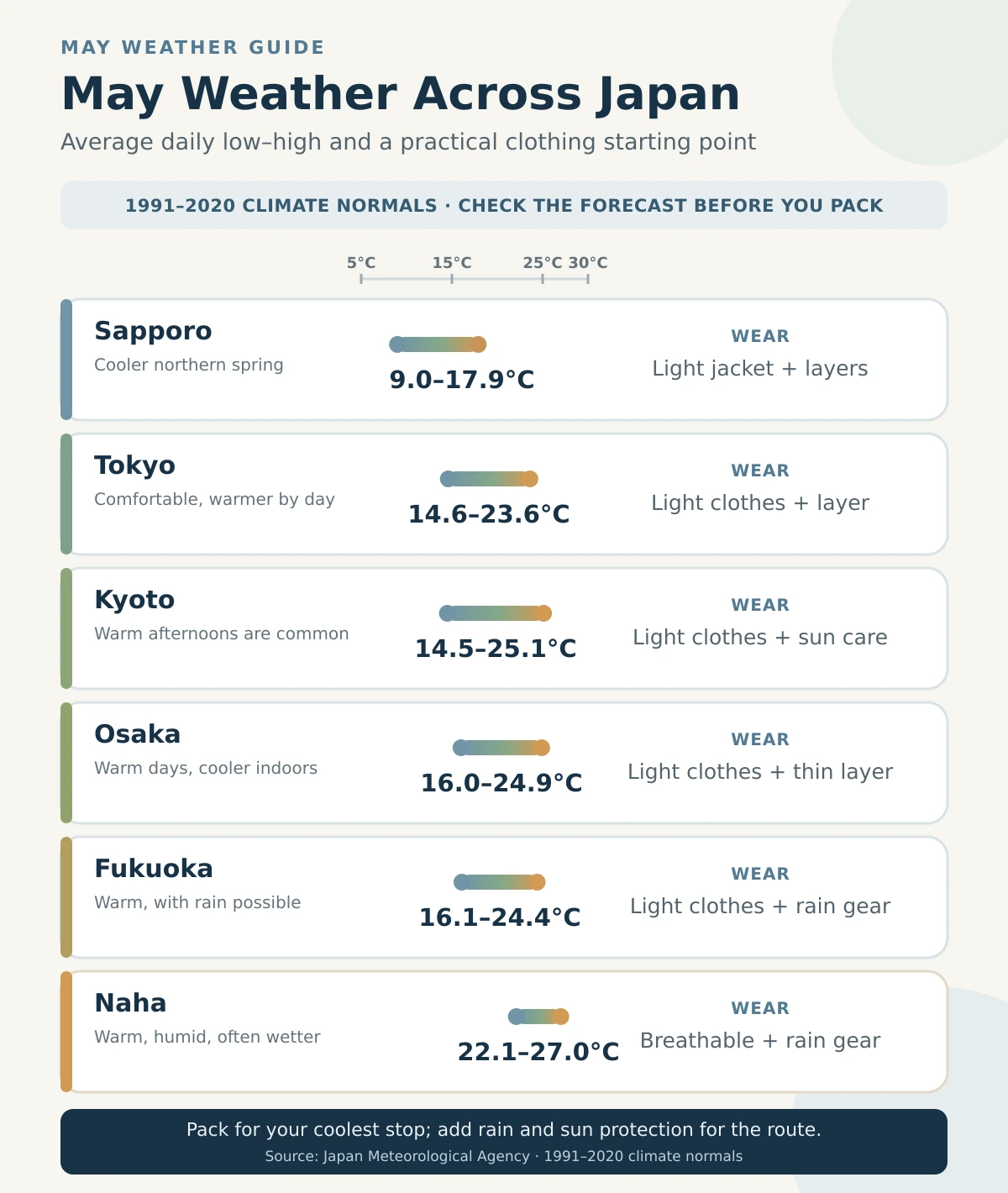
Monthly averages hide day-to-day variation. A cool rainy day in Tokyo can require more clothing than the average suggests, while sunny Kyoto or Osaka can feel warmer. Check each stop’s short-range forecast and carry a layer that fits in your day bag.
Is May Rainy in Japan?
May is not reliably dry. Tokyo, Kyoto, Osaka, and Fukuoka can all have wet days, even though the main rainy-season transition in these areas normally comes later. A compact umbrella or light rain shell remains useful.
Okinawa follows a different seasonal clock. The JMA normal for the start of Okinawa’s rainy season is around May 10, but the actual transition has varied from late April to June in the historical record. Treat that date as a climate reference, not a promise about one trip, and check the JMA Okinawa rainy-season record (Japanese) together with the current forecast.
Early, Mid, or Late May: What Changes?
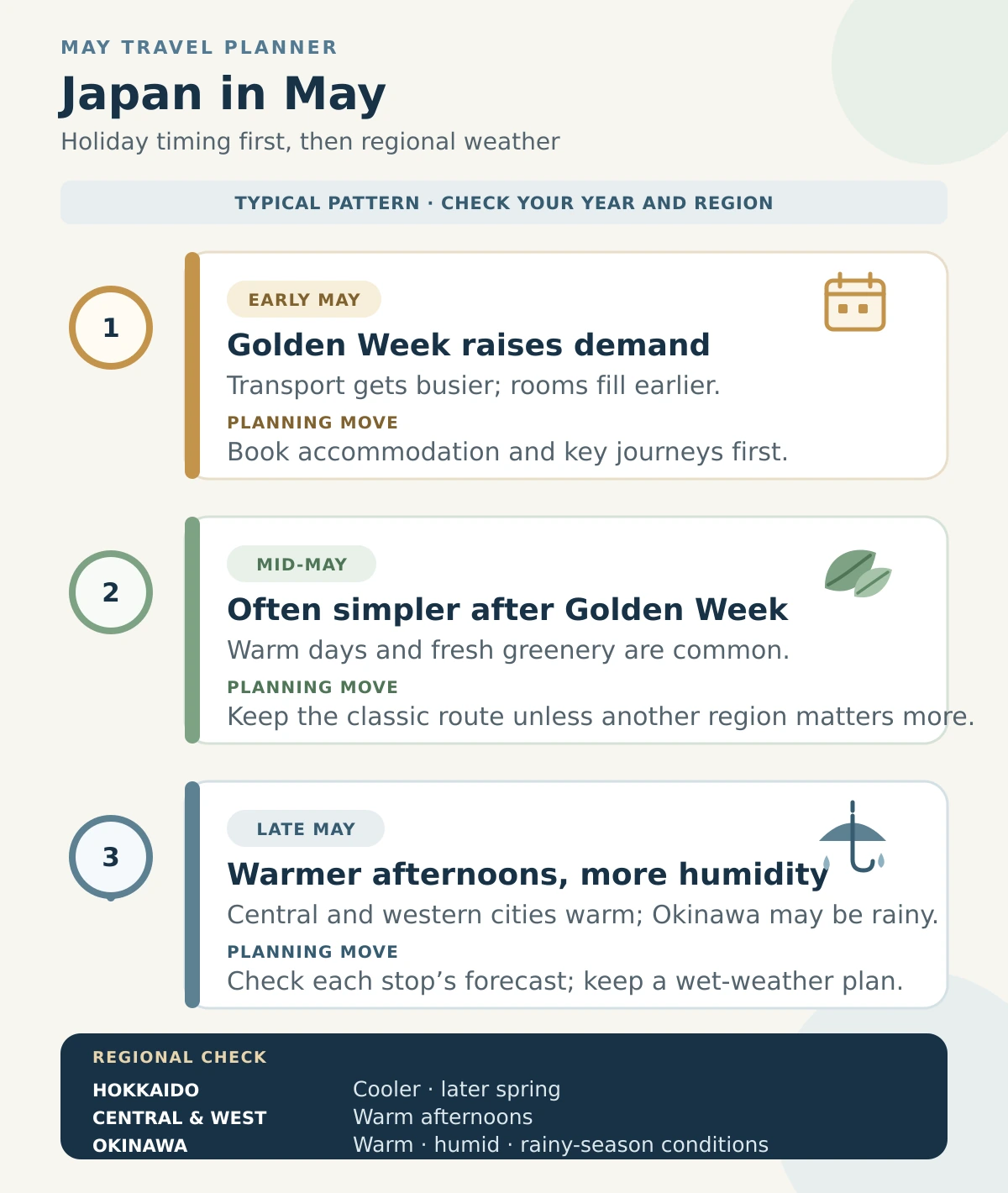
The most important divide is not a precise temperature line. It is the change from Golden Week travel conditions to the rest of the month.
| Part of May | Typical Pattern | Best Fit | Main Planning Point |
|---|---|---|---|
| Early May | Golden Week demand, warm weather in many cities, and possible later blossoms in parts of Hokkaido | Travelers with fixed dates who can reserve their overnight bases and important transport | Use fewer bases, secure important intercity journeys, and allow more transfer time |
| Mid-May | Warmer city weather, fresh greenery, and a return to more ordinary travel patterns after the holiday cluster | Most first-time visitors who want comfortable outdoor days without building the trip around blossoms | Keep the classic route unless a northern, mountain, or island experience is a genuine priority |
| Late May | Warm to occasionally hot afternoons in central and western Japan, increasing humidity, and rainy-season conditions in Okinawa | Travelers comfortable with lighter clothing, sun protection, and flexible wet-weather plans | Check local forecasts and avoid assuming that “before June” means cool or dry everywhere |
Golden Week in May: What Travelers Need to Book
ゴールデンウィーク / Gōruden Wīku / Golden Week is a group of national holidays that begins with Shōwa Day on April 29 and continues with Constitution Memorial Day on May 3, Greenery Day on May 4, and Children’s Day on May 5. Weekends and substitute holidays change the practical length of the break from year to year, and some people take additional leave between the fixed holidays.
Check the Cabinet Office national holiday calendar (Japanese) for your travel year. Do not assume that every date from April 29 through May 5 is a national holiday, but do plan for elevated domestic demand across the broader period.
- Reserve accommodation in each overnight base before optional activities.
- Reserve an intercity train or domestic flight when the travel date and time cannot move.
- Use fewer hotel changes so that one delayed or crowded transfer does not affect several later bookings.
- Keep local sightseeing flexible and allow more time at large stations.
- Confirm the current reservation, opening, and transport rules for any attraction or event that the trip depends on.
Our guide to How to Buy Shinkansen Tickets in Japan explains official booking methods, reserved seats, and when advance purchase is useful during a busy period.
Should You Avoid Golden Week?
Not automatically. If early May is your only option, a well-structured trip can still work. The main change is that spontaneity should move to the local level: settle the hotel bases and essential long-distance journeys, then leave neighborhoods, gardens, meals, and minor day trips adjustable.
If your dates are flexible, moving the core trip until after the holiday period is usually the simpler choice. It reduces booking pressure without requiring a different countrywide route.
Cherry Blossoms and Fresh Greenery in May
Can You See Cherry Blossoms in Japan in May?
Usually not in Tokyo, Kyoto, Osaka, or Fukuoka. By May, the best-known lowland cherry-blossom period in central and western Japan has normally ended. Fresh leaves and other spring flowers are a more realistic expectation.
Parts of Hokkaido may still have blossoms in May, but the exact timing changes by city, elevation, tree variety, and year. Actual dates can differ substantially from long-term normals. Use the JMA cherry-blossom full-bloom records (Japanese) to understand the variation, then check current conditions near the trip.
If your trip begins in late April, our Japan in April: Weather, What to Wear, Cherry Blossoms & Where to Go guide explains how blossom uncertainty and the start of Golden Week affect that part of the journey.
What Replaces the Main Blossom Season?
新緑 / Shinryoku / Fresh greenery is one of May’s strongest seasonal qualities. New leaves change temple grounds, parks, river paths, mountain approaches, and ordinary residential streets without requiring a trip to one famous viewing site.
Wisteria, azaleas, roses, and other flowers may also appear depending on location and year. Treat their timing like weather: check near the visit, but choose gardens and neighborhoods that remain worthwhile at more than one stage.
May 5 is こどもの日 / Kodomo no Hi / Children’s Day. 鯉のぼり / Koinobori / Carp streamers may be displayed before and around the holiday in neighborhoods, parks, riverside areas, and public venues. Enjoy them when they fit the route rather than planning a long detour around a display that may change annually.
Where to Go in Japan in May
May does not require a special “seasonal route.” Start with the places that matter, then change regions only for a distinct experience you genuinely want.
| Main Priority | Best May Fit | Why It Works | Main Caveat |
|---|---|---|---|
| First trip after Golden Week | Tokyo, Kyoto, and Osaka | Warm walking weather, strong transport links, fresh greenery, and no need to chase one seasonal event | Popular sights and weekends can still be busy |
| Cooler weather and later spring | Hokkaido or a northern regional trip | Cooler temperatures, a different stage of spring, and possible later blossoms | The region should be worth the journey without flowers |
| Forests, mountains, and onsen | A specific accessible mountain or rural destination | Fresh greenery and cooler evenings can create a useful contrast with city sightseeing | High-elevation trails, roads, buses, and lifts may follow seasonal schedules |
| Warm island travel | Okinawa | Subtropical scenery, beaches, food, and much warmer conditions than mainland Japan | Humidity and rainy-season conditions can shape outdoor plans |
Tokyo, Kyoto, and Osaka: Keep the Core Route
For a first visit, Tokyo, Kyoto, and Osaka remain the most useful default. May makes district walks, gardens, riversides, and evening exploration easier to combine with the major sights. Build each day around one area rather than crossing the city repeatedly for a list of seasonal spots.
Kyoto also hosts 葵祭 / Aoi Matsuri / Aoi Festival. The main procession is normally scheduled for May 15 and may move to May 16 in case of rain. If the event fits an existing Kyoto stay, check the Kyoto City Official Travel Guide for current arrangements and allow for traffic restrictions around the route.
Hokkaido: Choose the Region, Not One Predicted Bloom
Hokkaido can still feel like later spring while central and western Japan are already greener and warmer. Choose it when its cooler weather, northern landscapes, food, and regional route belong in the trip. Blossoms may add to the experience, but they are not reliable enough to justify the journey on their own.
Mountain and Rural Areas: Check Access Separately
May can be excellent for fresh greenery, an onsen stay, or a cooler rural break, but nearby destinations can operate on different seasonal calendars. A valley town may feel fully springlike while a higher trail still has snow or has not opened for the season.
Before committing, verify the exact road, trail, bus, ropeway, or attraction you intend to use. A destination is not fully accessible simply because the nearest major city is warm.
What to Wear in Japan in May
Pack light clothing for warm afternoons, then add one removable layer for mornings, evenings, rain, and strongly air-conditioned interiors. The correct mix depends on the coldest and wettest stop, not the warmest city on the route.
| Route Type | Useful Base Clothing | Add for Conditions |
|---|---|---|
| Tokyo, Kyoto, Osaka, or Fukuoka | Short- or long-sleeve tops, light trousers or other comfortable bottoms, and walking shoes | A cardigan, overshirt, or light jacket; compact umbrella; sun protection |
| Sapporo and northern areas | Long sleeves, long trousers, and closed walking shoes | A warmer mid-layer or light jacket for cool mornings, evenings, wind, and rain |
| Mountain and high-elevation destinations | Flexible layers and footwear appropriate to the planned activity | Extra warmth, rain protection, and any destination-specific equipment advised by the operator |
| Okinawa | Light, breathable clothing and footwear suitable for warm conditions | Rain protection, sun protection, and a thin layer for strong indoor air conditioning |
- Comfortable shoes for longer city, garden, and neighborhood walks
- A compact umbrella or light rain shell
- A removable layer that fits inside the day bag
- Sun protection, including sunscreen and a hat when useful
- A refillable water bottle or regular drink breaks on warmer days
How Accommodation Changes a May Trip
During Golden Week, secure your main accommodation before filling the itinerary with optional activities. A hotel near a useful station can reduce the strain of crowded transfers, early departures, rain, and luggage movement.
After the holiday period, location still matters for a different reason. May encourages longer mornings and evenings outside, so a neighborhood with restaurants, shops, a riverside, park, or pleasant local streets can add more to the trip than saving a small amount on a remote room.
For Okinawa, mountain areas, or a stay built around one event, compare cancellation conditions with the weather and access risks that matter to that specific destination.
Plan a May Trip in This Order
- Place the dates on the holiday calendar. Decide whether the trip overlaps Golden Week before judging prices or transport availability.
- Choose the route for the trip itself. Keep Tokyo, Kyoto, and Osaka as the first-trip default; choose Hokkaido, mountains, or Okinawa only for a clear regional reason.
- Protect the fixed parts. Reserve your main accommodation and essential long-distance transport earlier when the dates overlap Golden Week.
- Pack for regional variation. Use light layers, rain protection, comfortable shoes, and more warmth for northern or high-elevation stops.
- Adjust individual days later. Use short-range weather, current flower conditions, and official access information without rebuilding the entire trip.
If you still need to organize flights, accommodation, transport, connectivity, and other preparations, follow our Japan Trip Planning Timeline: What to Book and Prepare to work through the remaining decisions in a practical order.
Frequently Asked Questions
- Is May a good month to visit Japan?
-
Yes. May offers warm walking weather, fresh greenery, and lighter packing in many major cities. For most first-time visitors with flexible dates, the period after Golden Week is the strongest default.
- How warm is Japan in May?
-
It depends on the region. Long-term May mean temperatures are 13.0°C in Sapporo, 18.8°C in Tokyo, 19.5°C in Kyoto, 20.1°C in Osaka, 19.9°C in Fukuoka, and 24.2°C in Naha.
- Is May rainy in Japan?
-
Rain is possible throughout Japan, so carry a compact umbrella or light rain shell. Okinawa commonly enters its rainy season in May; the JMA normal is around May 10, although the actual timing varies by year.
- Can I see cherry blossoms in Japan in May?
-
Not usually in Tokyo, Kyoto, Osaka, or Fukuoka. Parts of Hokkaido may still have blossoms depending on the location and year, but actual dates can differ substantially from long-term averages.
- What should I wear in Tokyo, Kyoto, and Osaka in May?
-
Use light clothing for warm afternoons, comfortable walking shoes, and one cardigan, overshirt, or light jacket for cooler periods, rain, and air-conditioned interiors. Add a compact umbrella and sun protection.
- Should I avoid Japan during Golden Week?
-
Not necessarily. If the dates are fixed, reserve your main accommodation and important long-distance transport, use fewer bases, and leave extra time around transfers. If the dates can move, traveling after the holiday period is usually simpler.
- Is May better than April for Japan?
-
May is usually warmer and greener in central and western Japan, while April has a stronger chance of classic cherry-blossom scenery in many first-trip cities. May is the better fit when comfortable outdoor days and fresh greenery matter more than the main blossom period, provided you account for Golden Week.