Choose the Safety Information You Need
Start with the question that prompted your search. The three safety articles have different jobs.
| What you want to know | Where to go |
|---|---|
| Crime, scams, nightlife, solo travel, walking at night, lost property, medical help, or emergency numbers | Continue with this guide. |
| How earthquakes, typhoons, tsunamis, floods, or volcanoes may affect travelers—and what to do | Read Natural Disasters in Japan: Earthquakes, Typhoons & What to Do |
| Whether a recent earthquake, storm, volcanic alert, heat event, or transport disruption is affecting your trip now | Check Is Japan Safe to Travel Right Now? Natural Hazards & Transport Disruptions |
If recent news made you concerned, check the current-conditions article first. If you are preparing before any particular event, use the natural-disaster guide. Japan’s disaster preparation reduces some risks but does not remove them: earthquakes can occur without warning, weather hazards may require itinerary changes, and tsunami or volcanic risk can be highly local. For the general risks of traveling in Japan as an international visitor, continue below.
What Risks Are Most Relevant to Foreign Travelers?
Most visitors travel around Japan without encountering serious crime. That does not make normal precautions unnecessary, and it does not mean every traveler has the same experience.
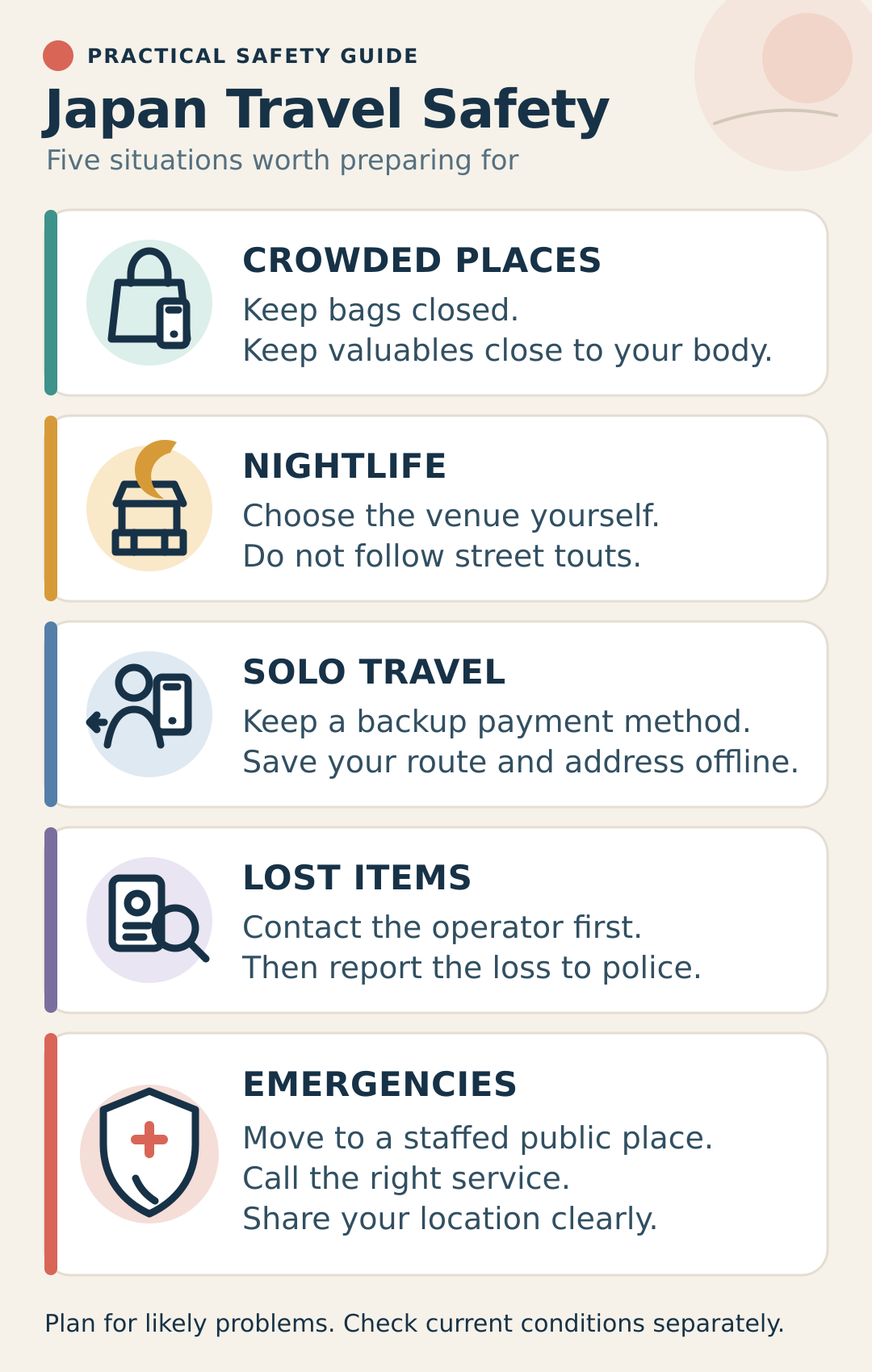
- Crowded places: wallets, phones, passports, and bags can be lost or stolen in stations, airports, shopping areas, and major attractions.
- Nightlife: street touts, excessive bar charges, fraudulent card use, drink spiking, and assault are the main crime patterns visitors should take seriously.
- Traveling alone: Japan is practical for solo travel, but a lost phone, missed last train, illness, or unwanted attention can be harder to manage without a companion.
- Language barriers: explaining your exact location or completing a police or medical procedure may be difficult when English support is limited.
- Everyday accidents: road traffic, bicycles, crowded platforms, heat, fatigue, and unfamiliar surroundings also deserve attention.
The best default is straightforward: protect your essential belongings, choose nightlife venues yourself, keep your accommodation address available in Japanese, and know how to contact help before you need it.
Does Being a Foreign Visitor Change the Risk?
Being a foreign visitor does not make Japan broadly dangerous, but it can change how a problem unfolds. A visitor who does not know normal prices, local procedures, or Japanese may be easier to pressure in a nightlife scam and may find it harder to describe a location or complete a police report.
Discriminatory treatment based on nationality or race can also occur. If an incident becomes threatening, move to a staffed public place and call 110. For a serious non-emergency incident, record the time, location, and what happened, then ask your accommodation or embassy or consulate for help understanding the practical next steps.
Crime and Nightlife Scams: Where to Be More Careful
In Crowded Stations and Tourist Areas
Do not let Japan’s safety reputation persuade you to leave a phone on a café table or a bag open on a train. Keep your bag closed and close to your body in crowds, and check your seat before leaving a train, taxi, restaurant, or attraction.
If you are visiting as a temporary visitor, carry your original passport securely. Keep a separate photo or copy of the identification page and your entry details so you still have the information if the original is lost.
In Nightlife and Entertainment Districts
Popular nightlife areas are not automatically unsafe or places to avoid. The risk changes when a stranger or street tout tries to choose the venue for you.
Official visitor advice identifies problems in entertainment districts including 歌舞伎町 / Kabukichō / Kabukicho, Shibuya, Roppongi, and Ikebukuro in Tokyo, as well as Shinsaibashi, Namba, and 道頓堀 / Dōtonbori / Dotonbori in Osaka. Reported incidents include hidden or excessive charges, fraudulent card transactions, forced ATM withdrawals, drink spiking, theft, and assault.
- Choose the bar or club yourself and check recent information before going.
- Do not follow a street tout, even if the offer sounds inexpensive or exclusive.
- Confirm cover charges and prices before ordering.
- Keep your drink with you and do not accept an open drink from a stranger.
- Keep control of your payment card and check the amount before authorizing a charge.
- If someone pressures you to withdraw money, move toward a staffed public place and call 110 when it is safe to do so.
The Tokyo Metropolitan Police’s visitor safety advice is especially direct: do not follow street touts. The same default is sensible in nightlife districts throughout Japan.
If You Think You Have Been Drugged, Assaulted, or Defrauded
Move to a staffed, public place if you can do so safely. Call 119 for urgent medical help and 110 for a crime or immediate danger. Ask a trusted person, hotel employee, station employee, or nearby business staff member to help communicate your location.
Keep receipts, card notifications, messages, and any other records. Contact your card issuer or bank promptly, tell your travel insurer, and contact your embassy or consulate if you need consular support. File a police report while you are still in Japan; arranging one after departure may not be possible.
If you have been assaulted, what happened is not your fault. Your immediate safety and medical needs come first.
Is Japan Safe for Solo Travelers and Women?
Japan is generally a practical destination for independent travel. Trains cover many destinations, eating alone is common, and solo rooms are widely available. The main difference is that you need a backup plan when nobody else is carrying a second phone, payment card, room key, or copy of the itinerary.
For Solo Travelers
- Share your accommodation and major travel days with someone you trust.
- Keep one backup payment method separate from your main wallet.
- Save your accommodation name, address, and phone number offline, including the address in Japanese.
- Check the last train before an evening out; after service ends, your options may be limited to a taxi or other late-night transport. Do not assume you can wait inside the station until morning.
- For a late arrival, favor accommodation with a staffed entrance and a simple route from the station.
For Women Traveling Alone
Many women travel independently in Japan, but harassment and sexual assault can occur. 痴漢 / Chikan / Groping is a particular concern on crowded trains, and unwanted attention can also happen in nightlife settings.
If someone touches or follows you, move toward other passengers or a staffed area. If it is safe, leave the train at the next station and approach station staff. You can say やめてください / Yamete kudasai / Please stop. Call 110 if you are in immediate danger or need police assistance.
Some train lines provide women-only cars at specified times, but the rules vary by line and service. Treat them as one available measure, not as a substitute for a late-night route and accommodation plan.
For Families With Children
Busy stations are the main place where families can become separated. Before entering a large station or festival, choose a meeting point and make sure older children know the accommodation name. Give younger children a card with a parent’s contact number and the accommodation address without displaying unnecessary personal information.
Hold hands near platforms and road crossings, and avoid trying to board a crowded train as the doors are closing. A convenience store counter, station office, police box, or hotel front desk is a sensible place for a child to ask for help.
Is It Safe to Walk Around Japan at Night?
Many city neighborhoods remain comfortable to walk through after dark, but “Japan is safe” should not become “every route is equally sensible.” A quiet residential street may simply be quiet; it can also mean fewer open businesses and fewer people to ask for help.
- Use well-lit routes with open shops or regular foot traffic when walking alone.
- Avoid isolated riverbanks, parks, alleys, and unfamiliar shortcuts late at night.
- Keep enough phone battery and money for a taxi if you miss the last train.
- Do not follow touts or strangers to a second location.
- If a situation feels wrong, enter an open convenience store, staffed station, hotel, or police box and ask for help.
Where you stay affects this part of the trip. A cheaper room can be poor value if it leaves you with a dark, complicated walk after the last useful train. For most visitors, a clear route from a station is the safer and easier default.
Traffic and Everyday Accidents
Crime is only one part of travel safety. Unfamiliar road direction, bicycles, crowded stations, fatigue, and weather can create more ordinary problems.
- Vehicles drive on the left in Japan. Look in both directions even when you think you know where traffic will come from.
- Cross at marked crossings and follow pedestrian signals.
- Watch for bicycles on roads and on permitted shared sidewalks; they can approach quietly.
- Do not stop suddenly at station gates or at the top and bottom of escalators to check your phone.
- Keep children and loose luggage away from platform edges.
- In hot or humid weather, reduce long outdoor periods, drink regularly, and take indoor breaks before you feel unwell.
What to Do If You Lose Something in Japan
Japan has an organized lost-property system, but recovery is never guaranteed. Reporting the loss quickly and to the right place gives you the best chance.
- Contact the place first. If you left something on a train, bus, taxi, aircraft, in a shop, or at an attraction, contact that operator or facility immediately. Note the time, route, carriage, seat, and a precise description.
- Report it to the police. Visit a nearby police box or police station and file a Lost Property Report. The National Police Agency’s English lost-property site explains the process.
- Protect accounts and devices. Lock a missing phone remotely when possible and contact your bank, card issuer, or mobile provider without waiting for the search.
- If it is your passport, contact your embassy or consulate. Report the loss to the police and follow the replacement instructions from the country that issued it.
- Keep the report details. Give the police a working email address or phone number and keep any receipt or reference number for your insurer and follow-up.
Useful words are 交番 / Kōban / Police box, 警察署 / Keisatsusho / Police station, 遺失届 / Ishitsu todoke / Lost Property Report, and 盗難 / Tōnan / Theft.
Medical Help and Emergency Numbers in Japan
A safe destination can still involve sudden illness or injury. Before departure, confirm what overseas medical coverage you already have, how to contact the insurer from Japan, and whether you may need to pay first and claim later. This separate guide explains what to check before relying on travel insurance for Japan.
| Service | When to use it | Contact |
|---|---|---|
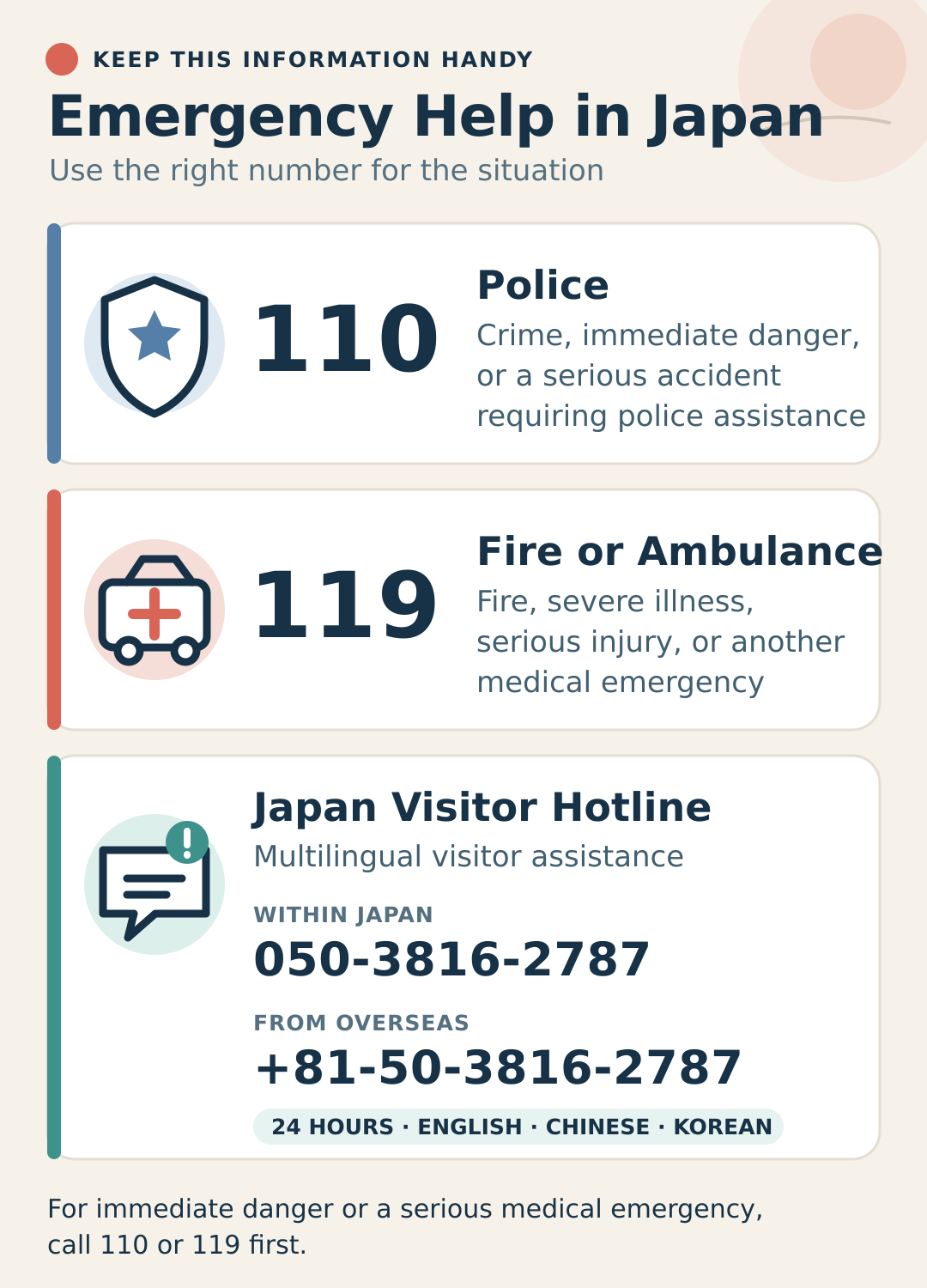
| Police | A crime, immediate danger, or serious accident requiring police | 110 |
| Fire or ambulance | A fire, severe illness, serious injury, or medical emergency | 119 |
| Japan Visitor Hotline | Visitor assistance involving an accident, illness, natural disaster, or general travel problem | 050-3816-2787 in Japan +81-50-3816-2787 from overseas |
The JNTO Japan Visitor Hotline operates 24 hours a day, 365 days a year, with English, Chinese, and Korean support. It is a visitor-assistance service; use 110 or 119 first when police, fire, or an ambulance is urgently needed.
When calling, state what happened, whether anyone is injured, and where you are. A station name, hotel, shop, landmark, or map pin can help. If communication is difficult, ask a nearby staff member or another person to call with you.
- 警察を呼んでください / Keisatsu o yonde kudasai / Please call the police.
- 救急車を呼んでください / Kyūkyūsha o yonde kudasai / Please call an ambulance.
- 場所はここです / Basho wa koko desu / The location is here.
Before You Go: A Practical Safety Checklist
- Check the current-conditions article close to departure if recent news affects any destination or route on your itinerary.
- Understand the natural hazards relevant to your season and destinations.
- Confirm medical coverage and save your insurer’s assistance number.
- Save each accommodation’s address and phone number offline, including the address in Japanese.
- Carry your original passport securely and keep a separate copy of its details.
- Keep a backup payment method separate from your main wallet.
- Save 110, 119, and the Japan Visitor Hotline in your phone.
- Carry essential medication, enough phone battery for the day, and a small power bank when possible.
- At check-in, identify the emergency exit and keep shoes and your phone easy to reach at night.
The goal is not to anticipate every possible problem. It is to make the few preparations that let you act quickly instead of beginning a search when you are already under pressure.
Emergency numbers, visitor-hotline details, and official visitor safety guidance were last verified on September 12, 2026 (JST).
Frequently Asked Questions
- Is Japan safe for foreign tourists?
-
Japan is generally a low-crime destination for international visitors, but it is not risk-free. Use normal precautions with valuables, take nightlife scams seriously, plan how to get help, and check destination-specific conditions when a natural hazard or disruption is in the news.
- Is Japan safe for solo female travelers?
-
Japan is generally practical for women traveling alone, and many everyday activities are easy to do independently. Harassment can still occur, especially on crowded trains or in nightlife settings, so plan late-night transport, stay near staffed areas, and seek police help if you are threatened or assaulted.
- Is it safe to walk around Japan at night?
-
Many urban areas are comfortable to walk through after dark, but the safest choice still depends on the route and time. Prefer well-lit streets with open businesses, avoid isolated shortcuts, know the last train, and keep money and battery for a taxi or change of plan.
- What scams should tourists watch for in Japan?
-
The clearest visitor risk is nightlife fraud: street touts leading people to bars, excessive charges, fraudulent card use, forced ATM withdrawals, and drink spiking. Choose venues yourself, confirm prices, keep control of your drink and card, and leave for a staffed public place if anyone pressures you.
- What should I do if I lose my passport in Japan?
-
Report the loss to a police box or police station, keep the report details, and contact the embassy or consulate of the country that issued the passport. If a wallet or phone disappeared with it, also protect your bank accounts and device immediately.
- What emergency numbers should travelers use in Japan?
-
Call 110 for police and 119 for fire or ambulance. For multilingual visitor assistance involving an accident, illness, natural disaster, or general travel problem, the JNTO Japan Visitor Hotline is 050-3816-2787 within Japan.