
Is Travel Insurance Required for Japan?
For ordinary short-term tourism, travel insurance is generally a recommendation rather than a standard entry requirement. Japan’s Ministry of Foreign Affairs says that purchasing international travel medical insurance for a trip to Japan is highly recommended.
Japan’s Ministry of Health, Labour and Welfare also strongly recommends private medical insurance with sufficient coverage for international visitors because treatment can become expensive.
Short-term foreign visitors should also not expect to use Japan’s public National Health Insurance in the same way as residents. The ministry lists short-term foreign visitors among those excluded from eligibility on its National Health Insurance eligibility page (Japanese).
Some visa or residence categories have their own insurance requirements. If you are entering Japan under a status other than ordinary short-term tourism, check the rules that apply to that status.
Start With Medical Coverage
Travel insurance often bundles several different risks into one policy: medical treatment, cancellation, baggage, and delays.
They are not all the same decision.
| Coverage | What to think about |
|---|---|
| Medical treatment and hospitalization | Make sure you know what coverage you have |
| Emergency medical transport or repatriation | Check how serious medical situations are handled |
| Trip cancellation or interruption | Depends on how much prepaid money is at risk |
| Baggage | Depends on what you carry and could afford to replace |
| Travel delay | More useful when disruption could create significant extra costs |
A Japan Tourism Agency survey (Japanese) of 3,069 international visitors conducted from October 2023 to February 2024 found that about 4% said they became sick or injured during their trip. About 73% said they had taken out private medical insurance for that visit.
Among travelers without it, common reasons included having a short stay and being confident in their health.
Those are understandable reasons. They still leave one practical question unanswered: what happens if you unexpectedly need medical treatment?
A Cheap or Short Trip Can Still Create a Medical Problem
Suppose you find a low-cost flight and book accommodation with free cancellation. You may reasonably decide that you do not need much cancellation protection because very little prepaid money is at risk.
Medical treatment is different. The cost of an unexpected illness or injury is not determined by how cheaply you booked the trip or whether you are staying for five days or two weeks.
So separate the two questions:
- Do I have adequate medical coverage?
- How much of the rest of my trip do I want to insure?
You may reach different answers—and that is fine.
Check What You Already Have Before Buying Anything
Do this before comparing insurance companies.
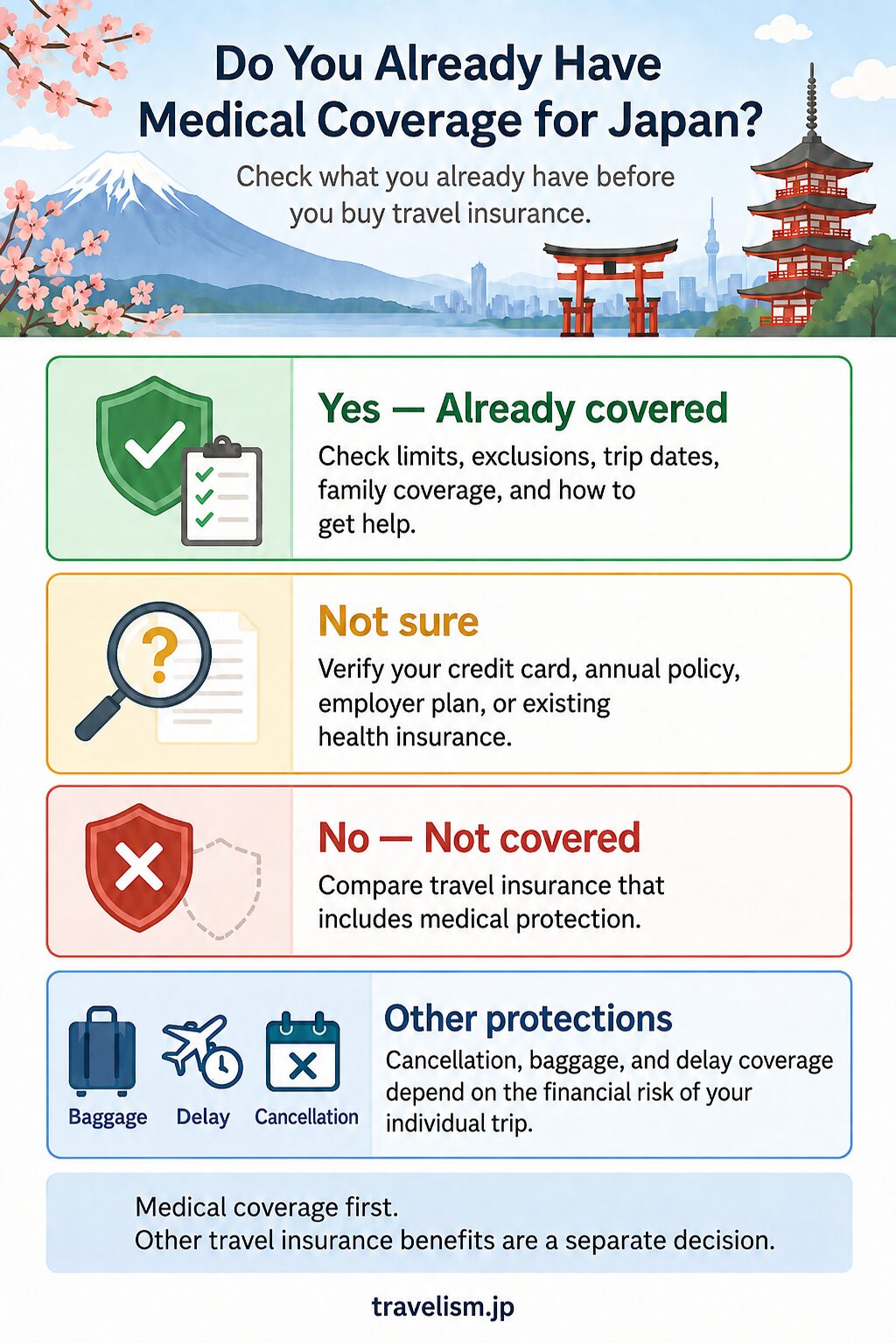
You may already have overseas medical coverage through:
- a credit card
- an annual travel insurance policy
- an employer-provided plan
- private health insurance with overseas benefits
- another travel or financial product
If the coverage is sufficient, buying another policy simply because you are traveling to Japan may add little value.
The problem is assuming that coverage exists without checking it.
If You Are Relying on a Credit Card
Look at the actual insurance terms, not just a benefits page that says “travel insurance included.”
- Does the insurance apply automatically, or must eligible travel expenses be paid with the card?
- What is the overseas medical limit?
- Are outpatient treatment and hospitalization covered?
- What happens if emergency medical transport or repatriation is needed?
- Are your spouse or children covered?
- Is there a deductible or excess?
- Is the policy valid for the full length of your Japan trip?
- Who do you contact from Japan?
Card benefits vary widely. Check your own issuer rather than relying on what another traveler’s card provides.
If You Still Need Insurance: Three Options to Check
There is no single policy that suits every visitor to Japan. Country of residence, age, trip length, medical history, and planned activities can all change what is available or appropriate.
The three options below are not an exhaustive ranking. They are useful starting points because they approach travel insurance in different ways. Always check the current policy wording and confirm that the product is available to you before buying.
For a Conventional Short-Trip Policy: Heymondo
Heymondo International Travel Insurance combines overseas medical cover with common travel-insurance benefits such as baggage and travel disruption, depending on the policy and options selected.
Its app is a practical feature for travelers who want help from their phone: Heymondo currently provides 24/7 medical chat and video consultation, assistance calls, access to policy documents, and claims management through the app.
Worth checking if: you want a conventional travel-insurance policy for a normal holiday and value app-based assistance.
Check carefully: Heymondo currently states an age limit of 69 for trips of up to 29 days and 49 for trips of 30 days or more. Benefits, limits, exclusions, and purchase conditions can also vary by policy.
If Activities Matter: World Nomads
World Nomads provides travel insurance that can include overseas medical treatment, emergency medical evacuation or repatriation, cancellation or interruption, baggage, and 24-hour assistance, depending on the country of residence and plan.
Its main point of difference for a Japan trip is activity coverage. World Nomads currently lists more than 150 activities, sports, and experiences, including skiing, snowboarding, hiking, and scuba diving. Not every activity is covered under every plan, and some require a different level or added option.
Worth checking if: skiing, hiking, diving, or another activity is an important part of your itinerary.
Check carefully: select your country of residence and confirm the exact activity and policy level before buying.
For Longer, Medical-First Travel: Genki Traveler
Genki Traveler is travel health insurance rather than broad travel protection. It focuses on medically necessary treatment for new illnesses and injuries, hospitalization, emergency transport, and medically necessary repatriation.
It is designed for travel periods of up to one year and can also be purchased while you are already abroad. If you are outside your home country when coverage starts and have no prior coverage, only medical emergencies are covered during the first 14 days. Genki Traveler is currently available to travelers up to age 69.
It does not cover non-medical travel costs such as trip cancellation, flight delays, lost luggage, theft losses, or personal liability.
Worth checking if: you are traveling for longer and your main concern is medical protection rather than insuring flights, hotels, and baggage.
Check carefully: pre-existing-condition rules, waiting periods, deductible, approval requirements, and whether travel health insurance fits your wider insurance situation.
What to Check in Any Policy
Do not choose insurance from the headline coverage number alone. A large number on a sales page tells you little about an exclusion that affects your trip or what happens when you actually need treatment.
Medical Treatment and Hospitalization
Make sure Japan is covered and that the policy is valid for your full travel period. Check illness, accidental injury, outpatient treatment, and hospitalization.
Japan’s government recommends private medical insurance with sufficient coverage, but it does not set one universal minimum medical amount for every ordinary tourist. Be cautious with travel websites that present a specific figure as if it were Japan’s official minimum for everyone.
Emergency Transport and Repatriation
Look beyond the hospital bill. A serious case may involve ambulance transport, transfer to another medical facility, or medically necessary transport back to your home country.
Check whether these benefits are separate from ordinary medical treatment and whether the insurer must approve or arrange them.
Pre-Existing Medical Conditions
If you have an existing condition, read the relevant policy terms before departure. Different insurers define and handle pre-existing conditions differently.
Do not assume that a policy covering “medical expenses” automatically covers treatment connected with a condition you already had.
Activities on Your Itinerary
Only investigate activities you actually plan to do.
If skiing, snowboarding, hiking, diving, cycling, or another activity is important to the trip, confirm that activity specifically. Do not assume that general medical coverage automatically includes every sport or activity.
How You Would Pay for Treatment
Imagine needing treatment in Japan. Would you pay the clinic or hospital first and claim reimbursement later, or can the insurer sometimes arrange payment directly?
This matters even when the coverage limit looks adequate. A traveler may still need access to money or a usable credit card if reimbursement comes later.
- Save the 24-hour assistance number
- Check whether the insurer helps locate medical care
- Find out when you must contact the insurer before treatment
- Check whether direct payment may be arranged
- Know when you may need to pay first
- Keep receipts, medical documents, prescriptions, and invoices required for a claim
Do You Need Cancellation, Baggage, and Delay Coverage Too?
Maybe. These parts depend much more on the trip you booked.
Cancellation
Look at the money you would actually lose. Expensive non-refundable flights, prepaid accommodation, tours, and tickets create more financial exposure than flexible bookings.
Also check what counts as a covered cancellation reason. Standard travel insurance does not normally mean that every change of mind is refundable.
Baggage
Think about what you are carrying and what you could reasonably replace yourself.
A suitcase of ordinary clothing creates a different financial risk from expensive cameras, laptops, or specialist equipment. Individual-item limits can matter as much as the overall baggage limit.
Delays
Delay benefits become more useful when disruption could create extra costs: a missed connection, an unexpected hotel stay, or prepaid arrangements you can no longer use.
A flexible itinerary with changeable bookings may leave you with less to insure.
A Simple Way to Make the Decision
- Check whether you already have medical coverage for Japan.
Start with your credit card, annual policy, employer benefits, or existing health insurance. - Decide whether you would actually be comfortable relying on it.
Check the limit, exclusions, full trip dates, emergency transport, family coverage, deductible, and assistance process. - If there is a gap, look for a policy that fills that gap.
A conventional holiday, an activity-heavy trip, and several months abroad may call for different types of cover. - Then decide how much non-medical risk you want to insure.
Look at non-refundable bookings, baggage value, and the financial effect of delays.
This keeps the decision manageable. You do not need to compare every insurance policy on the market.
If You Need Medical Care in Japan
For a serious medical emergency requiring an ambulance, call 119.
救急 / Kyūkyū / Medical emergency is useful Japanese to recognize, although you do not need to speak Japanese before calling.
For a non-life-threatening problem, check your insurance assistance information when practical. The insurer may be able to explain the next steps or help you find an appropriate medical facility.
Keep your policy number and assistance details somewhere easy to reach. If you receive treatment, keep receipts, invoices, prescriptions, and medical documents until any claim has been completed.
Last verified: August 29, 2026 (JST)
Frequently Asked Questions
- Is travel insurance mandatory for Japan?
-
For most ordinary short-term tourists, travel insurance is not a general entry requirement. Japan’s Ministry of Foreign Affairs does, however, highly recommend international travel medical insurance. Some visa or residence categories have separate requirements.
- Are tourists covered by Japan’s National Health Insurance?
-
Generally, no. Short-term foreign visitors are excluded from National Health Insurance eligibility, so tourists should not assume they can use the same public insurance system as residents.
- Is credit card travel insurance enough for Japan?
-
It can be, depending on the card and your trip. Check the medical limit, activation requirements, exclusions, emergency transport, family coverage, full travel period, deductible, and assistance process before relying on it.
- How much medical insurance do I need for Japan?
-
Japan’s general guidance recommends private medical insurance with sufficient coverage but does not set one universal minimum for ordinary tourists. Check medical treatment, hospitalization, emergency transport, repatriation, and the conditions that apply to your own policy.
- Can I buy travel insurance after arriving in Japan?
-
Some insurers allow coverage to be purchased after travel has started, but waiting periods or other restrictions may apply. Do not assume that a policy bought after departure provides full cover immediately; check the start date and policy conditions carefully.
- Which travel insurance is best for Japan?
-
There is no single best policy for every visitor. First check the coverage you already have, then focus on the gap: a conventional short trip, an activity-heavy holiday, and longer medical-first travel can require different types of protection.