Choose the Safety Information You Need
Japan safety questions fall into three different groups. Start with the one that matches your concern.
| What you want to know | Where to go |
|---|---|
| Whether a recent earthquake, storm, volcanic alert, heat event, or transport disruption is affecting your destination or route now | Check Is Japan Safe to Travel Right Now? Natural Hazards & Transport Disruptions — September 2026. |
| How earthquakes, typhoons, tsunamis, floods, volcanoes, or snow may affect travelers—and what to do | Continue with this guide. |
| Crime, scams, nightlife, solo travel, walking at night, medical help, or general emergency support | Read Is Japan Safe for Foreign Travelers? Crime, Disasters & Emergencies. |
This article explains lasting preparation and response principles. It cannot tell you whether a particular place is affected today. When recent news is the reason for your concern, check the current update first, then verify your exact destination, route, and travel date.
Natural Disasters Travelers Should Understand
Japan’s location, climate, and mountainous geography expose different regions to different hazards.
| Japanese | Romaji | English |
|---|---|---|
| 地震 | Jishin | Earthquake |
| 津波 | Tsunami | Tsunami |
| 台風 | Taifū | Typhoon |
| 大雨 | Ōame | Heavy rain |
| 洪水 | Kōzui | Flood |
| 土砂災害 | Dosha saigai | Landslide disaster |
| 火山 | Kazan | Volcano |
| 大雪 | Ōyuki | Heavy snow |
Earthquakes can occur anywhere and have no travel season. Tsunami risk is mainly relevant near coasts and rivers after certain earthquakes. Typhoons and heavy rain are more likely to affect itineraries in summer and autumn, although severe weather can occur outside the main season. Landslide risk is greater near mountains and steep slopes, volcanic restrictions apply to specific zones, and heavy snow matters most in northern and mountain regions during winter.
Do not treat Japan as one risk zone. Conditions in Okinawa, Kyushu, Osaka, Tokyo, Tohoku, and Hokkaido may be completely different on the same day. The place, route, and timing of your trip matter more than a general headline about Japan.
What to Do First in Any Emergency
Protect yourself from the immediate hazard before trying to understand every detail. Then follow staff, local authorities, and the operator responsible for the place or transport service you are using.
| Situation | First action |
|---|---|
| Strong shaking | Protect your head, move away from glass and unstable objects, and do not rush outside. |
| Strong or prolonged shaking near the coast | Leave coastal and riverside areas immediately and move to higher ground or a tsunami evacuation building. |
| Typhoon or heavy rain forecast | Check your exact route and move or change plans before transportation stops. |
| Evacuation Instruction, Alert Level 4 | Evacuate from the dangerous area immediately. Do not wait for Level 5. |
| Train, flight, ferry, or road closure | Stay in a safe place and follow the operator’s instructions. Do not enter tracks, roads, or closed areas. |
- Check whether the warning applies to your precise location, not only the wider prefecture or region.
- Keep your phone battery for maps, official information, translation, and contact with your accommodation.
- Do not cross barriers, enter damaged areas, or continue an outdoor plan because conditions look calm.
- Contact your accommodation if you are delayed or stranded.
- Use official information rather than an isolated social media post or an old screenshot.
Why Japan Is Prepared—but Not Risk-Free
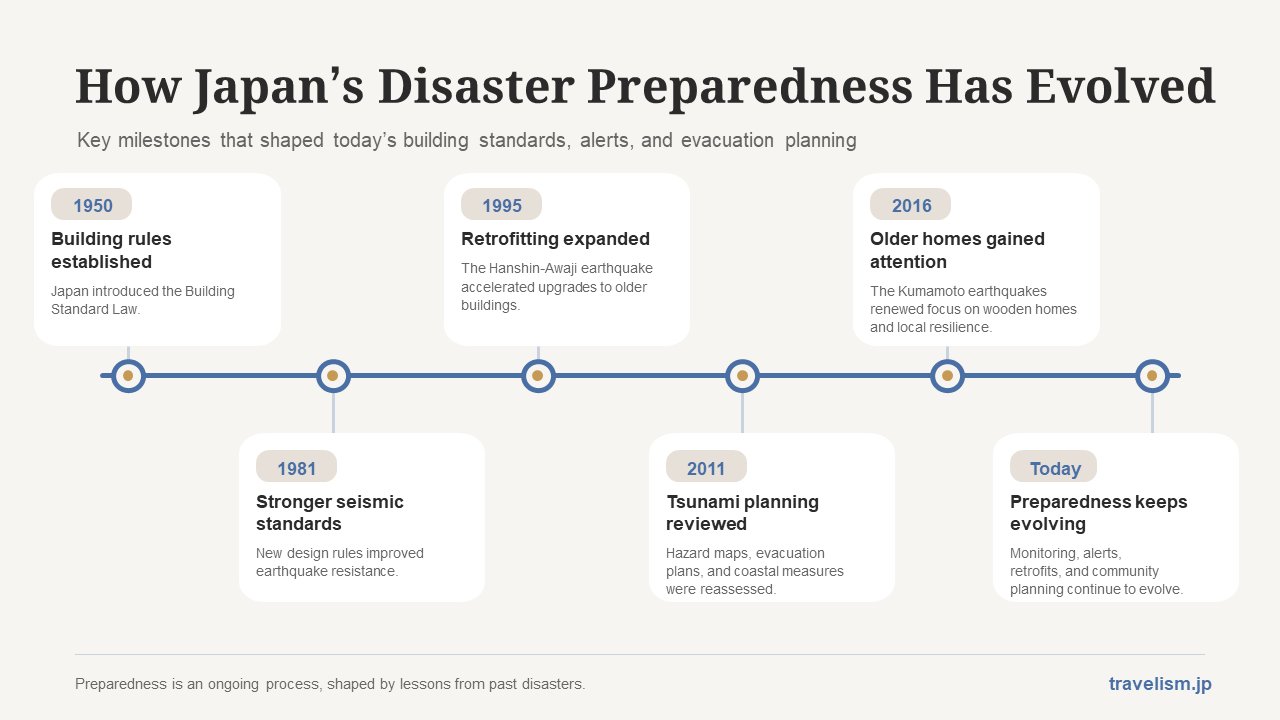
Japan’s disaster preparation has developed through repeated study of earthquakes, tsunamis, storms, floods, and eruptions. Building requirements, retrofitting, warning systems, evacuation planning, transportation procedures, and public drills have all changed over time.
A major revision to seismic design standards took effect in 1981. Buildings approved under older standards may have different levels of earthquake resistance, although age alone does not determine whether an individual property is safe. Structure, maintenance, retrofitting, ground conditions, and later work also matter.
Prepared does not mean that every building is equally resistant, every alert will reach every phone, or transportation will continue without disruption. It means that travelers will often find established systems to follow when conditions change.
Hotels, stations, schools, offices, and public facilities commonly display evacuation information. Railway operators may stop services for inspections, and staff may ask people to remain in place while the situation is checked. Follow those instructions instead of assuming that leaving immediately is always safer.
Earthquakes: What Travelers Need to Know
地震 / Jishin / Earthquake
Many earthquakes occur around the Japanese archipelago, but most are too small to feel or cause no significant damage. A traveler may notice a short vibration or slow swaying, particularly on an upper floor. Feeling an earthquake does not by itself tell you how serious the event is.
The earthquake’s location, depth, duration, local ground, and the building you are in all affect what you experience. Wait for verified information before deciding whether the event has implications beyond your immediate location.
Magnitude and Shindo Measure Different Things
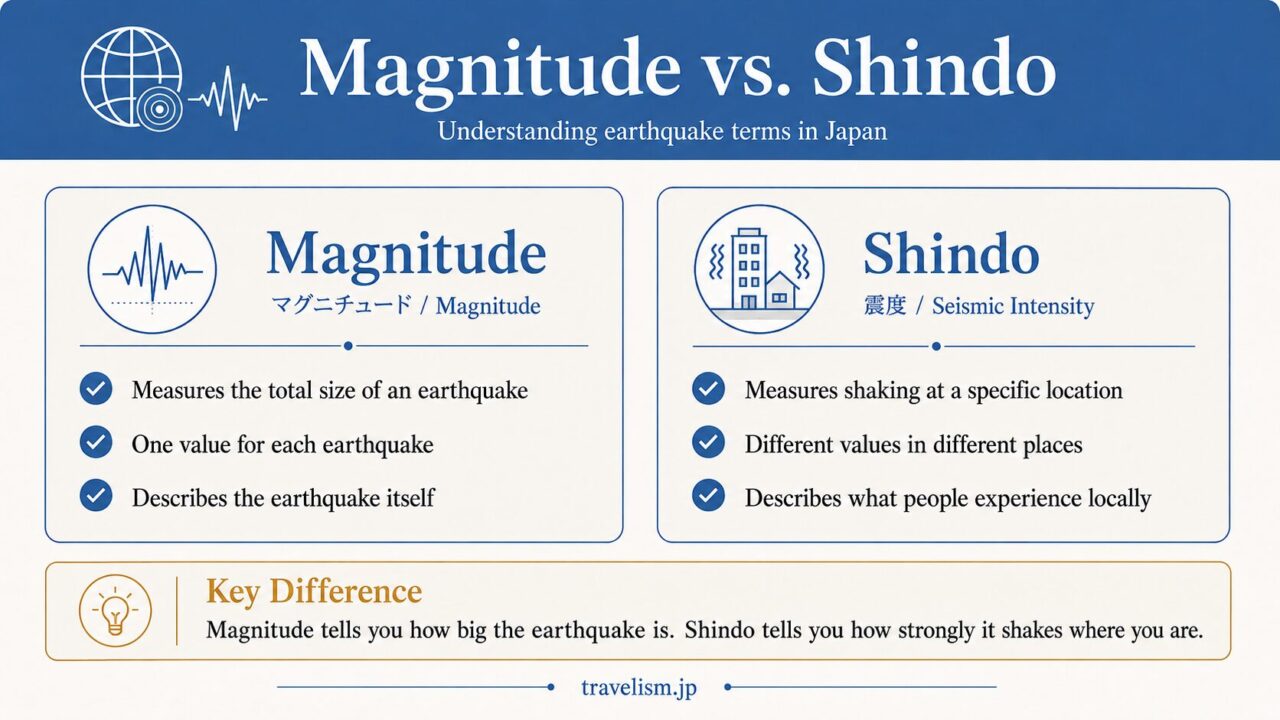
Magnitude measures the earthquake’s overall size or energy. An earthquake has one magnitude estimate, although an initial value may later be revised.
震度 / Shindo / Seismic intensity describes how strongly the ground shook at a particular location. The same earthquake can produce severe shaking in one area, moderate shaking elsewhere, and little or no noticeable movement farther away.
What Shindo Levels Mean
| Shindo level | What people may experience |
|---|---|
| 1 | Some people who are quiet indoors may feel slight shaking. |
| 2 | Many people indoors feel it, and hanging objects may sway slightly. |
| 3 | Most people indoors feel it, and dishes may rattle. |
| 4 | Most people are startled, and hanging objects may swing considerably. |
| 5 Lower | Many people want to hold onto something stable, and unsecured objects may fall. |
| 5 Upper | Walking may be difficult without support, and unsecured furniture may topple. |
| 6 Lower | It becomes difficult to remain standing. |
| 6 Upper | Remaining standing is generally impossible, and people may need to crawl. |
| 7 | Extremely strong shaking occurs, with major movement of unsecured furniture and possible serious structural damage. |
These are general descriptions, not guaranteed outcomes. Damage varies with the building, local ground, duration and type of shaking, and other conditions. For a traveler, the practical response matters more than memorizing every level.
What to Do During an Earthquake
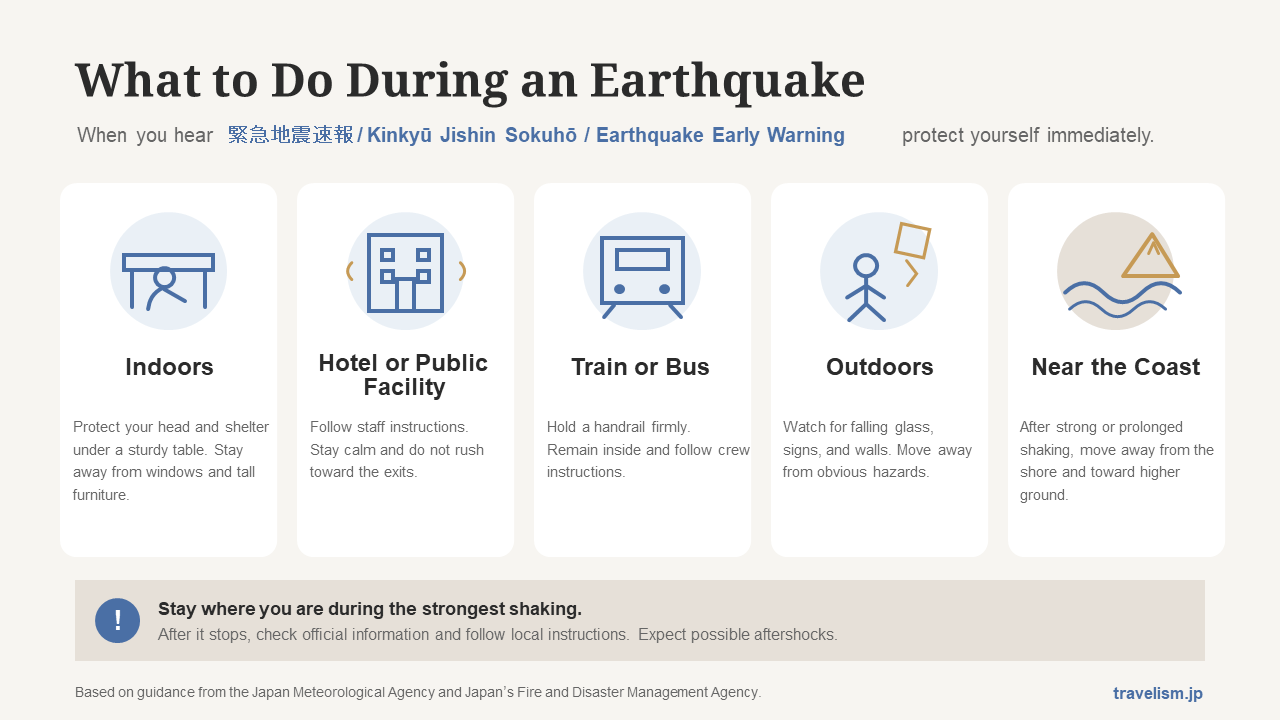
Your first priority is to protect yourself from falling objects, glass, and unstable furniture.
Inside a Hotel, Shop, or Station
- Protect your head and move away from windows, mirrors, shelves, and tall furniture.
- Shelter under a sturdy table when one is nearby and safe to reach.
- Do not rush outside or toward an exit while strong shaking continues.
- Do not use an elevator.
- Follow staff instructions.
- After the shaking stops, watch for broken glass, fallen objects, and damaged ceilings or walls.
Outside
Protect your head with a bag if necessary and move away from glass-fronted buildings, signs, roof tiles, unreinforced walls, vending machines, utility poles, and damaged electrical lines. Move toward a safe open area when possible, but do not run into traffic or stand directly beside a building entrance.
On a Train or Bus
Remain inside unless staff tell you otherwise. Hold a handrail or strap, protect your head if needed, and wait for instructions. Railway services may stop automatically so tracks, bridges, tunnels, signals, electrical equipment, and trains can be inspected.
A suspension for a safety check does not necessarily mean the line has been damaged. Do not leave a vehicle or enter the tracks unless staff direct you to do so.
In an Elevator and After the Shaking
If you are in an elevator, press the buttons for nearby floors and leave at the first floor where the doors open safely. Do not force the doors open or climb out without assistance.
After a large earthquake, expect aftershocks. Stay away from visibly damaged buildings, steep slopes, cracked walls, and areas closed by authorities. If you are near the coast, follow the tsunami guidance below.
Earthquake Early Warnings and Overseas Phones
緊急地震速報 / Kinkyū jishin sokuhō / Earthquake Early Warning
Japan’s Earthquake Early Warning system detects initial seismic waves after an earthquake begins and attempts to warn people before stronger shaking arrives. It is not an earthquake prediction.
Depending on your distance from the source, a warning may provide several seconds to protect yourself, arrive at almost the same time as the shaking, or provide no advance notice. If an alert sounds, do not begin searching for details. Protect your head and respond to your surroundings first.
An overseas phone may receive an alert, but this is not guaranteed. Reception can depend on the phone model, operating system, emergency-alert settings, network, original carrier configuration, and roaming, SIM, or eSIM service. A Japanese SIM or eSIM alone does not guarantee compatibility.
Install an additional official information source before the trip and pay attention to public announcements and staff. The Safety Tips app for travelers, listed below, provides push alerts and emergency guidance in multiple languages.
Tsunamis: Leave the Coast and Go Higher
津波 / Tsunami / Tsunami
Most earthquakes do not cause a tsunami. However, if you feel strong or prolonged shaking near the sea, do not wait beside the water for a warning or try to judge the risk yourself.
- Leave beaches, ports, breakwaters, river mouths, and waterfront areas immediately.
- Go to higher ground or a designated tsunami evacuation building.
- Keep moving higher when local signs or staff direct you to do so.
- Do not return for belongings.
- Remain in the evacuation location until tsunami warnings or advisories are lifted.
Tsunami waves can arrive repeatedly, and a later wave may be larger than the first. An apparently small first wave is not a reason to leave a safe place.
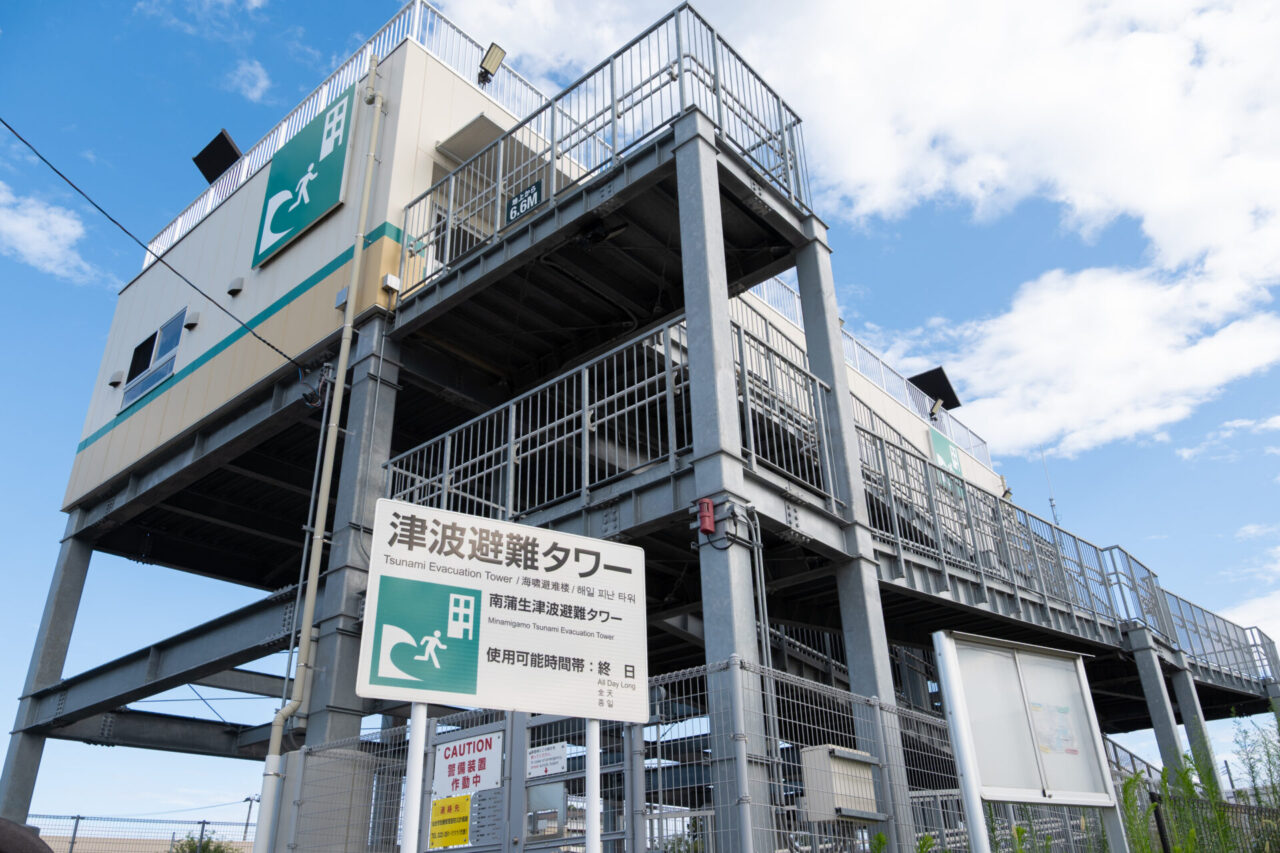
津波避難タワー
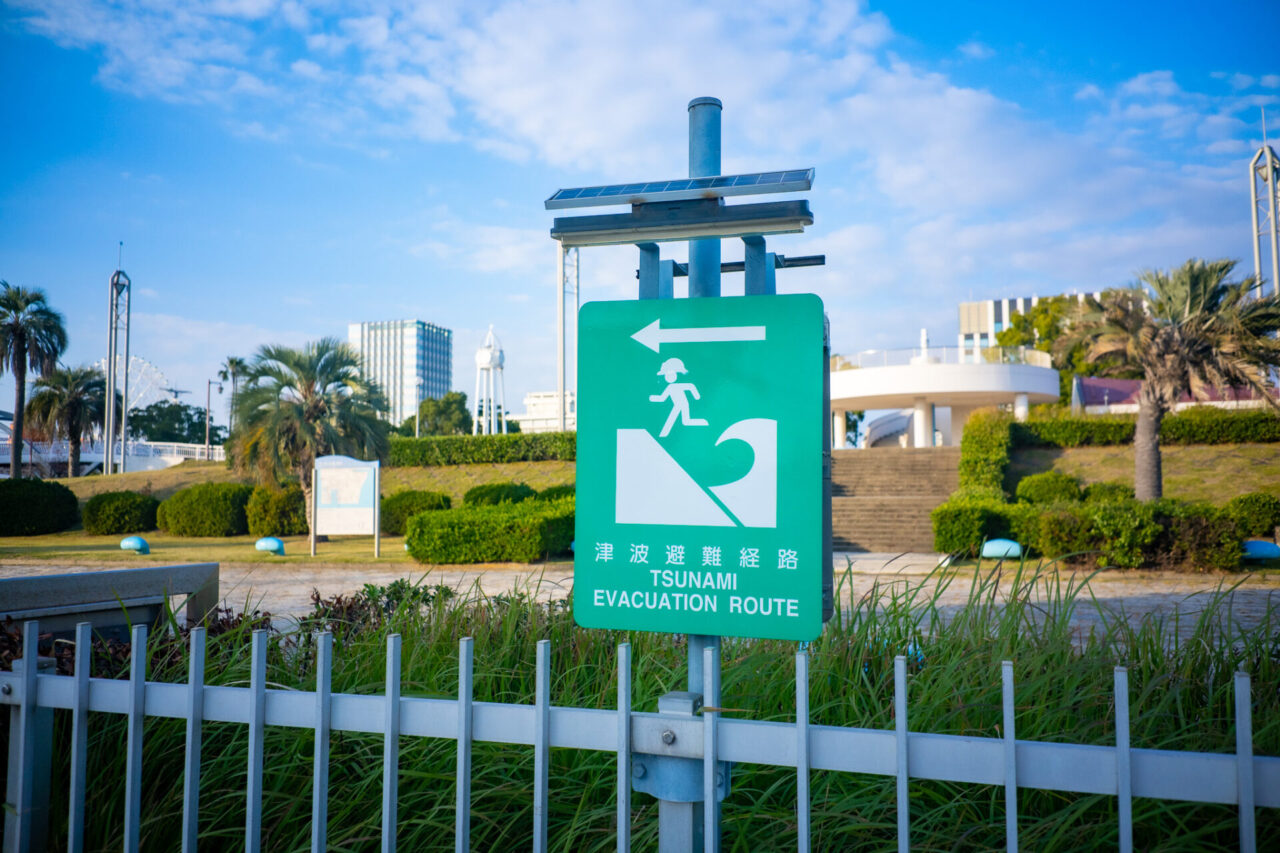
津波避難経路
| Japanese | Romaji | English |
|---|---|---|
| 津波避難場所 | Tsunami hinan basho | Tsunami evacuation area |
| 津波避難ビル | Tsunami hinan biru | Tsunami evacuation building |
| 高台 | Takadai | Higher ground |
| 避難 | Hinan | Evacuation |
| 立入禁止 | Tachiiri kinshi | No entry |
Risk depends on your exact location, not only the city name. Central Kyoto is inland, while parts of Tokyo and Osaka include coastal, bayside, riverside, or low-lying areas. If your accommodation is near the sea, identify the evacuation route when you check in.
Typhoons: Change Plans Before Transport Stops
台風 / Taifū / Typhoon
Typhoons can bring strong winds, heavy rain, rough seas, flooding, landslides, and transportation disruption. Unlike earthquakes, they are monitored and forecast before arrival, so travelers often have time to adjust.
Typhoon activity affecting Japan is most relevant from July through October, particularly around August and September, but a storm can occur outside that period. Its path and effects may change, and one region can remain unaffected while another experiences serious disruption.
- Flight delays or cancellations
- Train or ferry suspensions
- Road restrictions
- Closed attractions or mountain trails
- Changes to festivals and outdoor events
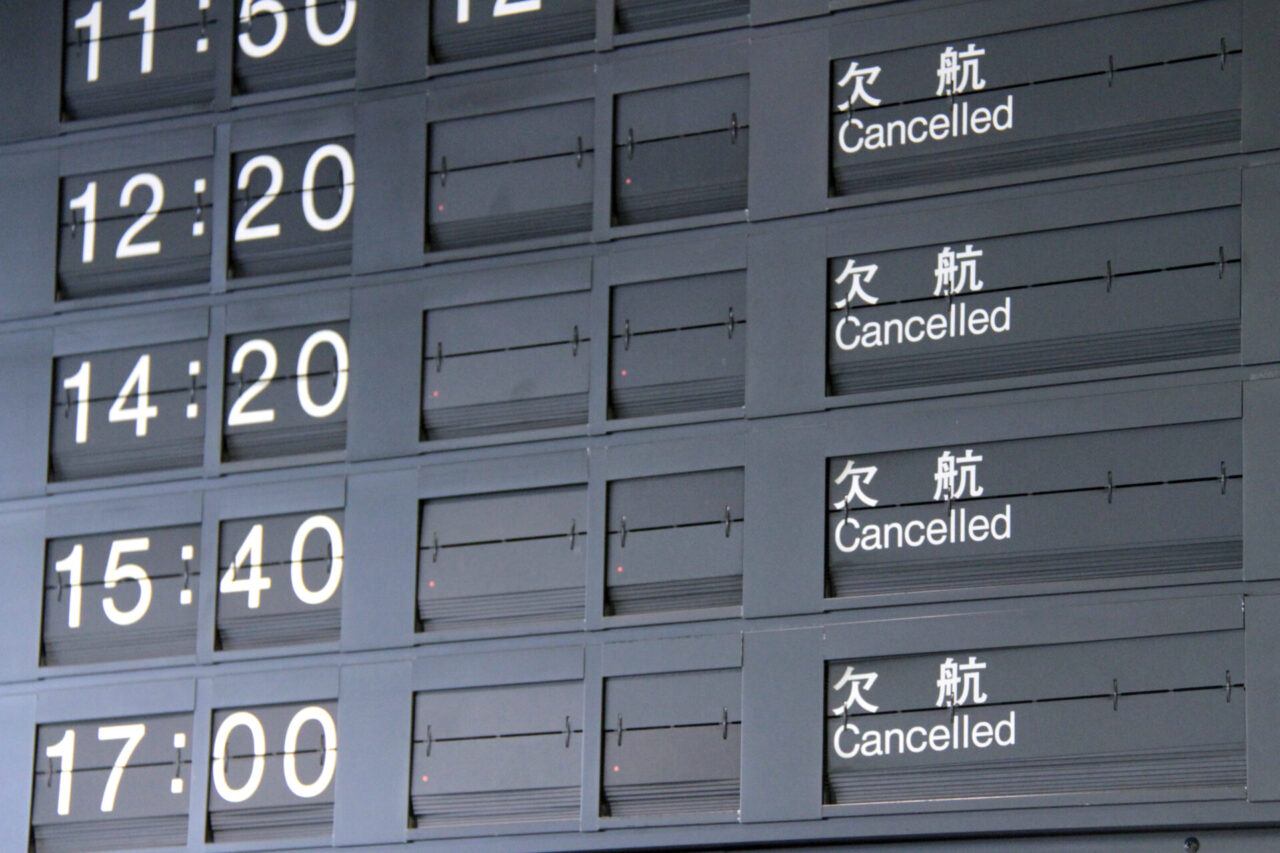
欠航
計画運休 / Keikaku unkyū / Planned service suspension means that a railway operator intends to stop services in advance because dangerous conditions are expected. Do not wait for the last train before changing locations; services may become crowded before they stop.
- Check your airline, railway, ferry, or bus operator directly.
- Ask your accommodation how the local area is likely to be affected.
- Avoid beaches, rivers, breakwaters, mountain trails, and exposed viewpoints.
- Do not continue simply because a service still appears to be operating.
- Keep food, water, medication, and a charged phone available.
- Allow flexibility when traveling during the main typhoon season.
Heavy Rain, Flooding, and Landslides
大雨 / Ōame / Heavy Rain; 洪水 / Kōzui / Flood; 土砂災害 / Dosha saigai / Landslide Disaster
Heavy rain may occur during the rainy season, around a typhoon, or when weather systems remain over the same area. Rivers can rise quickly, low-lying roads and underpasses can flood, and intense or prolonged rain can destabilize mountain slopes.
Avoid riverbanks, dry-looking channels, underpasses, steep slopes, closed hiking trails, and any area behind a barrier or warning sign. If you are staying in a rural property, mountain lodge, vacation rental, or traditional inn, ask whether it is near a river, coast, or steep slope and where to go if evacuation is announced.
Understand Alert Levels 3, 4, and 5
Municipal evacuation information uses alert levels to indicate the action people should take. The instruction applies to the dangerous area named by the local authority, not automatically to an entire city or prefecture.
| Alert level | Evacuation information | What travelers should do |
|---|---|---|
| Level 3 | Evacuation of the Elderly, Etc. | People who need extra time to evacuate, and those helping them, should leave dangerous areas. Others should prepare and check the route. |
| Level 4 | Evacuation Instruction | Everyone in a dangerous area should evacuate immediately or follow the specified protective action. |
| Level 5 | Emergency Safety Measures | A disaster is occurring or imminent. Take the safest action still available. Do not wait for Level 5 before leaving a dangerous area. |
You may also see Japan Meteorological Agency weather products labeled Level 3 Warning, Level 4 Urgent Warning, or Level 5 Emergency Warning for heavy rain, floods, landslides, and storm surge. JMA warnings describe the hazard level; municipal evacuation information tells residents and visitors what action to take. At Level 4, get out of the dangerous area rather than waiting to see whether conditions worsen.
Volcanic Activity: Check the Restricted Area
火山 / Kazan / Volcano
Japan has many volcanoes, including well-known destinations such as 富士山 / Fujisan / Mount Fuji, 箱根山 / Hakoneyama / Mount Hakone, 阿蘇山 / Asosan / Mount Aso, and 桜島 / Sakurajima.
The presence of an active volcano does not automatically make an entire destination unsafe. Warnings identify areas that may be affected, and authorities may close a crater, trail, road, ropeway, or part of a mountain while nearby towns continue operating.
Japan’s Volcanic Alert Levels
For volcanoes where the system applies, the Japan Meteorological Agency uses five levels based on the target area and the action required.
| Alert level | What it generally means for travelers |
|---|---|
| Level 1 | Check current information and follow any local restrictions near the crater before hiking. |
| Level 2 | Do not approach the crater. Access around it may be restricted. |
| Level 3 | Do not approach the volcano. Entry into wider non-residential risk areas may be restricted. |
| Level 4 | People who need extra time to leave at-risk residential areas should evacuate, while others prepare. |
| Level 5 | People in at-risk residential areas must evacuate. |
Always check the current warning together with the mapped restriction or local closure. Respect ropes, gates, trail closures, and instructions from park staff, guides, accommodation providers, and transport operators. An access restriction is a safety measure; it does not necessarily mean the whole tourism region is closed.
Heavy Snow and Winter Weather
大雪 / Ōyuki / Heavy Snow
Heavy snow can delay or cancel trains, buses, flights, and ferries and can close roads or mountain attractions. It is most relevant in Hokkaido, Tohoku, Hokuriku, the Japanese Alps, and other mountain regions.
Check local transport before a long winter journey, allow extra time, wear shoes with suitable grip, and do not enter a closed road or trail. Tokyo, Kyoto, and Osaka receive less regular heavy snow than northern and mountain regions, but even moderate snowfall can disrupt transport where snow is less common.
How Accommodation Affects Disaster Safety
Your accommodation’s location, evacuation routes, staff support, and available information affect how easily you can respond.
- Identify the nearest emergency exit.
- Read the evacuation map on the door or wall.
- Check how to reach the stairs without an elevator.
- Keep shoes, your phone, and a small light within reach at night.
- Save the property’s address and contact details offline.
- Ask where to evacuate if the property is near the coast, a river, or a steep slope.
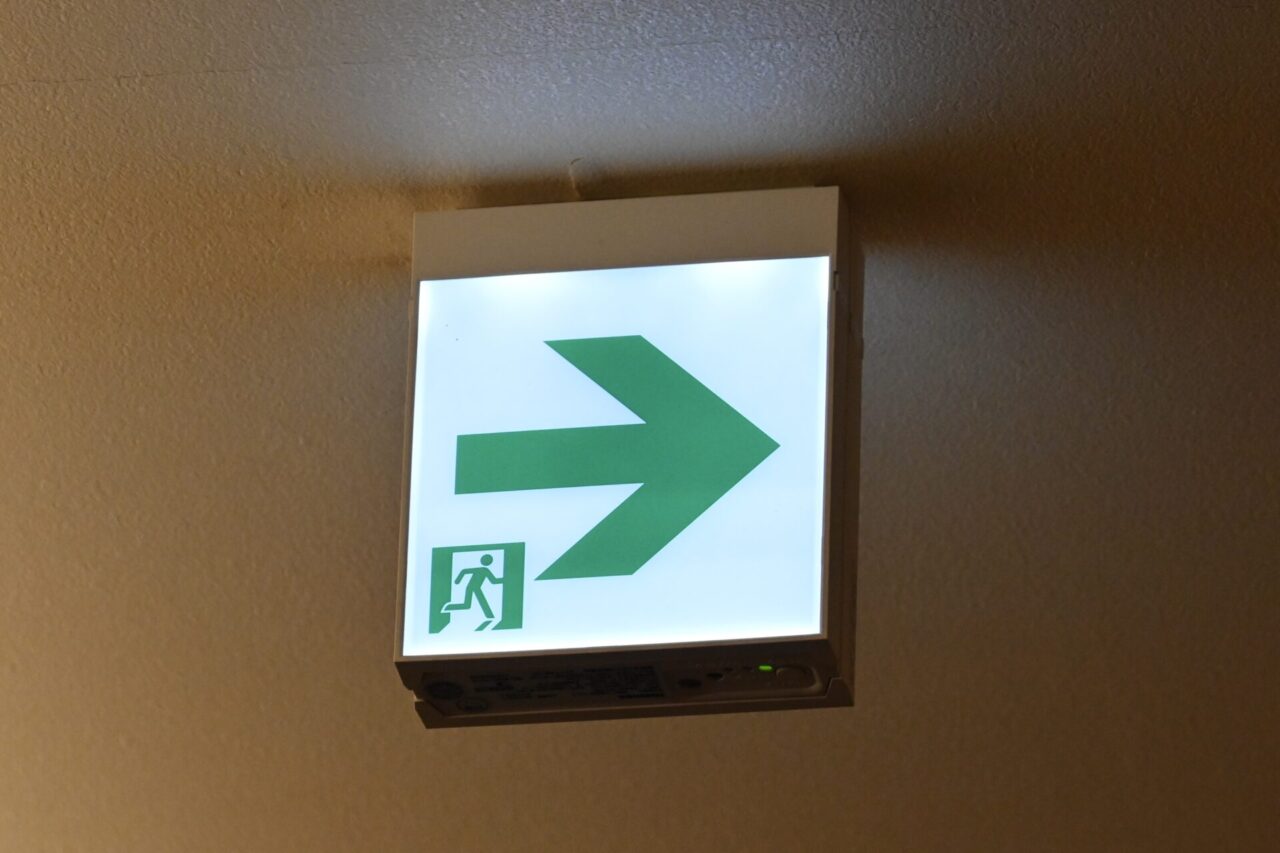
非常口案内
Large hotels often have more multilingual support and established procedures. A small inn, private rental, or rural property is not automatically unsafe, but you may need to take more responsibility for understanding the building and surrounding area. Ask the host before an emergency if anything is unclear.
Reliable Emergency Information
Use a combination of official hazard information and the operator responsible for your route. No single source answers every question.
| Source | Use it for |
|---|---|
| Safety Tips app | Push alerts for earthquake early warnings, tsunami warnings, weather warnings, and multilingual emergency guidance. Install and configure it before the trip. |
| Japan Meteorological Agency | Official weather, earthquake, tsunami, and volcanic information. Check the exact area named in the warning. |
| JNTO Japan Safe Travel Information | Visitor-oriented emergency information and links to transportation and support. |
| Your airline, railway, ferry, bus, or road operator | The actual operating status, planned suspension, cancellation, reopening, or alternative route. |
| Accommodation and local authorities | Evacuation instructions, the nearest safe place, and conditions immediately around you. |
The Safety Tips app currently supports 15 languages, including Japanese and English. App and phone behavior can change, so install it before travel, allow notifications, and keep another way to obtain information.
Useful Phrases
If you do not understand an announcement, stop and ask rather than continuing to move.
| Japanese | Romaji | English |
|---|---|---|
| ここは安全ですか? | Koko wa anzen desu ka? | Is it safe here? |
| どこに避難すればいいですか? | Doko ni hinan sureba ii desu ka? | Where should I evacuate? |
| 英語で説明できますか? | Eigo de setsumei dekimasu ka? | Can you explain it in English? |
Emergency Numbers and Visitor Support
| Contact | Use | Number |
|---|---|---|
| Police | Urgent police assistance | 110 |
| Fire and ambulance | Fire or medical emergency | 119 |
| JNTO Japan Visitor Hotline | Visitor assistance for accidents, illness, natural disasters, and general travel problems | 050-3816-2787 in Japan; +81-50-3816-2787 from overseas |
The JNTO Japan Visitor Hotline operates 24 hours a day, 365 days a year, with support in English, Chinese, and Korean.
When calling 110 or 119, explain what happened, your location, whether anyone is injured, and the name of a nearby hotel, station, shop, or landmark. Ask staff or someone nearby to help if communication is difficult.
What to Keep With You
You do not need to carry a full emergency kit while sightseeing. A few ordinary items make an unexpected delay easier to manage:
- A charged phone and portable power bank
- Essential medication
- A small amount of drinking water
- Comfortable walking shoes
- Your accommodation address and contact details offline
- A copy or photo of your passport details
- Your insurance policy and assistance contacts
- A small amount of Japanese yen
Check Travel Insurance Before Departure
Check whether your existing or new policy covers emergency medical treatment, trip interruption, delayed or canceled transport, additional accommodation, natural disasters, and any relevant evacuation costs. Coverage and exclusions differ, and a change you make before an official cancellation may be treated differently from a cancellation made by the operator.
Do You Need Travel Insurance for Japan? What to Check Before You Go explains how to review existing coverage before deciding whether to buy another policy.
Emergency numbers, visitor-hotline details, app availability, alert terminology, and official guidance were last verified on September 12, 2026 (JST).
Frequently Asked Questions
- Is Japan safe to visit despite natural disasters?
-
Japan remains a practical destination for international travelers, but it is not free from natural hazards. Most visitors do not experience a serious emergency. Learn the basic actions, check current conditions for your destination and route, and follow official instructions if an event occurs.
- How likely am I to feel an earthquake in Japan?
-
There is no reliable way to predict whether you will feel an earthquake during a particular trip. Many visitors feel none, while others notice light shaking. The large number of earthquakes recorded around Japan should not be confused with the much smaller number that seriously affect travelers.
- Should I leave my hotel during an earthquake?
-
Do not rush outside while strong shaking continues. Protect your head, move away from glass and unstable objects, and follow hotel instructions. After the shaking stops, use stairs rather than an elevator and evacuate if staff or local authorities tell you to leave.
- Will my overseas phone receive an earthquake warning?
-
It may, but automatic reception is not guaranteed. Compatibility can depend on the device, settings, operating system, network, original carrier configuration, and roaming, SIM, or eSIM service. Install an official disaster-information app and pay attention to local announcements as backups.
- Should I cancel a trip during typhoon season?
-
Not automatically. A typhoon may affect only part of Japan, and its route and timing can change. Check the destination, route, and dates that apply to your itinerary, keep some flexibility, and follow transportation and accommodation guidance.
- What should I do if my train stops after an earthquake or storm?
-
Remain calm and follow staff instructions. The operator may be inspecting tracks, bridges, tunnels, signals, or electrical equipment. Do not leave the train or enter the tracks unless staff direct you to do so, and contact your accommodation if the delay may strand you.
- Should I worry about a tsunami in Tokyo, Kyoto, or Osaka?
-
Tsunami risk depends on your precise location. Central Kyoto is inland, while parts of Tokyo and Osaka include coastal, bayside, riverside, or low-lying areas. When you stay near the sea, learn the evacuation route and move to higher ground after strong or prolonged shaking or when instructed.
- Does a volcanic alert mean the whole destination is closed?
-
Not necessarily. A volcanic alert identifies a target area and required action. A crater, trail, road, or part of a mountain may be restricted while nearby towns continue operating. Check the mapped restriction and local transport or attraction information before visiting.