
Are Taxis Easy to Use in Japan?
Yes. You do not need to speak much Japanese for a typical taxi journey.
If you use an app and enter the destination before requesting the taxi, the driver already has the destination information. Otherwise, show the destination name, Japanese address, or a map pin on your phone.
The main difference from trains is cost: taxis are usually more expensive, especially for longer journeys or when traffic is slow. They work best when the door-to-door convenience is worth the extra fare.
When Does Taking a Taxi Make Sense?
Japan’s rail network handles most everyday travel well, but there are times when door-to-door transport is more convenient.
Consider a taxi when:
- Traveling with large luggage
- Arriving late at night
- Visiting areas with limited train service
- Traveling during heavy rain
- Moving between nearby destinations
- Traveling as a group and splitting the fare
A common approach is to use public transportation for the main journey and a taxi for the final section.
If luggage is the main reason the route feels difficult, compare a short taxi ride with sending the suitcase ahead. Our guide to luggage delivery in Japan explains hotel and airport forwarding, coin lockers and the limitations of unstaffed stays.
How to Get a Taxi in Japan
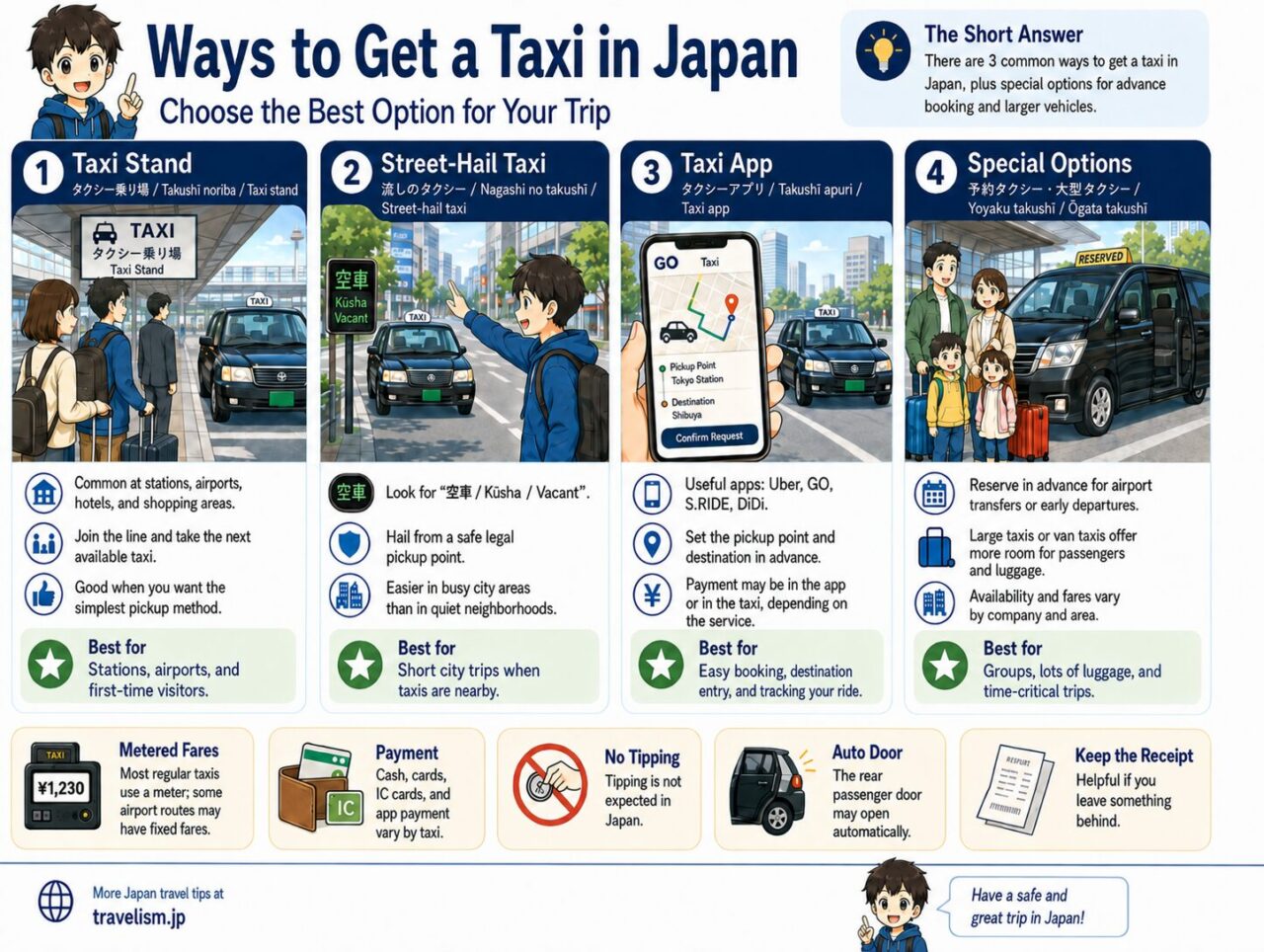
There are three common ways to get a taxi in Japan: use a taxi stand, hail an available taxi, or request one through an app. For time-specific journeys, groups, or extra luggage, advance reservations and larger taxis provide additional options.
1. Use a Taxi Stand
Taxi stands are common outside major railway stations, airports, large hotels, and some shopping areas.
タクシー乗り場 / Takushī noriba / Taxi stand
Join the line and take the next available taxi. At airports, use the official taxi stand or the pickup area specified for your reserved service.
2. Hail an Available Taxi
In many cities, you can hail an available taxi from the roadside where stopping is permitted. Look for the availability display:
空車 / Kūsha / Vacant
Not every road is a suitable pickup point, and some busy areas have designated taxi-stand rules. If street hailing is difficult, use a taxi stand or app instead.
3. Request a Taxi Through an App
Use an app when you want to set the pickup point and destination in advance. If the destination is already entered in the app, you generally do not need to explain it again when you get in unless you want to change the route or stop.
Check the vehicle details before boarding and wait at the pickup point shown in the app.
4. Reserve in Advance or Request a Larger Taxi
Reserve in advance for early airport departures, late-night pickups, time-specific journeys, or when you need a larger vehicle for several passengers or bulky luggage.
Availability, vehicle types, and reservation fees vary by area and taxi company. Check whether the booking is confirmed, where the pickup point is, and whether any additional charges apply.
Taxi Apps Used in Japan
Taxi apps are especially helpful when you do not speak Japanese because the pickup point and destination can be shared with the driver in advance. Availability still depends on the specific location, time, weather, and number of vehicles nearby.
| App | When It Is Most Useful | What to Know |
|---|---|---|
| Uber | Travelers who already use Uber | Familiar account and interface; available ride types vary by area |
| GO | Broad taxi coverage within Japan | English guidance, international credit cards and Apple Pay supported |
| S.RIDE | Tokyo and other supported urban areas | Strong taxi network in Tokyo; English website and app features |
| DiDi | An additional option in supported areas | Coverage, account setup, and payment options should be checked in the app |
Uber
If you already use Uber at home, it is often the easiest app to try first. Your account may already be set up, and you can enter the pickup point and destination, view the available ride options, track the vehicle, and use an in-app payment method.
Selecting the Taxi option dispatches a licensed local taxi. Other ride types may also appear in the Uber app depending on the location and time, so check the vehicle type shown before confirming the request.
Uber Assist is designed for travelers who need an accessible Universal Design taxi, including wheelchair users. Availability still depends on whether an eligible vehicle and driver are available at your location.
GO
GO is a major Japanese taxi app with broad nationwide coverage. Its English guidance supports international credit cards and Apple Pay, and registration uses a phone number and verification code.
Try GO when Uber cannot find a vehicle or when you are traveling outside areas where Uber has strong availability. The app can set the pickup point and destination, show estimated arrival information, track the approaching taxi, and use GO Pay on eligible journeys.
Coverage across Japan does not mean a taxi will be available everywhere. Reservation, pickup, service, and vehicle-type options also vary by area and taxi company.
S.RIDE
S.RIDE is another option in supported urban areas and has a particularly large network in Tokyo. It supports app dispatch, advance booking, multiple payment methods, and S.RIDE WALLET on compatible taxis.
If you are staying in Tokyo and cannot find a taxi through your first app, S.RIDE is worth checking. Service areas and individual features vary, so confirm availability at your location.
DiDi
DiDi remains another taxi-booking option in parts of Japan. Treat it as an additional choice rather than an app you need to install for every trip.
Service areas, account registration, and payment compatibility can change, so check the current app settings before relying on it for an important journey.
Which Taxi App Should You Use?
If you already have Uber, try it first. Otherwise, GO is a strong starting point for broad taxi coverage in Japan. In Tokyo and other supported urban areas, S.RIDE is another option to check. DiDi can provide another option where available.
For an early airport departure or another time-critical journey, do not rely only on finding a car immediately. Use an advance-booking feature where available, contact a local taxi company, or ask your accommodation to arrange the ride.
How a Taxi Ride Works
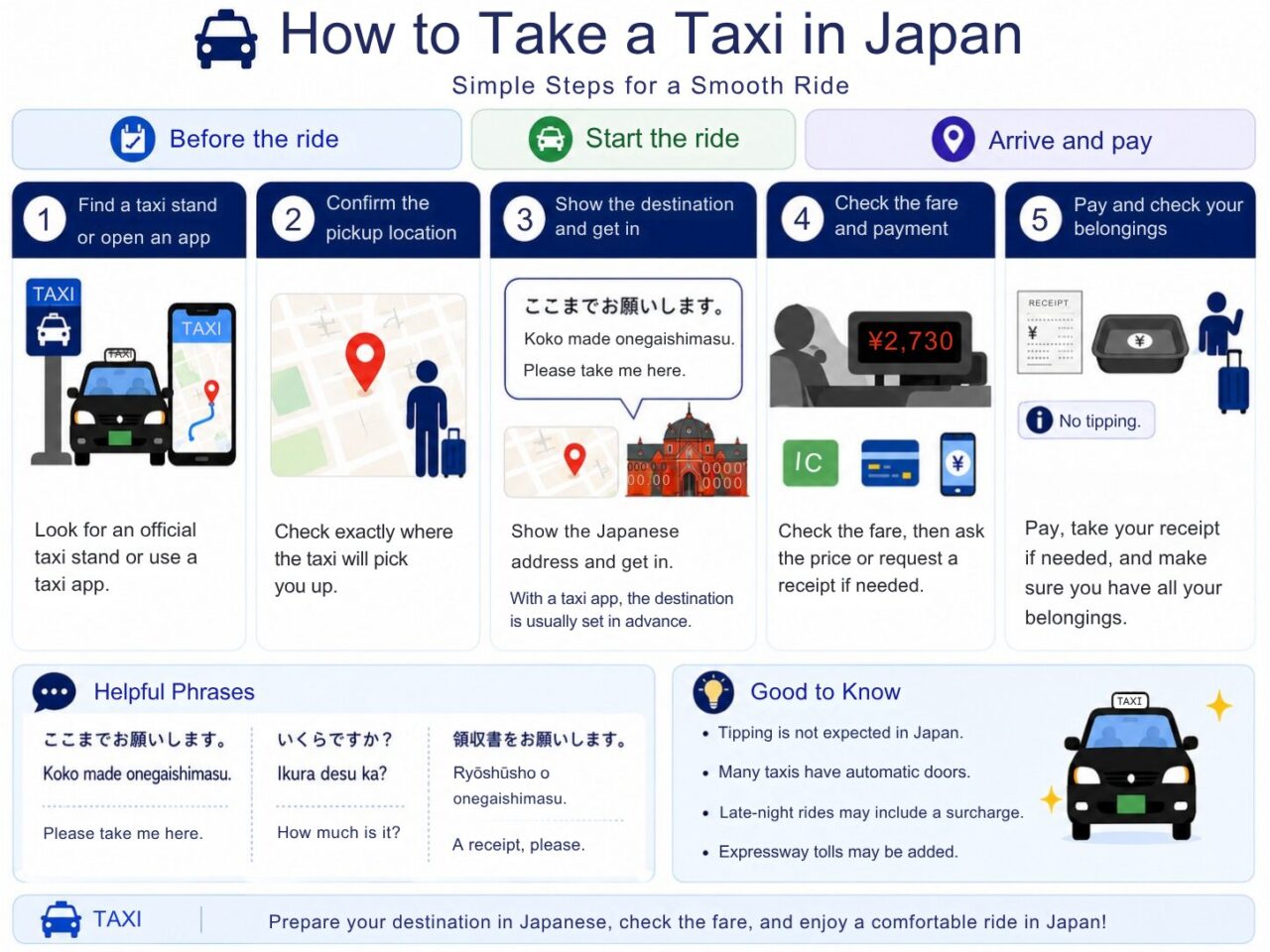
Once you have found or booked a taxi, the rest of the journey is usually simple. Prepare the destination before boarding, confirm the vehicle when using an app, and check the fare, payment method, receipt, and your belongings before you leave.
The next sections explain taxi fares and payment methods in more detail.
How Much Do Taxis Cost?
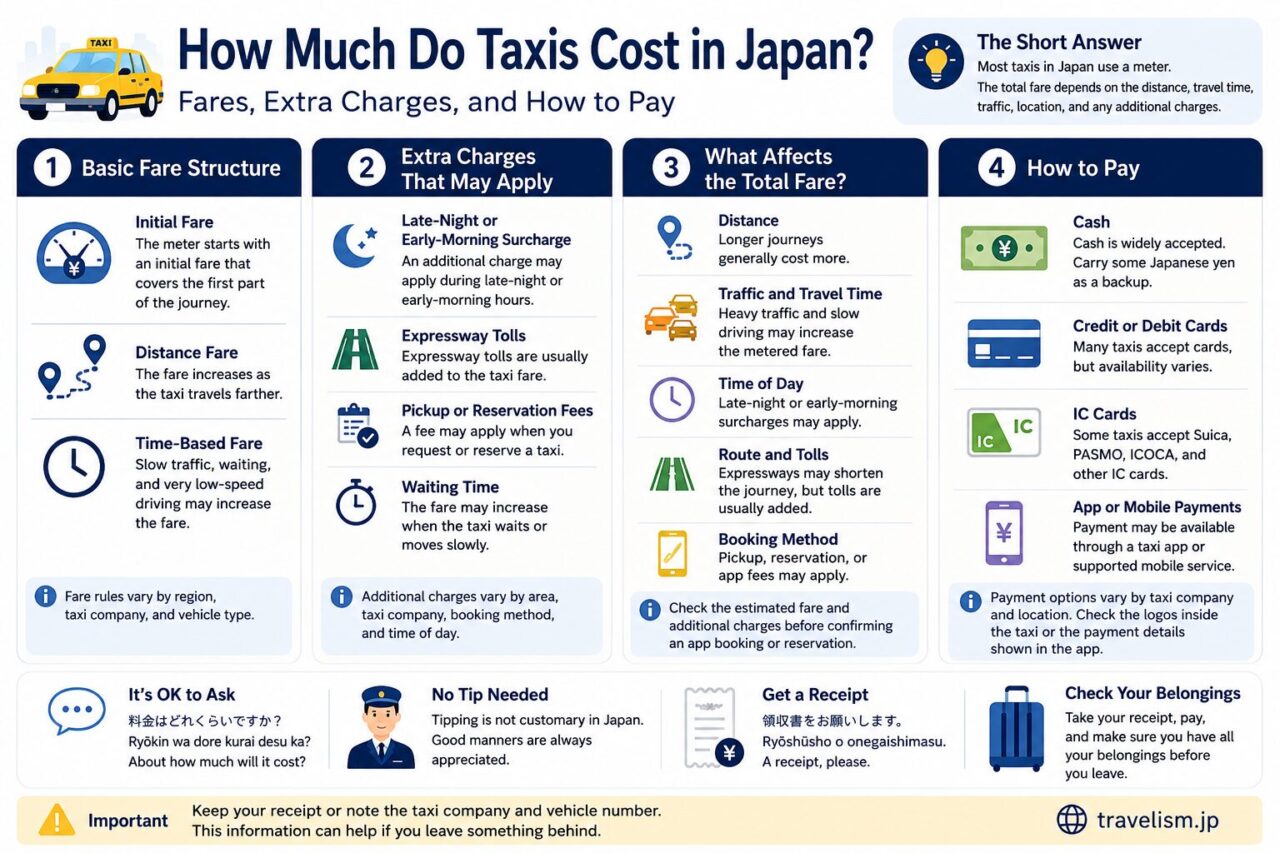
Taxi fares in Japan vary by region, taxi company, vehicle type, distance, and travel time.
Most ordinary taxi journeys use a meter. The fare normally increases according to the distance traveled and may also increase when the taxi moves slowly or waits in traffic.
運賃 / Unchin / Fare
Additional costs may include:
- A late-night or early-morning surcharge
- A pickup or dispatch fee
- An advance reservation fee
- A larger-vehicle fee
- Expressway tolls
- Parking charges
- Taxi app service fees
Late-night and early-morning surcharges are common. In Tokyo’s 23 wards, Musashino, and Mitaka, for example, the fare increases by 20% from 10:00 p.m. to 5:00 a.m. Other regions and services may use different fare rules.
Expressway tolls and parking charges are generally paid by the passenger in addition to the taxi fare.
Check the Estimated Fare Before Booking
Taxi apps often show an estimated fare before you confirm the request. Some journeys may also be offered with a fixed or pre-confirmed fare.
Before confirming, check whether the estimate includes:
- Pickup fees
- Reservation fees
- App fees
- Late-night surcharges
- Expressway tolls
- Parking charges
When taking a taxi from a taxi stand or the street, the final amount will normally be based on the meter unless a fixed fare has been arranged.
Taxi fares can become more reasonable when shared by three or four passengers. However, make sure that the vehicle has enough space for both the passengers and their luggage.
For a short journey from a station to your accommodation, the convenience may be worth the extra cost. For longer journeys, compare the taxi estimate with trains, buses, airport transfers, and fixed-fare services before deciding.
How Can You Pay for a Taxi in Japan?
Payment options vary by taxi company and location.
Many taxis in major cities accept several payment methods, but some taxis—particularly in regional or rural areas—may accept cash only.
Possible payment methods include:
- Japanese yen in cash
- Credit or debit cards
- IC cards such as Suica, PASMO, or ICOCA
- QR code and mobile payment services
- Payment through a taxi app
Do not assume that every logo or payment method is accepted by every taxi. Look for payment logos inside the vehicle, on the window, or in the taxi app before starting the journey.
Paying Through a Taxi App
When you request a taxi through Uber, GO, or another app, the fare may be charged automatically to the payment method registered in the app.
Before depending on app payment:
- Confirm that your registered card can be used in Japan
- Check the estimated fare and additional fees
- Keep the app open until the journey is completed
- Carry another payment method in case the app payment fails
Some taxis ordered through an app may still require payment inside the vehicle. Check the payment instructions shown when confirming the booking.
Paying Inside the Taxi
At the end of the journey, wait until the driver stops the meter and shows you the final amount.
Useful payment terms include:
支払い / Shiharai / Payment
現金 / Genkin / Cash
クレジットカード / Kurejitto kādo / Credit card
You can show the driver your card or phone and ask:
- カードは使えますか?
- Kādo wa tsukaemasu ka?
- Can I use a card?
Tipping is not expected in Japanese taxis. Some apps may offer an optional tipping feature, but you do not need to add a tip. Pay the displayed fare and any clearly explained additional charges.
Carry Some Cash as a Backup
Even when you plan to use a credit card or taxi app, carrying some Japanese yen is recommended.
Cash can be helpful when:
- A card terminal is unavailable
- Your overseas card is declined
- Mobile communication is interrupted
- You take a taxi in a rural area
- The taxi does not support your preferred payment method
For more information about using cash, credit cards, and mobile payments during your trip, read our guide to cash and credit cards in Japan.

Taking a Taxi From an Airport
A taxi is worth considering after a flight when you have heavy luggage, are traveling as a family or group, arrive late, or are staying somewhere that requires several transfers from the airport.
At major airports, follow the signs for the official taxi stand:
タクシー乗り場 / Takushī noriba / Taxi stand
Taxi Stands and App Pickup Areas May Be Different
A taxi requested through an app may use a different pickup area from the regular taxi line. Check the terminal, floor, exit number, and pickup point shown in the app, then follow the current airport signs.
If you cannot find the pickup location, show the booking screen to airport information staff. Do not assume that an app pickup point shown in an older article or map is still current.
Check the Total Cost, Not Just the Taxi Fare
Airport taxi journeys can be expensive because some airports are a considerable distance from the city center. Fixed-fare services are available on selected routes:
定額運賃 / Teigaku unchin / Fixed fare
A fixed fare may still exclude expressway tolls, late-night surcharges, pickup charges, or reservation fees. Confirm what is included before booking.
高速道路料金 / Kōsoku dōro ryōkin / Expressway toll
Taxi or Public Transportation From the Airport?
| A Taxi May Be More Practical When | Train or Airport Bus May Be Better When |
|---|---|
| You have several large suitcases | You are traveling alone or lightly |
| You are traveling with children or someone with limited mobility | Your accommodation is near a direct station or bus stop |
| Several people can share the fare | Public transportation is still operating |
| Your accommodation is difficult to reach by public transportation | Road traffic is heavy |
| You arrive after normal public transport hours | The airport is far from the city and taxi cost is high |
Where you stay changes the calculation. Accommodation near a direct airport train or bus can be easy to reach without a taxi, while a property in a residential area may require several transfers and a long final walk. In that case, taking public transportation for most of the journey and a taxi from the nearest station can be a comfortable compromise.
Reserve Time-Critical Airport Trips in Advance
For an early flight, a large group, or a journey requiring a larger or accessible vehicle, arrange transportation in advance when possible. App reservations are available in some areas, and your accommodation or a local taxi company may also be able to arrange a pickup.
Confirm the pickup time, airport and terminal, number of passengers, luggage, estimated total fare, additional fees, and cancellation conditions. An app reservation is not always a guarantee until a vehicle or driver has been confirmed.
Prepare the Exact Destination
Keep the accommodation name, Japanese address, map location, and telephone number on your phone. For airport departures, also show the airline and terminal when needed.
For current taxi stands, app pickup areas, fixed fares, and terminal information, check the official airport access page before traveling.
- Narita International Airport taxi information
- Haneda Airport taxi information
- Kansai International Airport taxi information
Useful Taxi Etiquette in Japan
Using a taxi in Japan does not require complicated etiquette, but a few customs may be different from those in your home country.
Wait for the Door to Open
Many Japanese taxis have a rear passenger door that is opened and closed automatically by the driver.
Wait for the door to open before entering, and do not pull or push it unless the driver asks you to do so.
When leaving, gather your belongings first and allow the driver to operate the door.
Sit in the Rear Seat
Most passengers use the rear seat. The front passenger seat may be used when several people are traveling together or when the driver directs you there.
If you have large suitcases, let the driver know before getting into the vehicle. The driver may open the trunk or explain where the luggage should be placed.
Do not assume that an ordinary taxi can carry four passengers together with several large suitcases. When traveling as a group, consider requesting a larger vehicle.
Confirm the Destination
Before the taxi starts moving, show the driver the destination name, Japanese address, or location on a map.
Hotel names, station names, and sightseeing attractions may have similar names or multiple entrances. Providing the full address and a map pin can reduce misunderstandings.
If your accommodation is inside a narrow residential street, check whether the taxi can stop directly outside the entrance. In some areas, the safest drop-off point may be on a nearby main road.
Wear Your Seat Belt
Wear the seat belt provided, including in the rear seat. Seat belts are required for taxi passengers.
Keep children seated and avoid moving around the vehicle while it is traveling.
Do Not Tip
Tipping is not expected in Japanese taxis. If an app offers an optional tipping feature, using it is a personal choice rather than a local requirement.
Pay the fare shown on the meter or in the app, together with any clearly explained tolls, pickup fees, or other charges.
A simple thank-you is enough:
- ありがとうございます
- Arigatō gozaimasu
- Thank you
Ask for a Receipt
Keep the receipt if you may need to check the fare, claim a travel expense, or contact the taxi company after leaving an item behind.
領収書 / Ryōshūsho / Receipt
You can ask:
- 領収書をお願いします
- Ryōshūsho o onegaishimasu
- A receipt, please
When paying through a taxi app, the receipt may be available electronically in the app rather than being issued inside the vehicle.
Before leaving, check the seat, floor, door pocket, and trunk for your phone, wallet, passport, shopping bags, and luggage.
What If You Do Not Speak Japanese?
You do not need to speak fluent Japanese to use a taxi.
A practical method is to enter the destination in a taxi app or show the driver the destination on your phone.
Prepare:
- The destination name
- The full address in Japanese
- A Google Maps location
- The telephone number
- A nearby landmark
- Your accommodation booking page
For a hotel or accommodation, showing only the English property name may not be enough. Keep the Japanese name and address available whenever possible.
Useful Taxi Phrases
Please take me to this address
- この住所までお願いします
- Kono jūsho made onegaishimasu
- Please take me to this address
Please take me here
- ここまでお願いします
- Koko made onegaishimasu
- Please take me here
Use this while showing the destination on your phone.
Please stop here
- ここでお願いします
- Koko de onegaishimasu
- Please stop here
Can I use a credit card?
- クレジットカードは使えますか?
- Kurejitto kādo wa tsukaemasu ka?
- Can I use a credit card?
Please use the expressway
- 高速道路を使ってください
- Kōsoku dōro o tsukatte kudasai
- Please use the expressway
Use this only when you understand that the expressway toll will normally be added to the fare.
Which terminal is this?
- ここは何ターミナルですか?
- Koko wa nani tāminaru desu ka?
- Which terminal is this?
Use a Translation App When Necessary
A translation app can help with unusual destinations, changes to the route, or questions about payment.
Keep the message short and specific. Showing the address, map, or booking information is usually more reliable than trying to explain a complicated route verbally.
For important journeys, prepare the destination before entering the taxi rather than searching for it after the vehicle has started moving.
Choosing Taxis as Part of Your Trip
Where you stay matters too. Accommodation beside a major station may reduce the need for taxis, while a quieter residential or regional stay may make an occasional short taxi ride worthwhile. Compare the whole journey—walking, transfers, luggage, time, and fare—rather than choosing the cheapest mode automatically.
For many journeys in Japan, trains and subways remain the fastest and most affordable choice. If you are still planning how to get around the country, these guides explain the basics of rail travel and train payment.
→ How to Use Trains and Subways in Japan
→ How to Pay for Train Travel in Japan

Last verified: August 16, 2026 (JST)
Taxi app coverage, fares, payment methods, pickup rules, and airport procedures may change. Check the app or local operator before an important journey.
Frequently Asked Questions
- What is the easiest way to get a taxi in Japan?
-
Use an official taxi stand, hail a taxi displaying 空車 / Kūsha / Vacant where street pickup is permitted, or request one through an app. At airports and major stations, a taxi stand is often the simplest option.
- Which taxi app should I use in Japan?
-
If you already use Uber, it is a convenient first option. GO has broad taxi coverage within Japan and supports international credit cards and Apple Pay. S.RIDE is another useful option in Tokyo and other supported urban areas, while DiDi may be available in selected locations.
- Do taxi drivers in Japan speak English?
-
English ability varies. Enter the destination in your taxi app or keep the destination name, Japanese address, map pin, and telephone number on your phone. If the destination is already set in the app, you generally do not need to explain it again when you board.
- How are taxi fares calculated in Japan?
-
Most ordinary rides use a meter based on distance, with time-based increments when the taxi is moving slowly or waiting. Late-night surcharges, pickup fees, reservation fees, app fees, expressway tolls, and other charges may also apply.
- Can I pay for a taxi by credit card?
-
Many taxis accept credit cards, IC cards, mobile payments, or app payment, especially in larger cities. Payment methods vary by vehicle and operator, so check the displayed logos or app instructions and keep Japanese yen as a backup.
- Do I need to tip a taxi driver in Japan?
-
No. Tipping is not expected. Pay the metered or app fare and any clearly explained additional charges.
- Should I open the taxi door myself?
-
Usually not. Many Japanese taxis have a rear passenger door operated by the driver. Wait for it to open and close, and do not pull or push it unless the driver asks you to.
- Is it a good idea to take a taxi from the airport?
-
It can be practical with heavy luggage, children, a group sharing the fare, a late arrival, or accommodation that is difficult to reach by public transportation. For longer airport journeys, compare the total taxi cost with trains, airport buses, and a train-plus-taxi combination.
Related Guides
Explore practical guides to help you plan your trip and travel around Japan with confidence.
Planning Your Trip to Japan
- A Complete Guide for First-Time Visitors to Japan: Stay, Travel, and Experience Local Life
- How to Prepare for a Trip to Japan: What to Plan Before You Go
Transportation
- How to Use Trains and Subways in Japan
- How to Use IC Cards in Japan: Suica, PASMO, ICOCA & Mobile IC Cards
- How to Pay for Train Travel in Japan
- How to Use Local Buses in Japan: A First-Time Visitor Guide
- How to Use Taxis in Japan
- Kansai Airport to Osaka: Best Routes for 8 Areas
- Kansai Airport to Umeda: A Practical Route Example Using Train, Bus & Taxi
- How to Buy Shinkansen Tickets in Japan
- Japan Rail Pass: Is It Worth It? A Complete Guide
Money
- Cash or Credit Cards in Japan? A Complete Guide for First-Time Visitors
- Can I Use Credit Cards Everywhere in Japan? Where Cards Work—and Where You’ll Still Need Cash
- How to Exchange Money in Japan: The Best Ways to Get Japanese Yen
- Tax-Free Shopping in Japan: Rules, Purchases & Refunds
Cities & Destinations
- Osaka vs Kyoto: Which City Is Right for You?
- Where to Stay in Osaka: Best Areas for First-Time Visitors
- Are Osaka Hotels Expensive in 2026? What to Expect and When to Book
- Where to Stay in Yodoyabashi, Higobashi & Edobori: Central Osaka Area Guide
Culture & Etiquette
- Japanese Etiquette Every Visitor Should Know
- Onsen & Sento Etiquette in Japan: A First-Time Visitor Guide